Indiana Science HS-AP6-2
The Standard
Make and/or use a model of the anatomy of the eye; then construct an explanation for hyperopia, myopia and astigmatism using the model.
Indiana Academic Standards for Science (2023) · Integration and Coordination, Somatic and Special Senses
Teacher's field guide
What This Standard Means
What Students Need to Do
- Students build or use an eye model and trace light through the cornea, pupil, and lens to the retina. They explain how eye length or uneven curvature can blur an image.
What Mastery Looks Like
- Students label the cornea, iris, pupil, lens, retina, and optic nerve on their model. They show myopia focusing before the retina, hyperopia behind it, and astigmatism focusing light unevenly.
Common Misconceptions
- Students often swap where light focuses in myopia and hyperopia. Some think astigmatism comes from a long or short eyeball, rather than uneven curvature of the cornea or lens.
How to Assess It
- Exit ticket: Draw three eye diagrams for myopia, hyperopia, and astigmatism. Trace light rays, mark the retina, and write one sentence explaining each blur.
Lesson moves
Ways to Teach It
Use a magnifying glass to focus a window image on a card, then shift the card to model myopia and hyperopia.
Compare diagrams of a round and an uneven cornea; write why the uneven cornea sends light to different focal points.
Give pairs three unlabeled ray diagrams to sort into myopia, hyperopia, and astigmatism, then have them defend each choice.
Show sample prescriptions marked plus sphere, minus sphere, and cylinder; ask students which eye model each would help correct.
Free download
Printable HS-AP6-2 Worksheet
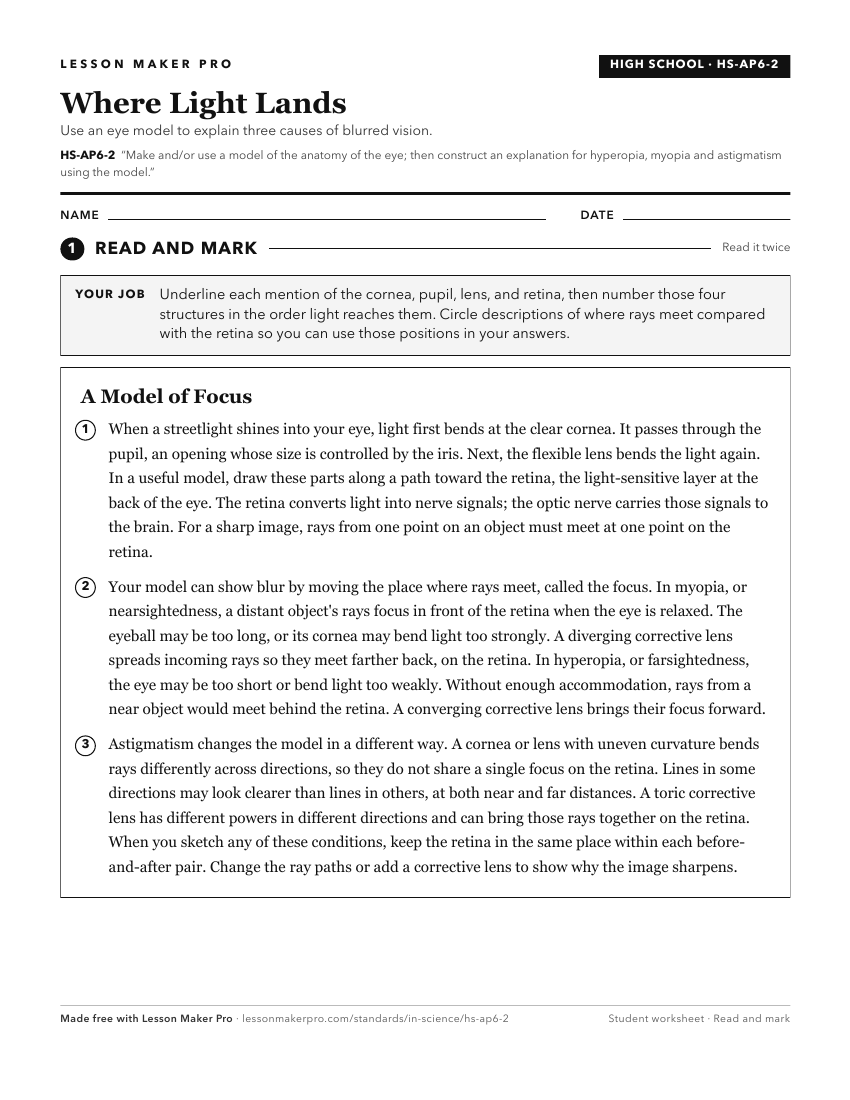
A ready-to-print activity worksheet aligned to HS-AP6-2, with an answer key for the teacher on its own page. No account needed.
PDF, US Letter, prints cleanly in black and white.
Download the worksheetKeep exploring
Related Standards
- HS-PSII-8.3
Develop graphical, mathematical, and pictorial representations (e.g., ray diagrams) that describe the relationships between the focal length, the image distance...
- HS-AP6-3
Make and/or use a model of the anatomy of the ear. Construct an explanation for sensorineural and conductive hearing loss using the basic structure and function...
- HS-PSII-8.1
Develop graphical, mathematical, and pictorial representations (e.g., ray diagrams) that describe the relationships between the focal length, the image distance...
Turn this exact standard into a lesson
Grade, subject, topic, and the complete standard are prefilled. Create one free, no account needed.
Also for this standard:Make a WorksheetMake a QuizMake a Sub Lesson