Indiana Science HS-AP6-1
The Standard
Compare and contrast the somatic, visceral, and special senses, the prominent sensory receptor types of each, and their functional operation.
Indiana Academic Standards for Science (2023) · Integration and Coordination, Somatic and Special Senses
Teacher's field guide
What This Standard Means
What Students Need to Do
- Students sort sensations by where they come from: skin, muscles, and joints; internal organs; or the eyes, ears, nose, and tongue. They name the receptors that detect each stimulus and explain how those receptors send nerve signals to the brain.
What Mastery Looks Like
- A student can identify a warm mug as somatic temperature sensing, a full bladder as visceral stretch sensing, and bright light as special-sense vision. They can name the receptor type in each case and explain what activates it.
Common Misconceptions
- Students may call bladder stretch somatic because they can feel it. They may think chemical detection is always visceral, missing taste and smell. Some think receptors interpret a sensation on their own, rather than sending signals to the brain.
How to Assess It
- Exit ticket: Classify a cold spoon on your hand, a stretched stomach, and a ringing bell. For each, name the sense group, receptor type, and stimulus.
Lesson moves
Ways to Teach It
Touch a cotton ball to a fingertip, then move a finger with eyes shut; label the receptors involved in touch and position.
Ask: Why is a full bladder visceral, while a warm mug is somatic? Name each stimulus and receptor type.
Give pairs cards labeled warm mug, full bladder, bright light, and ringing bell; sort them by sense group and receptor type.
Draw a lunch table with lemonade and a cold cup; label the receptors used to taste the drink and feel the cup.
Free download
Printable HS-AP6-1 Worksheet
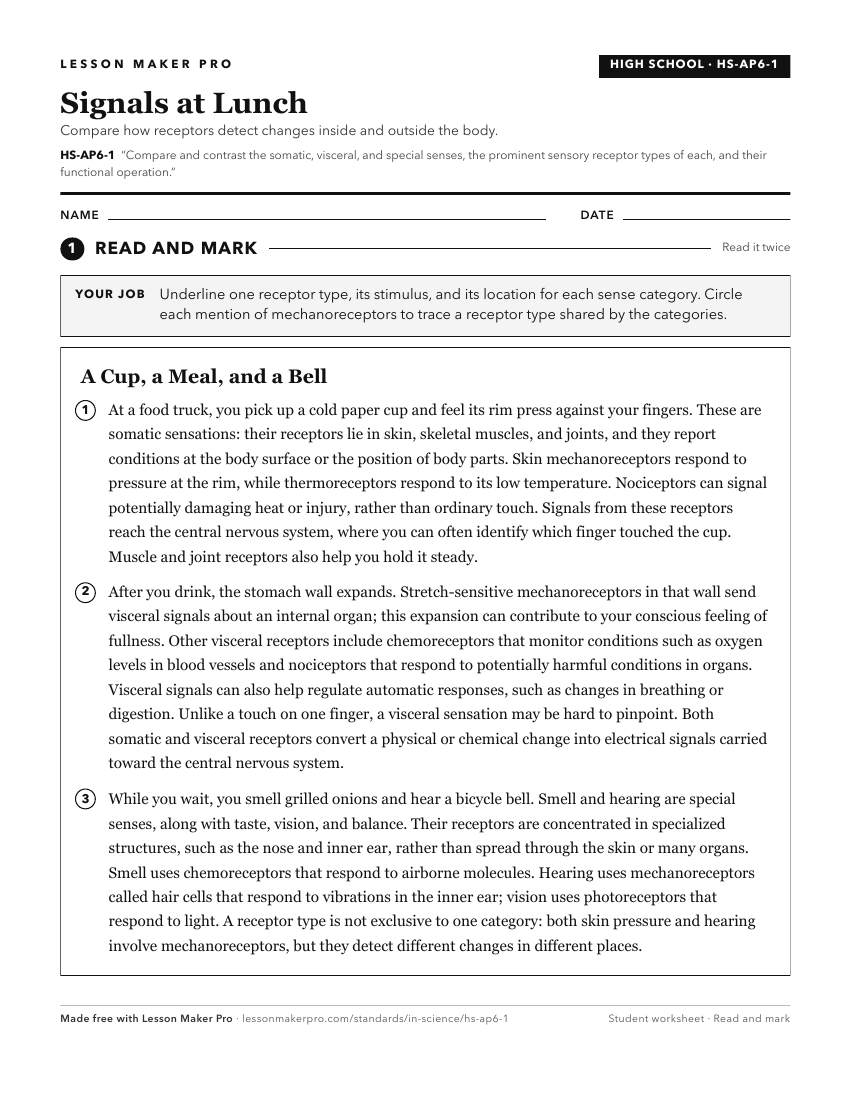
A ready-to-print activity worksheet aligned to HS-AP6-1, with an answer key for the teacher on its own page. No account needed.
PDF, US Letter, prints cleanly in black and white.
Download the worksheetKeep exploring
Related Standards
- HS-AP1-5
Compare and contrast the major organ systems and describe their basic functional importance.
- HS-AP5-3
Compare and contrast the actions, origins, and pathways of nerve fibers in the parasympathetic and sympathetic divisions of the autonomic nervous system.
- HS-AP4-1
Compare and contrast between the structural and functional characteristics of skeletal, cardiac, and smooth muscle.
Turn this exact standard into a lesson
Grade, subject, topic, and the complete standard are prefilled. Create one free, no account needed.
Also for this standard:Make a WorksheetMake a QuizMake a Sub Lesson