Indiana Science HS-AP4-6
The Standard
Compare and contrast between isotonic and isometric contractions and construct an explanation for the causes of hypertrophy and atrophy of muscles.
Indiana Academic Standards for Science (2023) · Movement and Support, the Muscular System
Teacher's field guide
What This Standard Means
What Students Need to Do
- Students tell whether a muscle changes length while working or stays roughly the same length while holding a position. They explain why repeated resistance exercise can make muscle fibers larger and why disuse can make them smaller.
What Mastery Looks Like
- A student identifies a bottle curl as a moving contraction and holding the bottle still as a holding contraction. They explain that muscles can grow with repeated resistance work and shrink during weeks in a cast.
Common Misconceptions
- Students may think a muscle stops working when it holds a position still. They may think muscle growth means new muscle cells appear. Some think unused muscle turns into fat rather than shrinking.
How to Assess It
- Ask: “You curl a water bottle, then hold it halfway up. Name each contraction and explain why lifting for six weeks might increase muscle size while wearing a cast might decrease it.”
Lesson moves
Ways to Teach It
Curl a half-full water bottle, then hold it halfway up; feel the biceps and record when the elbow angle changes.
Ask: “One student lifts weights for six weeks; another wears an arm cast. What happens to their arm muscles, and why?”
Sort cards labeled bottle curl, wall sit, lowering a backpack, and plank into moving or holding contractions.
Read a physical therapy plan after cast removal; label each exercise as moving or holding and predict how regular practice affects muscle size.
Free download
Printable HS-AP4-6 Worksheet
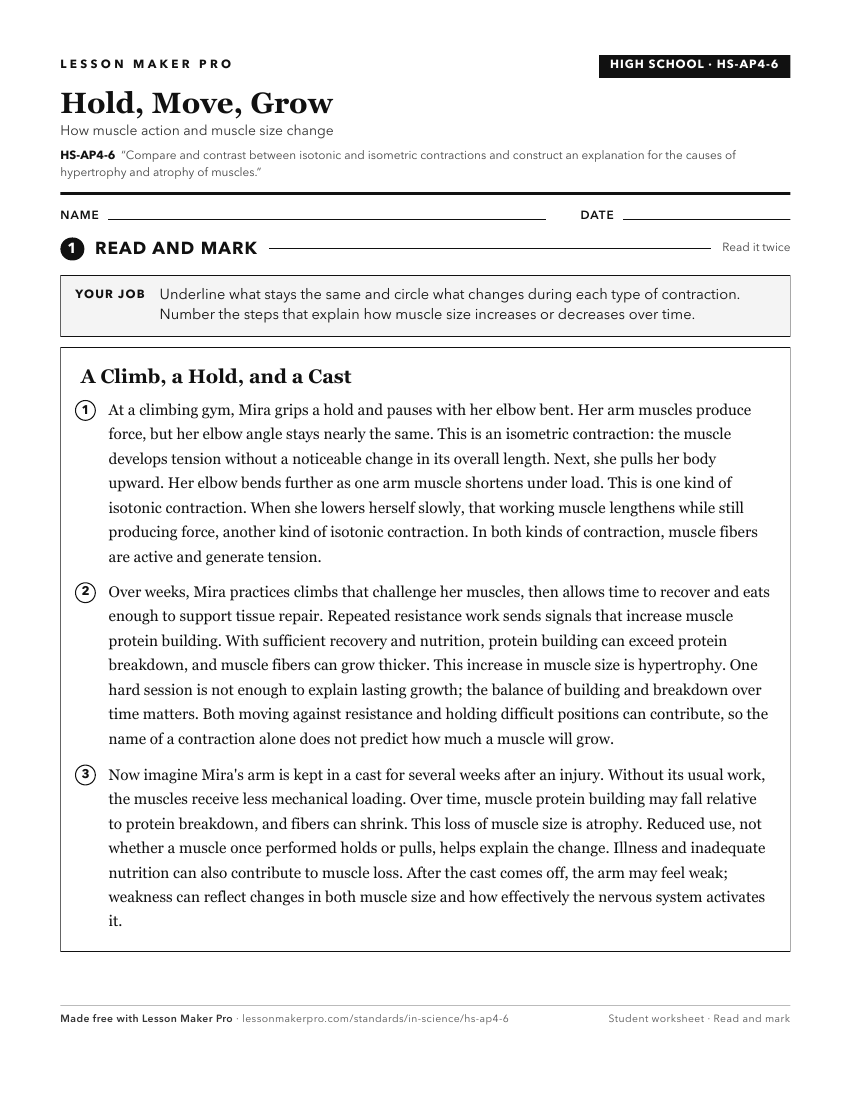
A ready-to-print activity worksheet aligned to HS-AP4-6, with an answer key for the teacher on its own page. No account needed.
PDF, US Letter, prints cleanly in black and white.
Download the worksheetKeep exploring
Related Standards
- HS-AP4-4
Describe how a neuromuscular junction functions. Design an experiment to determine how motor recruitment influences the force and velocity of contraction.
- HS-AP1-3
Compare and contrast the relationships among the various tissue types as well as the molecular and cellular composition of these tissues.
- HS-AP4-2
Develop a model to illustrate the components of a muscle fiber and how they interact in contraction and relaxation.
- HS-AP4-1
Compare and contrast between the structural and functional characteristics of skeletal, cardiac, and smooth muscle.
Turn this exact standard into a lesson
Grade, subject, topic, and the complete standard are prefilled. Create one free, no account needed.
Also for this standard:Make a WorksheetMake a QuizMake a Sub Lesson