Indiana ELA 7.W
Standard Cluster
Students compose writing and presentations for various genres which demonstrate a command of English grammar and usage through the writing and research processes.
Indiana Academic Standards for English/Language Arts (2023)
Cluster contents
Standards in This Cluster
7.W is a cluster heading. These are the individual standards under it.
- 7.W.1.a
Introduce claim(s), acknowledge alternate or opposing claims, and use appropriate organizational structures.
- 7.W.1.c
Establish and maintain a consistent style and tone appropriate for the purpose and audience.
- 7.W.1.d
Use effective transitions to create cohesion and clarify the relationships among claim(s), reasons, and evidence.
- 7.W.2.b
Develop the topic with relevant facts, definitions, concrete details, quotations, or other information and examples from various sources and texts.
- 7.W.2.d
Choose language and content-specific vocabulary that express ideas precisely and concisely, recognizing and eliminating wordiness and redundancy.
- 7.W.2.e
Establish and maintain a style appropriate for the purpose and audience.
- 7.W.3.a
Engage and orient the reader by establishing a context and point of view and introducing a narrator and/or characters.
- 7.W.3.b
Organize an event sequence (e.g., conflict, climax, resolution) that unfolds naturally and logically, using a variety of transition words, phrases, and clauses ...
- 7.W.4.a
Plan and develop, draft, and revise writing using appropriate reference materials. Rewrite, try a new approach, and edit to produce and strengthen writing that ...
- 7.W.4.b
Use technology to interact and collaborate with others to generate, produce, and publish writing and link to sources.
- 7.W.5
Conduct research assignments and tasks to build knowledge about the research process and the topic under study.
- 7.W.5.a
Formulate a research question.
- 7.W.5.b
Gather relevant information from multiple sources, using search terms effectively and annotate sources.
- 7.W.5.c
Assess the credibility and accuracy of each source.
- 7.W.5.d
Quote or paraphrase the information and conclusions of others.
- 7.W.5.e
Avoid plagiarism and follow a standard format for citation.
- 7.W.5.f
Present information, choosing from a variety of formats. (E)
- 7.W.6.a
Verbs – Recognizing and correcting problems with subject/verb agreement.
- 7.W.6.b
Phrases and Clauses – Recognizing and correcting misplaced and dangling modifiers.
- 7.W.6.c
Usage – Writing simple, compound, complex, and compound-complex sentences; recognizing and correcting sentence fragments and run-ons; varying sentence patterns ...
- 7.W.7.a
Punctuation – Using commas with subordinate clauses. (E)
- 7.W.1Write arguments in a variety of forms that: a. Introduce claim(s), acknowledge alternate or opposing claims, and use appropriate organizational structures. b. Support claim(s) with logical reasoning and relevant evidence, using accurate, credible sources and demonstrating an understanding of the topic or text. c. Establish and maintain a consistent style and tone appropriate for the purpose and audience. d. Use effective transitions to create cohesion and clarify the relationships among claim(s), reasons, and evidence. e. Provide a concluding statement or section that follows and supports the argument presented. (E)
- 7.W.1aWrite an argument that: a. Introduces at least one claim using an appropriate organizational structure such as problem/solution, compare/contrast, or cause/effect, and acknowledges an alternate or opposing claim. b. Supports at least one claim with at least two clear reasons and relevant evidence from more than one accurate and credible source. c. Uses language that is appropriate to the purpose and the audience. d. Uses at least three transitions to connect the claim(s), reasoning, and evidence. e. Provides a concluding statement that relates to the argument. (E)
- 7.W.2Write informative compositions in a variety of forms that: a. Introduce a topic clearly, previewing what is to follow; organize ideas, concepts, and information using strategies such as definition and classification; include formatting (e.g., headings), graphics (e.g., charts, tables), and multimedia when useful to aid comprehension. b. Develop the topic with relevant facts, definitions, concrete details, quotations, or other information and examples from various sources and texts. c. Use appropriate transitions to create cohesion and clarify the relationships among ideas and concepts. d. Choose language and content-specific vocabulary that express ideas precisely and concisely, recognizing and eliminating wordiness and redundancy. e. Establish and maintain a style appropriate for the purpose and audience. f. Provide a concluding statement or section that follows and supports the information or explanation presented. (E)
- 7.W.2aWrite an informative piece that: a. Introduces a topic in a way that previews what is to follow, and organizes ideas and information using a strategy such as definition or classification. b. Develops the topic with at least three relevant facts, definitions, concrete details, quotations, or other information from at least two different sources or texts. c. Uses at least three transitions to connect ideas. d. Includes formatting (e.g., headings), graphics (e.g., charts, tables), and multimedia when useful to aid comprehension. e. Uses language that is appropriate to the purpose and audience and content-specific vocabulary to help express ideas precisely. f. Provides a concluding statement related to the information or explanation presented. (E)
- 7.W.3Write narrative compositions in a variety of forms that: a. Engage and orient the reader by establishing a context and point of view and introducing a narrator and/or characters. b. Organize an event sequence (e.g., conflict, climax, resolution) that unfolds naturally and logically, using a variety of transition words, phrases, and clauses to convey sequence and signal shifts from one time frame or setting to another. c. Use narrative techniques, such as dialogue, pacing, and description, to develop experiences, events, and/or characters. d. Use precise words and phrases, relevant descriptive details, and sensory language to capture the action and convey experiences and events. e. Provide an ending that follows and reflects on the narrated experiences or events. (E)
- 7.W.3aWrite a narrative that: a. Introduces a narrator and/or characters in a way that establishes the point of view or context for the reader. b. Organizes a sequence of events (e.g., conflict, climax, resolution) that unfolds logically, using transition words, phrases, and/or clauses to signal shifts from one time frame or setting to another. c. Uses more than two narrative techniques, such as dialogue, pacing, and/or description, to develop experiences, events, or characters. d. Uses relevant descriptive details and/or sensory language to describe experiences and events. e. Provides an ending that follows and/or reflects on the narrated experiences or events. (E)
- 7.W.4Apply the writing process to all formal writing including but not limited to argumentative, informative, and narrative: a. Plan and develop, draft, and revise writing using appropriate reference materials. Rewrite, try a new approach, and edit to produce and strengthen writing that is clear and coherent with some guidance and support from peers and adults. b. Use technology to interact and collaborate with others to generate, produce, and publish writing and link to sources.
- 7.W.4aApply the writing process to all formal writing: a. Plan by generating and recording ideas for writing through discussions, pictures, drawings, and/or provided reference materials about a topic or experience; b. Select a topic, purpose, and genre; c. Develop drafts in written form and revise writing using appropriate reference materials; d. Use varied forms of provided feedback and strengthen writing by rewriting or trying a new approach; e. With some support from peers and/or adults, edit writing for conventions, clarity, and coherence; and f. Use available and familiar technology to gather information, interact and collaborate with others, produce and publish writing, and/or link to resources.
- 7.W.5aConduct research to build knowledge about the research process and the topic under study. a. Formulate a research question (e.g., "How does Indiana influence life in the Midwest?"). b. Identify relevant information from at least three sources and create at least four annotations. c. Assess the credibility or accuracy of each source. d. Quote or paraphrase the information or conclusions of others. e. Use assistive technology or tools to avoid plagiarism and follow a standard format for citation. f. Present information, choosing from a variety of formats. (E)
- 7.W.6Demonstrate command of English grammar and usage, focusing on: a. Verbs – Recognizing and correcting problems with subject/verb agreement. b. Phrases and Clauses – Recognizing and correcting misplaced and dangling modifiers. c. Usage – Writing simple, compound, complex, and compound-complex sentences; recognizing and correcting sentence fragments and run-ons; varying sentence patterns for meaning, reader interest, and style. (E)
- 7.W.6aCorrectly apply English grammar and usage, focusing on: a. Verbs - Using correct subject/verb agreement. b. Phrases and Clauses - Recognizing misplaced or dangling modifiers. c. Usage - With the aid of cloze activities, producing simple, compound, complex, and compound-complex sentences; correcting fragments and run-ons, and varying some sentence patterns for meaning or reader interest. (E)
- 7.W.7Demonstrate command of the conventions of standard English capitalization, punctuation, and spelling, focusing on: a. Punctuation – Using commas with subordinate clauses. (E)
- 7.W.7aApply capitalization, punctuation, and spelling conventions, focusing on: a. Correct use of capitalization throughout writing. b. Punctuation - Using commas with subordinate clauses. c. Spelling - Using assistive technology or tools for spell checking. (E)
Teacher's field guide
What This Cluster Means
What Students Need to Do
- Students write for different purposes, such as explaining a topic or making a case. They gather facts, draft, revise, and edit their work. They also prepare presentations and use clear English when they speak.
What Mastery Looks Like
- A student can use source notes to write an organized explanation or argument without copying sentences. They revise for their audience and fix run-ons, verb tense shifts, and unclear pronouns. They present their main points clearly.
Common Misconceptions
- Students may use the same tone for a letter to the principal and a speech to classmates. They may copy source sentences instead of using their own words. Some check only spelling and miss run-ons or verb tense shifts.
How to Assess It
- Give students a two-sentence fact sheet about a school event. Ask them to write a three-sentence announcement for families using one fact, check its grammar, and read it to a partner.
Lesson moves
Ways to Teach It
Give pairs printed drafts of a lunch menu proposal and a source excerpt; have them cut, reorder, and edit sentences before presenting.
Ask students to write two introductions to the same library survey result, one for the principal and one for a friend, then compare word choices.
Play an editing relay with sentence cards: teams fix a run-on, a pronoun mismatch, and a verb tense shift, then explain each fix.
Have students check a school club flyer for facts, write a family announcement, and read a version aloud for morning announcements.
Free download
Printable 7.W Worksheet
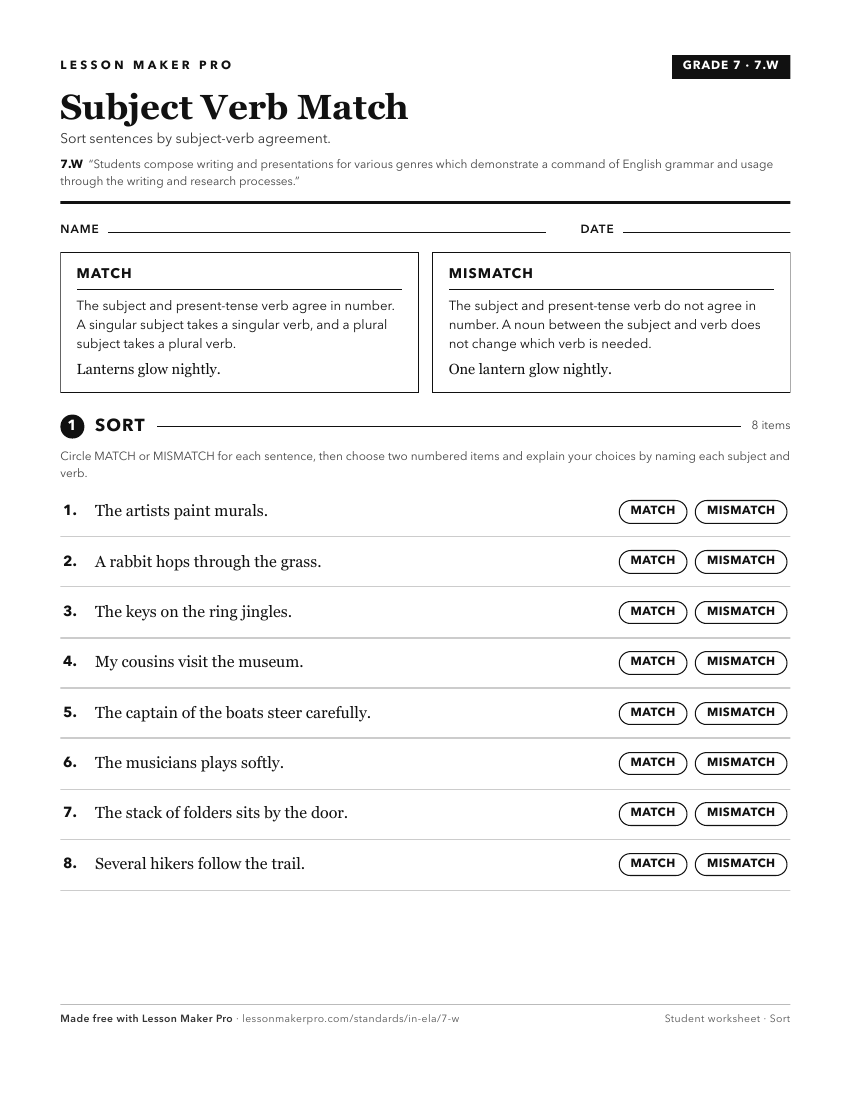
A ready-to-print activity worksheet aligned to 7.W, with an answer key for the teacher on its own page. No account needed.
PDF, US Letter, prints cleanly in black and white.
Download the worksheetKeep exploring
Related Standards
- 8.W
The 8th Grade version of this standard.
- 6.W
The 6th Grade version of this standard.
- 9-10.W
Students compose writing and presentations for various genres which demonstrate a command of English grammar and usage through the writing and research processe...
- 11-12.W
Learning Outcome: Students compose writing and presentations for various genres which demonstrate a command of English grammar and usage through the writing and...
Turn this cluster into a lesson
Grade, subject, topic, and the complete cluster are prefilled. Create one free, no account needed.
Also for this cluster:Make a WorksheetMake a QuizMake a Sub Lesson