Indiana ELA 7.W.2.b
The Standard
- 7.W
- Students compose writing and presentations for various genres which demonstrate a command of English grammar and usage through the writing and research processes.
- 7.W.2
- Write informative compositions in a variety of forms that: a. Introduce a topic clearly, previewing what is to follow; organize ideas, concepts, and information using strategies such as definition and classification; include formatting (e.g., headings), graphics (e.g., charts, tables), and multimedia when useful to aid comprehension. b. Develop the topic with relevant facts, definitions, concrete details, quotations, or other information and examples from various sources and texts. c. Use appropriate transitions to create cohesion and clarify the relationships among ideas and concepts. d. Choose language and content-specific vocabulary that express ideas precisely and concisely, recognizing and eliminating wordiness and redundancy. e. Establish and maintain a style appropriate for the purpose and audience. f. Provide a concluding statement or section that follows and supports the information or explanation presented. (E)
Develop the topic with relevant facts, definitions, concrete details, quotations, or other information and examples from various sources and texts.
Indiana Academic Standards for English/Language Arts (2023)
Teacher's field guide
What This Standard Means
What Students Need to Do
- Students explain a topic with accurate facts, definitions, examples, and short quotations. They choose details from more than one text and show how each detail helps the reader understand the topic.
What Mastery Looks Like
- A student can explain why bees matter using a fact from a science article and an example from a garden guide. Each detail supports the point, and the student explains it in their own words.
Common Misconceptions
- Students may drop in a quote without explaining it. They may choose an interesting fact that does not support their point. They may use several details from one text when the task calls for more than one source.
How to Assess It
- Give students two source cards: “Compost enriches soil” and “Flowers give bees nectar.” Ask for a short paragraph explaining two benefits of a school garden, using and explaining both details.
Lesson moves
Ways to Teach It
Cut facts and quotes from two short sleep articles into strips; have pairs sort them under claims about mood, memory, and energy.
Ask: “Which detail from these two sleep articles best supports the claim that sleep helps memory, and why?”
Play Evidence Match: groups match six detail cards from two articles to three topic sentences, then explain each choice.
Compare tomorrow’s cafeteria menu with a packaged snack’s nutrition label; write a paragraph explaining one lunch choice with details from both.
Free download
Printable 7.W.2.b Worksheet
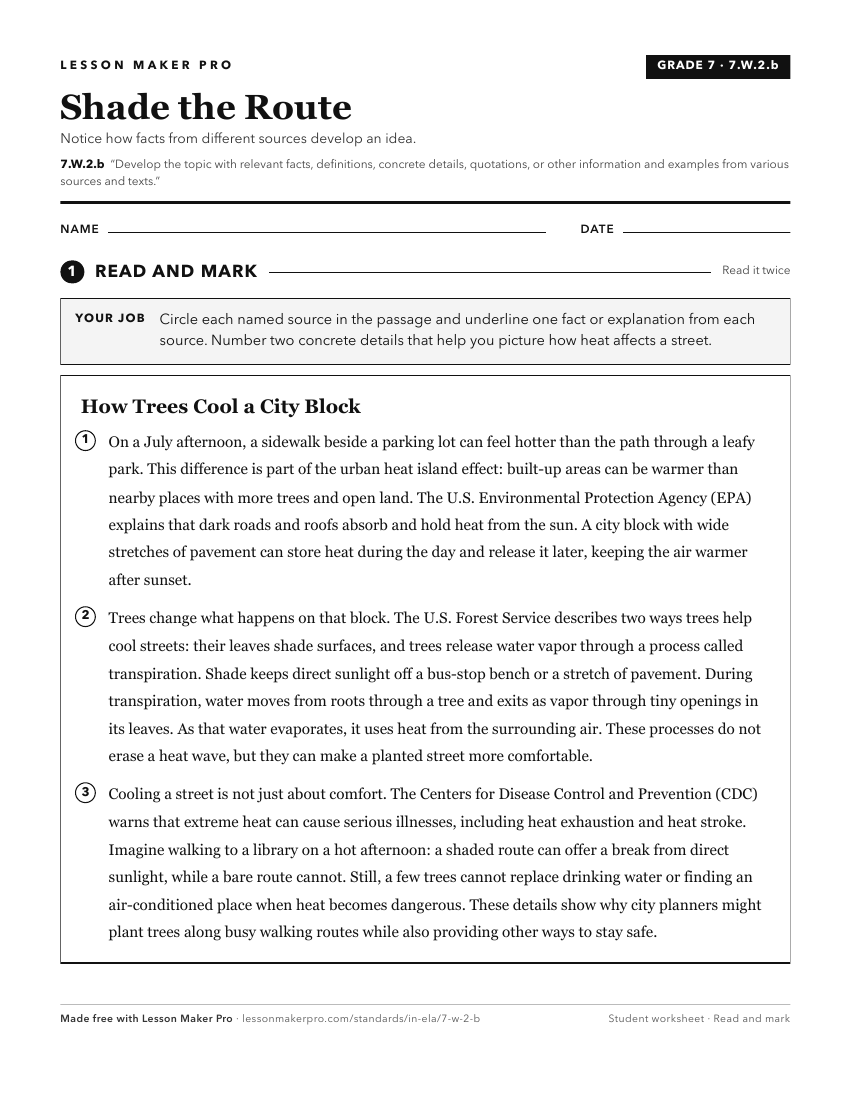
A ready-to-print activity worksheet aligned to 7.W.2.b, with an answer key for the teacher on its own page. No account needed.
PDF, US Letter, prints cleanly in black and white.
Download the worksheetKeep exploring
Related Standards
- 6.W.2.b
The 6th Grade version of this standard.
- 8.W.2.b
Develop the topic with relevant, well-chosen facts, definitions, concrete details, quotations, or other information and examples from various sources and texts.
- 9-10.W.2.b
Develop the topic utilizing credible sources with relevant, and sufficient facts, extended definitions, concrete details, quotations, or other information and e...
- 3.W.3.b
Develop the topic with facts and details.
Turn this exact standard into a lesson
Grade, subject, topic, and the complete standard are prefilled. Create one free, no account needed.
Also for this standard:Make a WorksheetMake a QuizMake a Sub Lesson