Indiana ELA 7.W.3.b
The Standard
- 7.W
- Students compose writing and presentations for various genres which demonstrate a command of English grammar and usage through the writing and research processes.
- 7.W.3
- Write narrative compositions in a variety of forms that: a. Engage and orient the reader by establishing a context and point of view and introducing a narrator and/or characters. b. Organize an event sequence (e.g., conflict, climax, resolution) that unfolds naturally and logically, using a variety of transition words, phrases, and clauses to convey sequence and signal shifts from one time frame or setting to another. c. Use narrative techniques, such as dialogue, pacing, and description, to develop experiences, events, and/or characters. d. Use precise words and phrases, relevant descriptive details, and sensory language to capture the action and convey experiences and events. e. Provide an ending that follows and reflects on the narrated experiences or events. (E)
Organize an event sequence (e.g., conflict, climax, resolution) that unfolds naturally and logically, using a variety of transition words, phrases, and clauses to convey sequence and signal shifts from one time frame or setting to another.
Indiana Academic Standards for English/Language Arts (2023)
Teacher's field guide
What This Standard Means
What Students Need to Do
- Students arrange story events so a problem builds to a turning point and ends with a believable outcome. They use different transitions to show the order of events and shifts in time or place.
What Mastery Looks Like
- A student can plan a conflict, turning point, and ending, then write a story that connects them. The reader can tell when an event happens later or in a new place.
Common Misconceptions
- Students may list events without showing why one leads to the next. They may use “suddenly” for every jump or change days and locations without telling the reader.
How to Assess It
- Exit ticket: Write six sentences about a student who loses a bus pass before school. Build to a turning point, resolve the problem, and use two different transitions, including one that marks a shift in time or place.
Lesson moves
Ways to Teach It
Give pairs cards labeled gate left open, dog runs off, neighbor spots dog, and dog comes home; have them order the cards and add transition strips.
Have students write two sentences explaining why the neighbor spotting the dog leads to the dog coming home.
Play Transition Swap with a paragraph that uses “then” four times; partners replace each one with a different time or place cue.
Use a school lunch line mix-up: write how a misplaced lunch card causes a delay, who fixes it, and when the setting changes.
Free download
Printable 7.W.3.b Worksheet
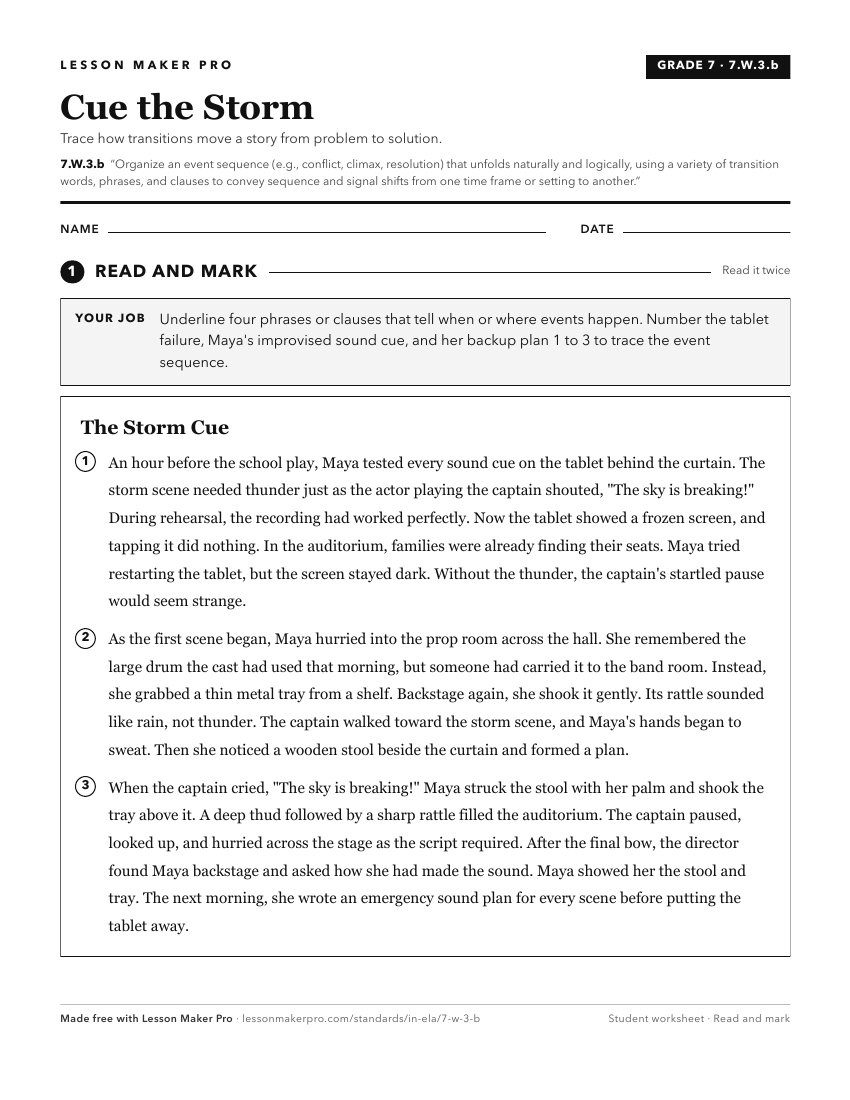
A ready-to-print activity worksheet aligned to 7.W.3.b, with an answer key for the teacher on its own page. No account needed.
PDF, US Letter, prints cleanly in black and white.
Download the worksheetKeep exploring
Related Standards
- 8.W.3.b
The 8th Grade version of this standard.
- 6.W.3.b
The 6th Grade version of this standard.
- 5.W.3.b
Develop an event sequence (e.g., conflict, climax, resolution) that unfolds naturally, connecting ideas and events using transitions.
- 4.W.3.b
Organize events that unfold naturally, using meaningful paragraphing and transitional words and phrases.
Turn this exact standard into a lesson
Grade, subject, topic, and the complete standard are prefilled. Create one free, no account needed.
Also for this standard:Make a WorksheetMake a QuizMake a Sub Lesson