Indiana ELA 6.W.3.b
The Standard
- 6.W
- Students compose writing and presentations for various genres which demonstrate a command of English grammar and usage through the writing and research processes.
- 6.W.3
- Write narrative compositions in a variety of forms that: a. Engage and orient the reader by developing an exposition (e.g., describe the setting, establish the situation, introduce the narrator and/or characters). b. Organize an event sequence (e.g., conflict, climax, resolution) that unfolds naturally and logically, using a variety of transition words, phrases, and clauses to convey sequence and signal shifts from one time frame or setting to another. c. Use narrative techniques, such as dialogue, pacing, and description, to develop experiences, events, and/or characters. d. Use precise words and phrases, relevant descriptive details, and sensory language to convey experiences and events. e. Provide an ending that follows from the narrated experiences or events. (E)
Organize an event sequence (e.g., conflict, climax, resolution) that unfolds naturally and logically, using a variety of transition words, phrases, and clauses to convey sequence and signal shifts from one time frame or setting to another.
Indiana Academic Standards for English/Language Arts (2023)
Teacher's field guide
What This Standard Means
What Students Need to Do
- Students write a story in which each event leads to the next, from a problem to a turning point and an ending. They use varied transitions to show when events happen and when the setting changes.
What Mastery Looks Like
- A reader can follow why the character acts and what changes after the turning point. Time and place shifts are clear without repeating “then” at every step.
Common Misconceptions
- Students may list events without showing how they connect. They may end the story at its most exciting moment or move to a new day or place without a cue.
How to Assess It
- Ask students to write five sentences about losing a library book before it is due. Look for a problem, a turning point, an ending, and clear cues for a change in time and place.
Lesson moves
Ways to Teach It
Put “key missing,” “door locked,” “neighbor lends phone,” and “parent arrives” on index cards; pairs order them and add transition sticky notes.
Ask, “Why does the neighbor lend a phone, and what changes afterward?” Have students write two sentences linking those events.
Play Transition Swap: pairs replace three uses of “then” in a short paragraph with specific time or place cues.
Use a missed bus before practice: students write what went wrong, the turning point, and how they reached the field, with time and place cues.
Free download
Printable 6.W.3.b Worksheet
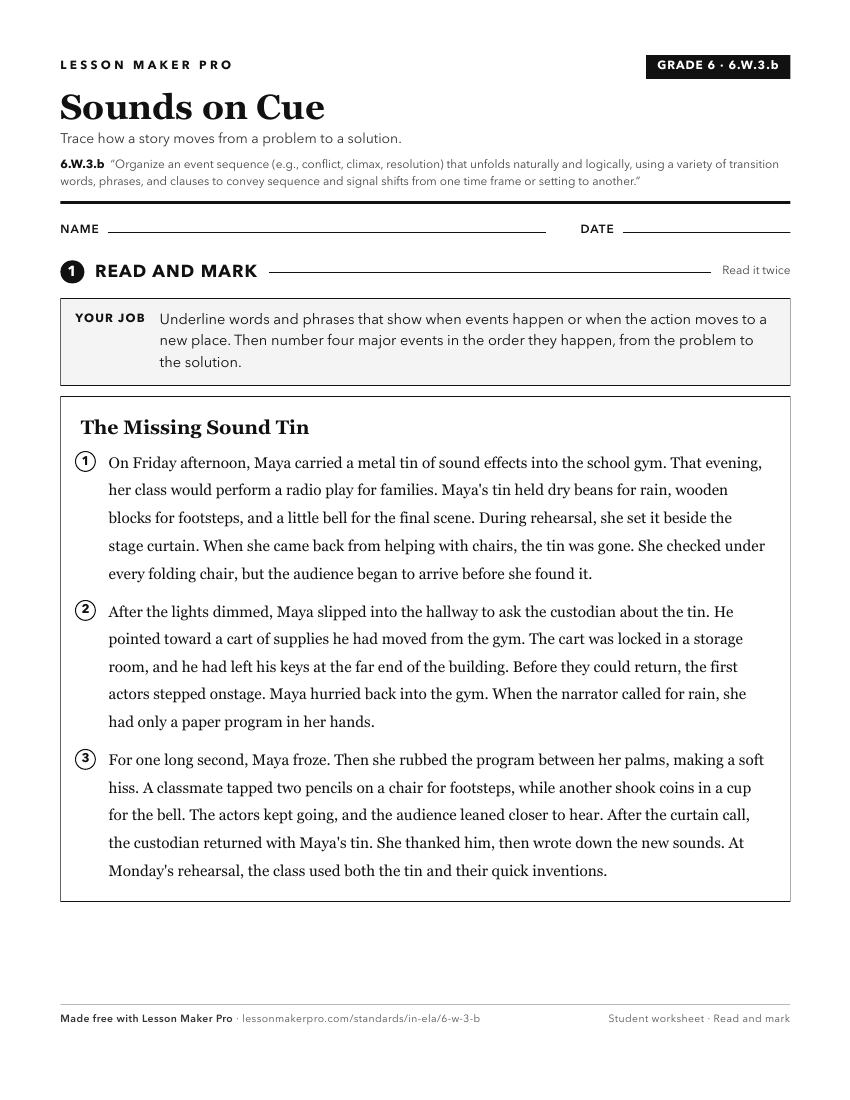
A ready-to-print activity worksheet aligned to 6.W.3.b, with an answer key for the teacher on its own page. No account needed.
PDF, US Letter, prints cleanly in black and white.
Download the worksheetKeep exploring
Related Standards
- 8.W.3.b
The 8th Grade version of this standard.
- 7.W.3.b
The 7th Grade version of this standard.
- 5.W.3.b
Develop an event sequence (e.g., conflict, climax, resolution) that unfolds naturally, connecting ideas and events using transitions.
- 4.W.3.b
Organize events that unfold naturally, using meaningful paragraphing and transitional words and phrases.
Turn this exact standard into a lesson
Grade, subject, topic, and the complete standard are prefilled. Create one free, no account needed.
Also for this standard:Make a WorksheetMake a QuizMake a Sub Lesson