Indiana ELA 11-12.W
Standard Cluster
Students compose writing and presentations for various genres which demonstrate a command of English grammar and usage through the writing and research processes; compositions will include correct use of standard formatting (e.g., MLA, APA) with sources correctly cited.
Indiana Academic Standards for English/Language Arts (2023)
Cluster contents
Standards in This Cluster
11-12.W is a cluster heading. These are the individual standards under it.
- 11-12.W.1.a
Introduce precise claim(s), establish the significance of the claim(s), distinguish the claim(s) from alternate or opposing claims, and create an organization t...
- 11-12.W.1.b
Use rhetorical strategies to enhance the effectiveness of the claim.
- 11-12.W.1.d
Use effective and varied transitions as well as varied syntax to link the major sections of the text, create cohesion, and clarify the relationships between cla...
- 11-12.W.1.e
Establish and maintain a consistent style and tone appropriate for the purpose and audience.
- 11-12.W.2.b
Utilizing credible sources, develop the topic thoroughly by selecting the most significant and relevant facts, extended definitions, concrete details, quotation...
- 11-12.W.2.d
Choose language, content-specific vocabulary, and techniques to manage the complexity of the topic, recognizing and eliminating wordiness and redundancy.
- 11-12.W.2.e
Establish and maintain a style appropriate for the purpose and audience.
- 11-12.W.3.a
Engage and orient the reader by setting out a problem, situation, or observation and its significance, establishing one or multiple point(s) of view, and introd...
- 11-12.W.3.b
Create a smooth progression of experiences or events.
- 11-12.W.4.a
Plan and develop, draft, and revise writing using appropriate reference materials. Rewrite, try a new approach, focusing on addressing what is most significant ...
- 11-12.W.4.b
Use technology to generate, produce, publish, and update individual or shared writing products in response to ongoing feedback, including new arguments or infor...
- 11-12.W.4.c
Utilize a standard style guide framework for in-text documentation, formatting, and works cited in order to properly credit sources in all writing types, utiliz...
- 11-12.W.5
Conduct more sustained research assignments and tasks to build knowledge about the research process and the topic understudy.
- 11-12.W.5.a
Formulate an inquiry question and refine and narrow the focus as research evolves.
- 11-12.W.5.b
Gather relevant information from multiple types of authoritative sources, using advanced searches effectively, and annotate sources.
- 11-12.W.5.c
Assess the strengths and limitations of each source in terms of the task, purpose, and audience.
- 11-12.W.5.d
Synthesize and integrate information into the text selectively to maintain the flow of ideas.
- 11-12.W.5.e
Avoid plagiarism and over reliance on any one source and follow a standard format (e.g., MLA, APA) for citation.
- 11-12.W.5.f
Present information, choosing from a variety of formats. (E)
- 11-12.W.1Write arguments in a variety of forms that: a. Introduce precise claim(s), establish the significance of the claim(s), distinguish the claim(s) from alternate or opposing claims, and create an organization that logically sequences claim(s), counterclaims, reasons, and evidence. b. Use rhetorical strategies to enhance the effectiveness of the claim. c. Develop claim(s) and counterclaims fairly and thoroughly, supplying the most relevant evidence for each while pointing out the strengths and limitations of both in a manner that anticipates the audience’s knowledge level, concerns, values, and possible biases. d. Use effective and varied transitions as well as varied syntax to link the major sections of the text, create cohesion, and clarify the relationships between claim(s) and reasons, between reasons and evidence, and between claim(s) and counterclaims. e. Establish and maintain a consistent style and tone appropriate for the purpose and audience. f. Provide a concluding statement or section that follows and supports the argument presented. (E)
- 11-12.W.1aWrite arguments that: a. Introduces more than one claim, distinguishes the claims from the counterclaims, and organizes the claims and reasoning into a thesis statement. b. Uses more than one rhetorical strategy to enhance the effectiveness of the claim. c. Develops claims and counterclaims fairly, supplying at least two pieces of strong evidence for each while pointing out at least one strength and one limitation of both. d. Uses effective transitions to link the major sections of the text, create cohesion, and demonstrate relationships between the claims and reasons, reasons and evidence, and claim(s) and counterclaim(s). e. Provides a concluding statement that relates to the argument presented. (E)
- 11-12.W.2Write informative compositions on a variety of topics that: a. Introduce a topic and organize complex ideas, concepts, and information so that each new element builds on that which precedes it to create a unified whole; include formatting (e.g., headings), graphics (e.g., figures, tables), and multimedia when useful to aid comprehension. b. Utilizing credible sources, develop the topic thoroughly by selecting the most significant and relevant facts, extended definitions, concrete details, quotations, or other information and examples appropriate to the audience’s knowledge of the topic. c. Use appropriate and varied transitions and syntax to link the major sections of the text, create cohesion, and clarify the relationships among complex ideas and concepts. d. Choose language, content-specific vocabulary, and techniques to manage the complexity of the topic, recognizing and eliminating wordiness and redundancy. e. Establish and maintain a style appropriate for the purpose and audience. f. Provide a concluding statement or section that follows and supports the information or explanation presented (e.g., articulating implications or the significance of the topic). (E)
- 11-12.W.2aWrite informative products that: a. Clearly introduce a topic and is organized so that each new element builds on the one before and the information is formatted to enhance the reader's comprehension. b. Develop the topic, using more than two credible sources, with at least three relevant and sufficient facts, definitions, concrete details, quotations, or other appropriate information and examples. c. Incorporate the use of content specific vocabulary and use varied and effective transitions to link the major sections of the text, create cohesion, and demonstrate the relationships among ideas and concepts. d. Provide a concluding statement that relates to the information or explanation presented and articulates the implications or the significance of the topic. (E)
- 11-12.W.3Write narrative compositions in a variety of forms that: a. Engage and orient the reader by setting out a problem, situation, or observation and its significance, establishing one or multiple point(s) of view, and introducing a narrator and/or characters. b. Create a smooth progression of experiences or events. c. Use narrative techniques, such as dialogue, pacing, description, reflection, and multiple plotlines to develop experiences, events, and/or characters. d. Use a variety of techniques to sequence events so that they build on one another to create a coherent whole and build toward a particular tone and outcome (e.g., a sense of mystery, suspense, growth, or resolution). e. Use precise words and phrases, telling details, and sensory language to convey a vivid picture of the experiences, events, setting, and/or characters. f. Provide an ending that follows and reflects on what is experienced, observed, or resolved over the course of the narrative. (E)
- 11-12.W.3aWrite narratives that: a. Introduce a narrator and/or characters in a way that establishes the point of view and provides context for the problem, situation, or observation. b. Create an understandable progression of experiences or events. c. Use dialogue and more than one additional narrative technique, such as pacing, description, reflection, or multiple plotlines to develop experiences, events, and/or characters. d. Use at least one literary technique to sequence events so that they build on one another to create a coherent whole and create a sense of mystery, suspense, growth, or resolution. e. Use descriptive details and sensory language to describe experiences, events, settings, and/or characters. f. Provide an ending that follows and reflects on what is experienced, observed, or resolved over the course of the narrative. (E)
- 11-12.W.4Apply the writing process to all formal writing including but not limited to argumentative, informative, and narrative: a. Plan and develop, draft, and revise writing using appropriate reference materials. Rewrite, try a new approach, focusing on addressing what is most significant for a specific purpose and audience, and edit to produce and strengthen writing that is clear and coherent. b. Use technology to generate, produce, publish, and update individual or shared writing products in response to ongoing feedback, including new arguments or information. c. Utilize a standard style guide framework for in-text documentation, formatting, and works cited in order to properly credit sources in all writing types, utilizing multiple sources when appropriate.
- 11-12.W.4aApply the writing process to all formal writing: a. Develop a plan for writing and draft multiple drafts of a writing product. b. Strengthen writing by revising, editing, rewriting, or trying a new approach. c. Use technology to collaborate, gather information, produce and publish writing, provide and respond to feedback, and present information and ideas. d. Use technology or style guide framework to guide appropriate formatting and proper documentation and credit to sources.
- 11-12.W.5aConduct research assignments and tasks to build knowledge about the research process and the topic under study. a. Formulate a research question and refine or narrow the focus as research evolves. b. Record relevant information from at least three authoritative sources. c. Assess the usefulness of each source in answering the research question. d. Use select information from research to support reasoning and provide evidence while maintaining the flow of ideas. e. Use technology to follow a standard format for citation and avoid plagiarism; avoid over reliance on any one source. f. Present information, choosing from a variety of formats. (E)
Teacher's field guide
What This Cluster Means
What Students Need to Do
- Find sources, write in different genres, and present findings for a specific audience. Revise for grammar and clarity, then use the assigned format to cite quotes and paraphrases.
What Mastery Looks Like
- A student can turn research into a clear paper and a short presentation suited to its audience. Their final work has corrected sentence errors, consistent MLA or APA format, and citations for borrowed ideas.
Common Misconceptions
- Students may think a URL on the last slide is enough credit, or that paraphrases need no citation. They may mix MLA and APA rules or rely on spellcheck to catch sentence errors.
How to Assess It
- Give students a short excerpt from Maya Lee’s article “City Trees” in Green Town, published in 2023 on page 8. Ask for a two-sentence paraphrase, an MLA in-text citation, and a Works Cited entry.
Lesson moves
Ways to Teach It
Give pairs printed article excerpts and highlighters; have them mark borrowed facts in a sample paragraph and add MLA citations.
Ask students to write a source-based claim twice, once for a school board speech and once for a research paper.
Run a citation repair relay: teams fix missing author names, page numbers, and punctuation on four MLA citation cards.
Give students a city council agenda and a local news story; have them draft a one-minute public comment with spoken source credits.
Free download
Printable 11-12.W Worksheet
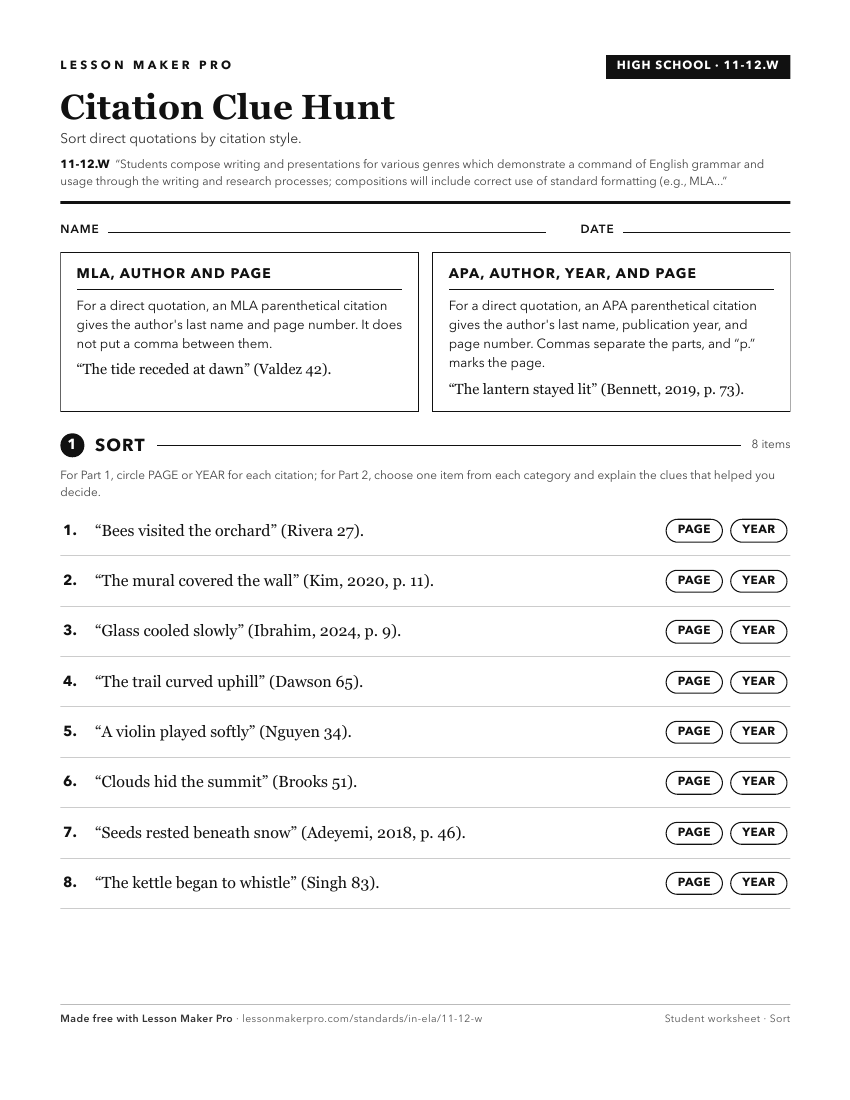
A ready-to-print activity worksheet aligned to 11-12.W, with an answer key for the teacher on its own page. No account needed.
PDF, US Letter, prints cleanly in black and white.
Download the worksheetKeep exploring
Related Standards
- 9-10.W
Students compose writing and presentations for various genres which demonstrate a command of English grammar and usage through the writing and research processe...
- 8.W
Students compose writing and presentations for various genres which demonstrate a command of English grammar and usage through the writing and research processe...
- 7.W
Students compose writing and presentations for various genres which demonstrate a command of English grammar and usage through the writing and research processe...
- 6.W
Students compose writing and presentations for various genres which demonstrate a command of English grammar and usage through the writing and research processe...
Turn this cluster into a lesson
Grade, subject, topic, and the complete cluster are prefilled. Create one free, no account needed.
Also for this cluster:Make a WorksheetMake a QuizMake a Sub Lesson