Indiana ELA 11-12.W.2.d
The Standard
- 11-12.W
- Learning Outcome: Students compose writing and presentations for various genres which demonstrate a command of English grammar and usage through the writing and research processes; compositions will include correct use of standard formatting (e.g., MLA, APA) with sources correctly cited.
- 11-12.W.2
- Write informative compositions on a variety of topics that: a. Introduce a topic and organize complex ideas, concepts, and information so that each new element builds on that which precedes it to create a unified whole; include formatting (e.g., headings), graphics (e.g., figures, tables), and multimedia when useful to aid comprehension. b. Utilizing credible sources, develop the topic thoroughly by selecting the most significant and relevant facts, extended definitions, concrete details, quotations, or other information and examples appropriate to the audience’s knowledge of the topic. c. Use appropriate and varied transitions and syntax to link the major sections of the text, create cohesion, and clarify the relationships among complex ideas and concepts. d. Choose language, content-specific vocabulary, and techniques to manage the complexity of the topic, recognizing and eliminating wordiness and redundancy. e. Establish and maintain a style appropriate for the purpose and audience. f. Provide a concluding statement or section that follows and supports the information or explanation presented (e.g., articulating implications or the significance of the topic). (E)
Choose language, content-specific vocabulary, and techniques to manage the complexity of the topic, recognizing and eliminating wordiness and redundancy.
Indiana Academic Standards for English/Language Arts (2023)
Teacher's field guide
What This Standard Means
What Students Need to Do
- Students explain a complex topic using accurate subject terms and words readers can follow. They define unfamiliar terms or give examples when needed. They remove repeated ideas and extra phrases without cutting needed facts.
What Mastery Looks Like
- A student can explain how a heat pump transfers heat using the term refrigerant and defining it for a new reader. They include an example and trim filler without leaving out a step the reader needs.
Common Misconceptions
- Students may use technical words without explaining them, assuming jargon makes their writing sound stronger. They may repeat a point in different words or cut needed details while trying to be concise.
How to Assess It
- Show this draft: “Evaporation happens when liquid water turns into water vapor. In evaporation, liquid water becomes water vapor.” Ask students to write one clear sentence that also explains what water vapor is.
Lesson moves
Ways to Teach It
Give pairs a wordy paragraph about earthquakes. Have them circle repeated points, replace vague terms with accurate ones, and define fault.
Post two explanations of a black hole, one with unexplained jargon. Ask, “Which would a ninth grader understand, and what would you change?”
Run a revision race: teams cut a 50-word water cycle explanation to 35 words without losing evaporation, condensation, or precipitation.
Give students a wordy cafeteria allergy notice. Ask them to define cross-contact and remove repeated warnings without weakening the message.
Free download
Printable 11-12.W.2.d Worksheet
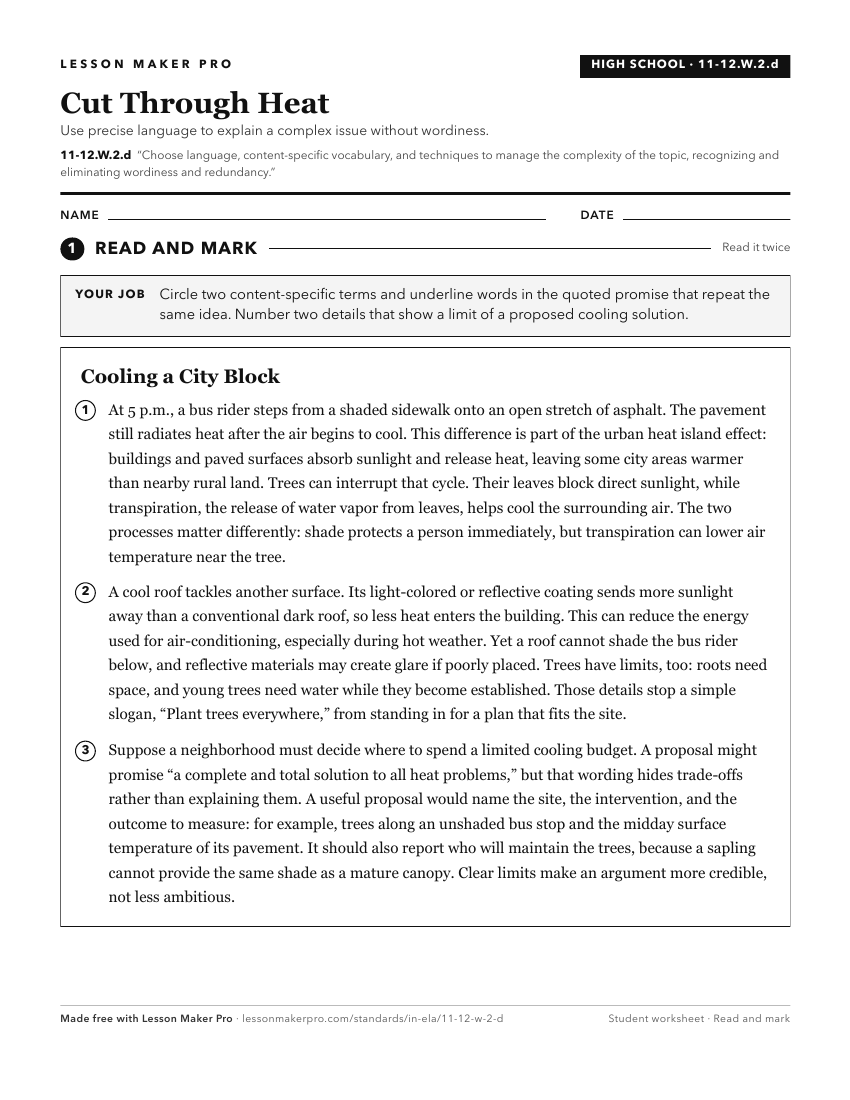
A ready-to-print activity worksheet aligned to 11-12.W.2.d, with an answer key for the teacher on its own page. No account needed.
PDF, US Letter, prints cleanly in black and white.
Download the worksheetKeep exploring
Related Standards
- 9-10.W.2.d
Choose language and content-specific vocabulary that express ideas precisely and concisely to manage the complexity of the topic, recognizing and eliminating wo...
- 7.W.2.d
Choose language and content-specific vocabulary that express ideas precisely and concisely, recognizing and eliminating wordiness and redundancy.
- 6.W.2.e
Choose language and content-specific vocabulary that express ideas precisely and concisely, recognizing and eliminating wordiness and redundancy.
- 8.W.2.d
Choose language and content-specific vocabulary that express ideas precisely and concisely, recognizing and eliminating wordiness and redundancy.
Turn this exact standard into a lesson
Grade, subject, topic, and the complete standard are prefilled. Create one free, no account needed.
Also for this standard:Make a WorksheetMake a QuizMake a Sub Lesson