Indiana ELA 8.W.2.d
The Standard
- 8.W
- Students compose writing and presentations for various genres which demonstrate a command of English grammar and usage through the writing and research processes.
- 8.W.2
- Write informative compositions in a variety of forms that: a. Introduce a topic clearly, previewing what is to follow; organize ideas, concepts, and information into broader categories; include formatting (e.g., headings), graphics (e.g., charts, tables), and multimedia when useful to aid comprehension. b. Develop the topic with relevant, well-chosen facts, definitions, concrete details, quotations, or other information and examples from various sources and texts. c. Use appropriate and varied transitions to create cohesion and clarify the relationships among ideas and concepts. d. Choose language and content-specific vocabulary that express ideas precisely and concisely, recognizing and eliminating wordiness and redundancy. e. Establish and maintain a style appropriate for the purpose and audience. f. Provide a concluding statement or section that follows and supports the information or explanation presented. (E)
Choose language and content-specific vocabulary that express ideas precisely and concisely, recognizing and eliminating wordiness and redundancy.
Indiana Academic Standards for English/Language Arts (2023)
Teacher's field guide
What This Standard Means
What Students Need to Do
- Students choose words that name ideas accurately in informative writing. They use topic terms where they help and cut repeated or unnecessary words without losing meaning.
What Mastery Looks Like
- A student uses terms such as sediment and erosion correctly in a paragraph about rivers. They replace 'due to the fact that' with 'because' and remove repeated details while keeping the explanation clear.
Common Misconceptions
- Students may think longer words always sound more knowledgeable. They may add jargon they do not understand or cut details the reader needs.
How to Assess It
- Exit ticket: Revise 'The river takes away soil from the bank, and this taking away of soil is called erosion.' Keep erosion accurate and cut the repetition.
Lesson moves
Ways to Teach It
Give pairs paper strips reading 'The river moves stuff, and this movement moves stuff downstream.' Have them cut repeats and replace 'stuff' with 'sediment'.
Ask students to write which is clearer, 'the water moves stuff' or 'the river carries sediment,' and explain why.
Run a revision relay: teams rewrite 'Erosion is a process that takes place when soil is removed away' on the board.
Have students revise a mock recycling notice that says 'put recyclable things in the recycling bin for recycling,' naming accepted items and cutting repeats.
Free download
Printable 8.W.2.d Worksheet
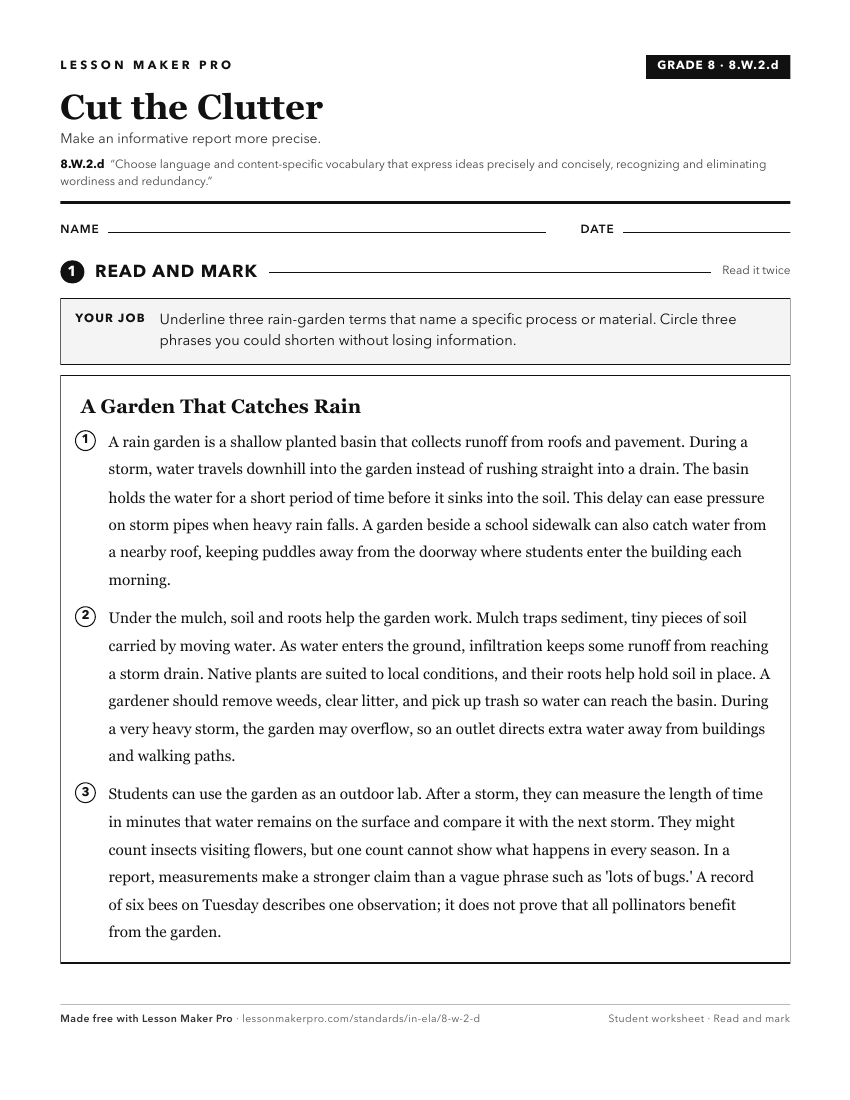
A ready-to-print activity worksheet aligned to 8.W.2.d, with an answer key for the teacher on its own page. No account needed.
PDF, US Letter, prints cleanly in black and white.
Download the worksheetKeep exploring
Related Standards
- 6.W.2.e
Choose language and content-specific vocabulary that express ideas precisely and concisely, recognizing and eliminating wordiness and redundancy.
- 7.W.2.d
The 7th Grade version of this standard.
- 9-10.W.2.d
Choose language and content-specific vocabulary that express ideas precisely and concisely to manage the complexity of the topic, recognizing and eliminating wo...
- 11-12.W.2.d
Choose language, content-specific vocabulary, and techniques to manage the complexity of the topic, recognizing and eliminating wordiness and redundancy.
Turn this exact standard into a lesson
Grade, subject, topic, and the complete standard are prefilled. Create one free, no account needed.
Also for this standard:Make a WorksheetMake a QuizMake a Sub Lesson