Indiana ELA 11-12.RC
Standard Cluster
Students analyze the author's technique, purpose, and perspective in grade-level fiction and nonfiction text, using textual evidence to support analysis.
Indiana Academic Standards for English/Language Arts (2023)
Cluster contents
Standards in This Cluster
11-12.RC is a cluster heading. These are the individual standards under it.
- 11-12.RC.1
Analyze what a text says explicitly and implicitly (e.g., inferences and interpretations) by citing strong and thorough textual evidence to support and explain ...
- 11-12.RC.2
Compare and contrast the development of similar themes across two or more works of literature, and analyze how they emerge and are shaped and refined by specifi...
- 11-12.RC.3
Analyze and evaluate how an author's choices concerning how to structure specific parts of a work of literature (e.g., the choice of where to begin or end a sto...
- 11-12.RC.4
Analyze and evaluate works of literary or cultural significance in history for the way in which these works have used archetypes drawn from myths, traditional s...
- 11-12.RC.5
Analyze the development of similar central ideas across two or more texts and determine how specific details shape and refine the central idea. (E)
- 11-12.RC.6
Analyze a complex set of ideas or sequence of events and explain how specific ideas, events, and individuals develop throughout the text.
- 11-12.RC.7
Determine an author's perspective or purpose in a text in which the rhetoric is particularly effective (e.g., appeals to both friendly and hostile audiences, an...
- 11-12.RC.8
Delineate and evaluate the arguments and specific claims in U.S. and world texts, assessing whether the reasoning is valid and the evidence is relevant and suff...
- 11-12.RC.10
Analyze and synthesize foundational U.S. and world documents of historical and literary significance for their themes, purposes, and rhetorical features
- 11-12.RC.14
Determine the meaning of words and phrases as they are used in a nonfiction text, including figurative, connotative, denotative, and technical meanings; evaluat...
- 11-12.RC.1aUse multiple pieces of evidence that support explicit and implicit interpretations of a text, and identify a matter that is uncertain. (E)
- 11-12.RC.2aCompare and contrast the development of similar themes across two works of literature, and explain how those themes are supported by specific details from the texts.
- 11-12.RC.3aExplain how an author's choices concerning how to structure specific parts of a work of literature (e.g., the choice of where to begin or end a story, the choice to provide a comedic or tragic resolution) contribute to the overall meaning or effect.
- 11-12.RC.4aAnalyze works of literary or cultural significance in history to identify archetypes authors employ drawn from myths, traditional stories, or religious works; compare how two or more of these texts treat similar themes, conflicts, issues, or topics.
- 11-12.RC.5aExplain how similar central ideas are developed across two texts, and identify specific details that support their development. (E)
- 11-12.RC.6aAnalyze a set of ideas or sequence of events to explain how the author develops specific ideas, events, or individuals throughout a text.
- 11-12.RC.7aDetermine an author's perspective or purpose in a text, and explain how the author uses rhetoric to develop the power and persuasiveness of the text. (E)
- 11-12.RC.8aEvaluate arguments and claims in U.S. and/or world texts, assessing whether the reasoning is valid and/or the evidence is relevant and sufficient; identify any false statements and fallacious reasoning.
- 11-12.RC.9aAnalyze information from two or more pre-selected sources to answer a question or solve a problem. (E)
- 11-12.RC.10aAnalyze foundational U.S. and world documents of historical and literary significance for their themes, purposes, and rhetorical features.
- 11-12.RC.11aDetermine or clarify the meaning of a word or phrase based on context. (E)
- 11-12.RC.12aExplain the differences in the meanings of words with similar denotations.
- 11-12.RC.13aAnalyze the meanings of various types of words and phrases used in works of literature, including figurative, connotative, and/or denotative meanings; identify literary techniques (e.g., imagery, allegory, and symbolism) and explain their impact.
- 11-12.RC.14aDetermine the meanings of various types of words and phrases as they are used in a nonfiction text (e.g., figurative, connotative, denotative, and/or technical meanings) and their impact on the overall meaning of the text. (E)
Teacher's field guide
What This Cluster Means
What Students Need to Do
- Students spot choices in word choice, structure, and narration in stories and articles. They explain what the writer wants readers to think or feel and whose viewpoint shapes the piece. They use specific lines to support their claims.
What Mastery Looks Like
- A student can name a technique, quote a precise passage, and explain its effect rather than just labeling it. They can distinguish the writer's goal from the writer's viewpoint in both fiction and nonfiction.
Common Misconceptions
- Students treat a first-person narrator as the author. They confuse purpose with perspective, calling both 'to inform.' They paste in a quote without explaining how it supports their claim.
How to Assess It
- Give students one paragraph from an opinion column. Ask: 'Which word choice shows the writer's viewpoint and helps achieve the writer's purpose? Quote it and explain how it works.'
Lesson moves
Ways to Teach It
Give pairs a short story scene and an opinion paragraph about a school phone ban; have them highlight telling words and label each viewpoint.
Have students write two sentences explaining how one word in the phone ban paragraph reveals the writer's viewpoint and supports their purpose.
Put four quotes from the passages on cards; teams draw one, identify a technique and the writer's purpose or viewpoint, and defend their answer.
Compare a school phone ban notice with a student's letter to the principal; circle phrases that show what each writer wants and believes.
Free download
Printable 11-12.RC Worksheet
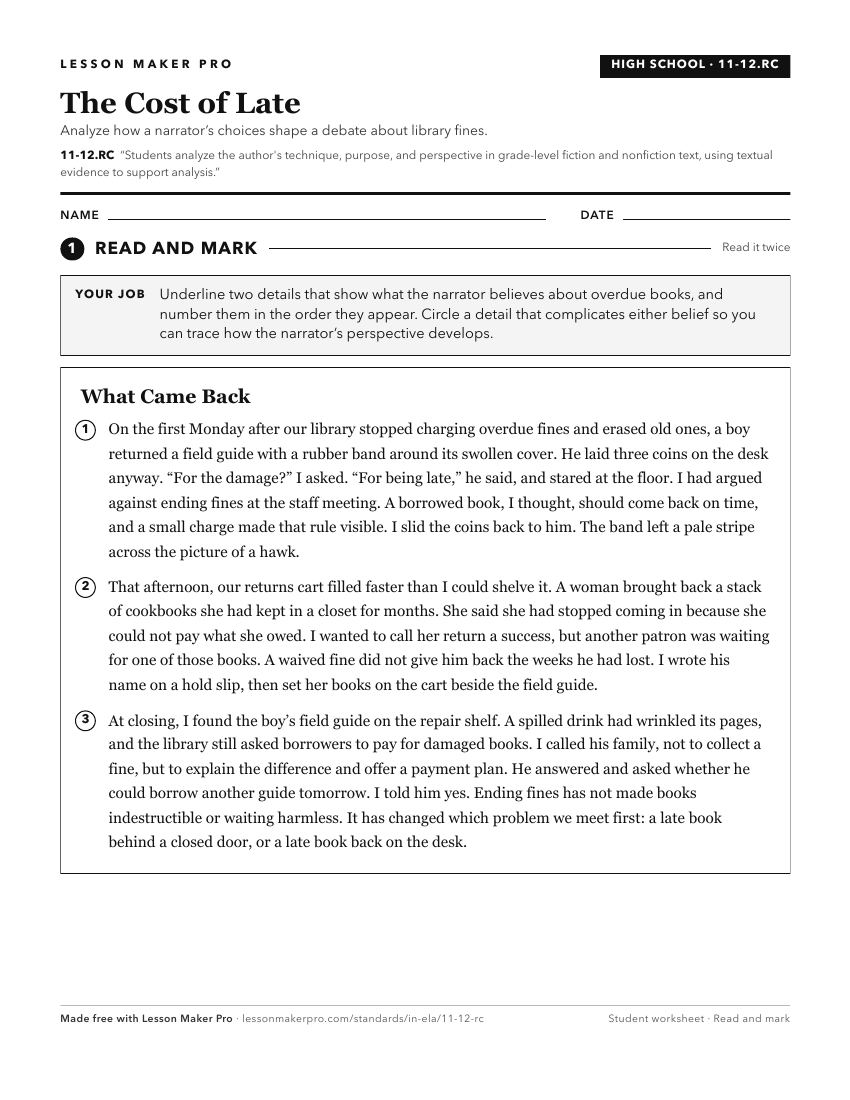
A ready-to-print activity worksheet aligned to 11-12.RC, with an answer key for the teacher on its own page. No account needed.
PDF, US Letter, prints cleanly in black and white.
Download the worksheetKeep exploring
Related Standards
- 7.RC
Students analyze the author's technique, structure, main ideas, purpose, and perspective in grade-level fiction and nonfiction text, using textual evidence to s...
- 9-10.RC
Students analyze the author's technique, structure, main ideas, purpose, and perspective in grade-level fiction and nonfiction text, using textual evidence to s...
- 8.RC
Students analyze the author's technique, structure, main ideas, purpose, and perspective in grade-level fiction and nonfiction text, using textual evidence to s...
- 6.RC
Students analyze the author's technique, structure, main ideas, purpose, and perspective in grade-level fiction and nonfiction text, using textual evidence to s...
Turn this cluster into a lesson
Grade, subject, topic, and the complete cluster are prefilled. Create one free, no account needed.
Also for this cluster:Make a WorksheetMake a QuizMake a Sub Lesson