Indiana ELA 6.RC
Standard Cluster
Students analyze the author's technique, structure, main ideas, purpose, and perspective in grade-level fiction and nonfiction text, using textual evidence to support analysis.
Indiana Academic Standards for English/Language Arts (2023)
Cluster contents
Standards in This Cluster
6.RC is a cluster heading. These are the individual standards under it.
- 6.RC.2
Determine how a theme or central idea of a work of literature is conveyed through particular details; provide a detailed, objective summary of the text. (E)
- 6.RC.3
Analyze how a particular sentence, chapter, scene, or stanza fits into the overall structure of a work of literature and contributes to the development of the t...
- 6.RC.9
Integrate information presented in different media or formats (e.g., visually, quantitatively, verbally) to demonstrate a coherent understanding of a topic or i...
- 6.RC.1aUse at least one specific detail in a text to support what it says explicitly or to draw inferences. (E)
- 6.RC.2aProvide a detailed, objective summary of the text that includes the theme or central idea. (E)
- 6.RC.3aDescribe how a particular sentence, chapter, scene, or stanza contributes to the theme, characterization, setting, or plot. Explain how a change in one particular sentence, chapter, scene, or stanza might impact the overall work of literature. (E)
- 6.RC.4aCompare and contrast works of literature from different genres (e.g., stories and poems, historical novels and fantasy stories) and identify similarities and differences in their approaches to similar themes.
- 6.RC.5aExplain how the central idea of a text is supported by at least two specific details, and summarize the text.
- 6.RC.6aDescribe in detail how a key individual, event, or idea is introduced and developed.
- 6.RC.7aIdentify an author's perspective or purpose in a text. (E)
- 6.RC.8aIdentify an argument and at least one claim in a text, and evaluate an author's reasoning and/or evidence to determine whether a claim is supported.
- 6.RC.9aUse information from two or more different media or formats (e.g., visually, quantitatively, verbally) to explain a topic or issue.
- 6.RC.10aUse context clues to determine the meaning of unknown words. (E)
- 6.RC.11aIdentify and demonstrate knowledge of word relationships, including cause/effect, part/whole, and item/category.
- 6.RC.12aDetermine the connotative meaning of words with similar denotations.
- 6.RC.13aUse common, instructional-level Greek or Latin affixes or roots as clues to the meaning of a word (e.g. audience, auditory, audible).
Teacher's field guide
What This Cluster Means
What Students Need to Do
- Students find the main idea in stories and articles. They explain how word choices and text structure help show the writer's purpose and perspective. They use details from the text to support their ideas.
What Mastery Looks Like
- A student can explain how a story's flashback or an article's heading affects what readers understand. They can identify the writer's purpose and perspective, then cite details that support their reading.
Common Misconceptions
- Students may retell the plot instead of stating a main idea. They may mistake a character's opinion for the author's perspective. They may copy a quote without explaining what it proves.
How to Assess It
- Hand out a one-page story or article. Ask students to state its main idea, name one word choice or structural choice that supports it, and explain one quoted line.
Lesson moves
Ways to Teach It
Give pairs a short story cut into scenes; have them put it in order and mark when readers learn a key fact.
After reading a one-page article, ask: 'Which two words show the writer's opinion? What would change if those words were neutral?'
Play evidence match: teams pair cards naming an article's main idea or purpose with quoted lines that support each claim.
Compare a school lunch announcement with a cafeteria poster; have students underline persuasive words and explain how each layout fits its purpose.
Free download
Printable 6.RC Worksheet
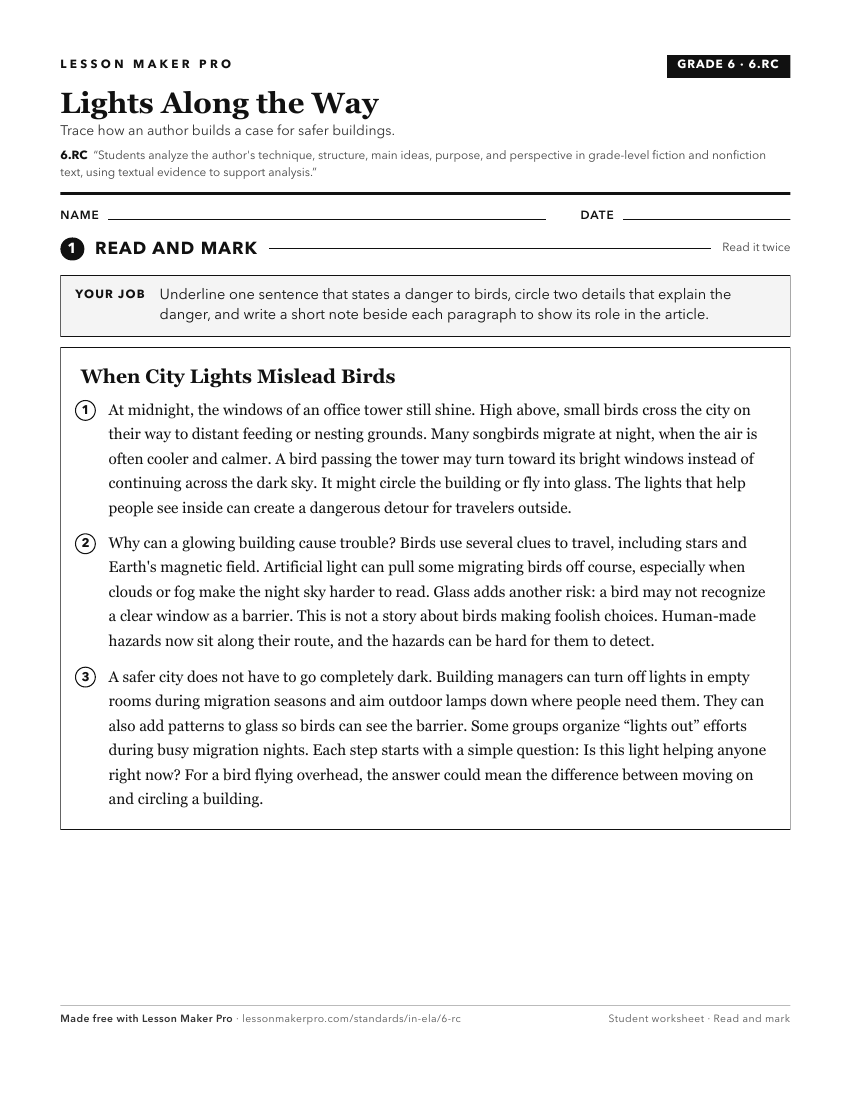
A ready-to-print activity worksheet aligned to 6.RC, with an answer key for the teacher on its own page. No account needed.
PDF, US Letter, prints cleanly in black and white.
Download the worksheetKeep exploring
Related Standards
Turn this cluster into a lesson
Grade, subject, topic, and the complete cluster are prefilled. Create one free, no account needed.
Also for this cluster:Make a WorksheetMake a QuizMake a Sub Lesson