Indiana ELA 11-12.RC.8
The Standard
- 11-12.RC
- Students analyze the author's technique, purpose, and perspective in grade-level fiction and nonfiction text, using textual evidence to support analysis.
Delineate and evaluate the arguments and specific claims in U.S.and world texts, assessing whether the reasoning is valid and the evidence is relevant and sufficient; analyze the impact of false statements and fallacious reasoning.
Indiana Academic Standards for English/Language Arts (2023)
Teacher's field guide
What This Standard Means
What Students Need to Do
- Students map the claims, reasons, and evidence in opinion pieces from U.S. and world sources. They check whether each reason supports the conclusion and whether the evidence fits and is enough. They explain how a false claim or faulty reasoning affects the argument.
What Mastery Looks Like
- Given an unfamiliar editorial, a student can name its main claim and trace its reasons to specific evidence. They can explain why a statistic is irrelevant, why one example is not enough, and how a false claim weakens the conclusion.
Common Misconceptions
- Students often treat any number as proof, even when it measures something else. They may use one personal story to accept a broad claim or assume that two events prove cause and effect. They may spot a false fact but not explain how it affects the argument.
How to Assess It
- Exit ticket: “Our school should ban phones because one student failed after using one, and all schools with bans have higher grades.” Tell students that grades fell at four surveyed schools with bans, then ask them to identify the weak reasoning, the false claim, and how each affects the conclusion.
Lesson moves
Ways to Teach It
Print a short U.S. editorial and a short international editorial on plastic bags; students color-code claims, reasons, and evidence, then draw arrows between them.
After reading the two editorials, ask, “Which writer gives enough relevant evidence for a ban, and which claim would you check first?”
Give teams six argument cards about plastic bags and a recycling fact sheet; award points for spotting weak links and disproving false claims.
Bring in a grocery bag labeled “recyclable” and local recycling rules; students decide whether that label supports a store’s “less waste” claim.
Free download
Printable 11-12.RC.8 Worksheet
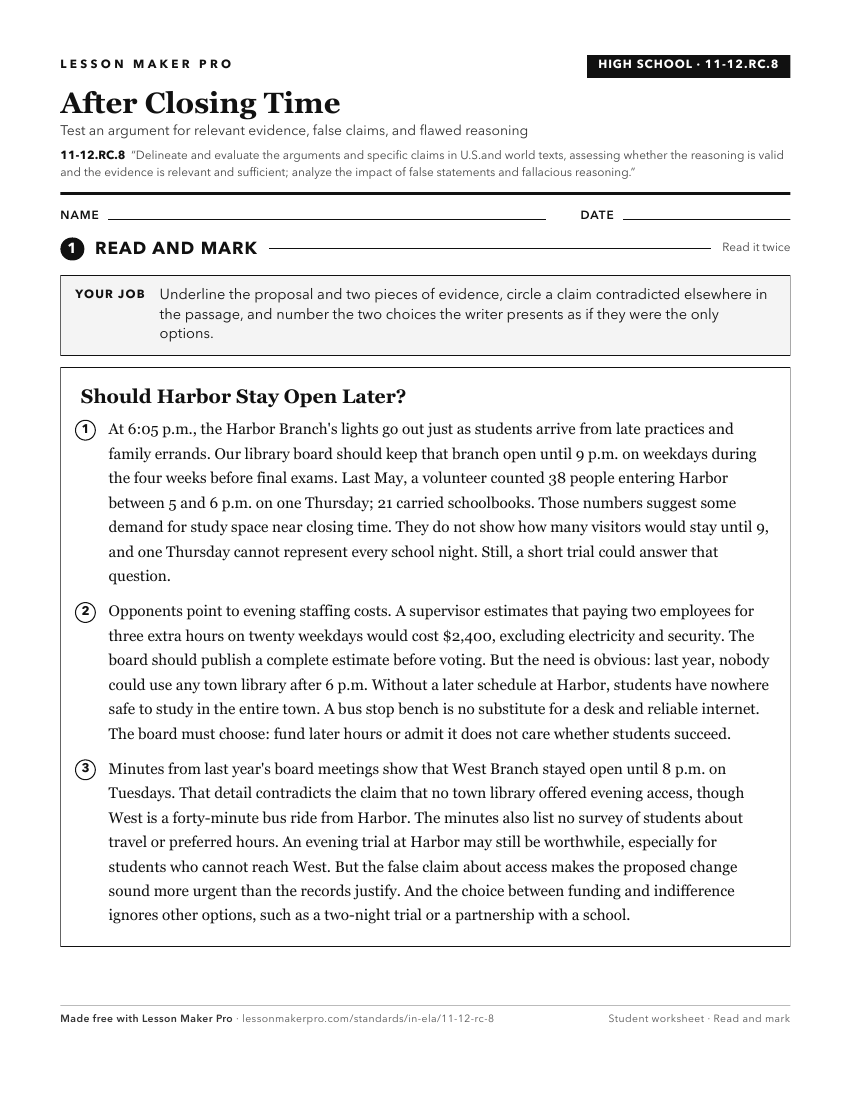
A ready-to-print activity worksheet aligned to 11-12.RC.8, with an answer key for the teacher on its own page. No account needed.
PDF, US Letter, prints cleanly in black and white.
Download the worksheetKeep exploring
Related Standards
- 7.RC.8
Trace and evaluate the argument and specific claims in a text, assessing whether the reasoning is sound and the evidence is relevant and sufficient to support t...
- 9-10.CC.6
Evaluate a speaker's perspective, reasoning, and use of evidence and rhetoric, identifying any fallacious reasoning or distorted evidence.
Turn this exact standard into a lesson
Grade, subject, topic, and the complete standard are prefilled. Create one free, no account needed.
Also for this standard:Make a WorksheetMake a QuizMake a Sub Lesson