Idaho Social Studies 9-12.US2.37
The Standard
Evaluate the factors that impacted relationships and policies with China, Russia, Latin America, and the Middle East.
Idaho Content Standards: K-12 Social Studies · Economic, Political, and Social Reorganization 1974-1992
Teacher's field guide
What This Standard Means
What Students Need to Do
- Students explain how events from 1974 to 1992 shaped U.S. policy toward China, the Soviet Union and later Russia, countries in Latin America, and countries in the Middle East. They weigh factors such as Cold War rivalry, trade, oil, war, and human rights.
What Mastery Looks Like
- A student can explain why the U.S. recognized China, negotiated arms limits with the Soviet Union, backed the Contras in Nicaragua, and fought Iraq after it invaded Kuwait. They can use evidence to judge which factors mattered most in each decision.
Common Misconceptions
- Students may call the Soviet Union “Russia” throughout the period or assume U.S. relations with China never changed. They may treat Latin America or the Middle East as a single country with one U.S. policy.
How to Assess It
- Exit ticket: For each of these decisions, name one factor behind it: U.S. recognition of China in 1979, the 1987 INF Treaty, support for Nicaragua’s Contras, and the 1991 war against Iraq. Choose one decision and explain why that factor mattered.
Lesson moves
Ways to Teach It
Give pairs four event cards, one per region, and have them place each on a map with a note naming a U.S. policy goal.
Ask: Was Cold War rivalry more important to U.S. recognition of China or support for Nicaragua’s Contras? Defend your answer with two facts.
Play a matching game with cards naming policy decisions, events, and factors, then have students explain one match a classmate disputes.
Compare a 1990 oil-price headline with a current gas-price headline, then discuss how energy concerns can affect foreign policy.
Free download
Printable 9-12.US2.37 Worksheet
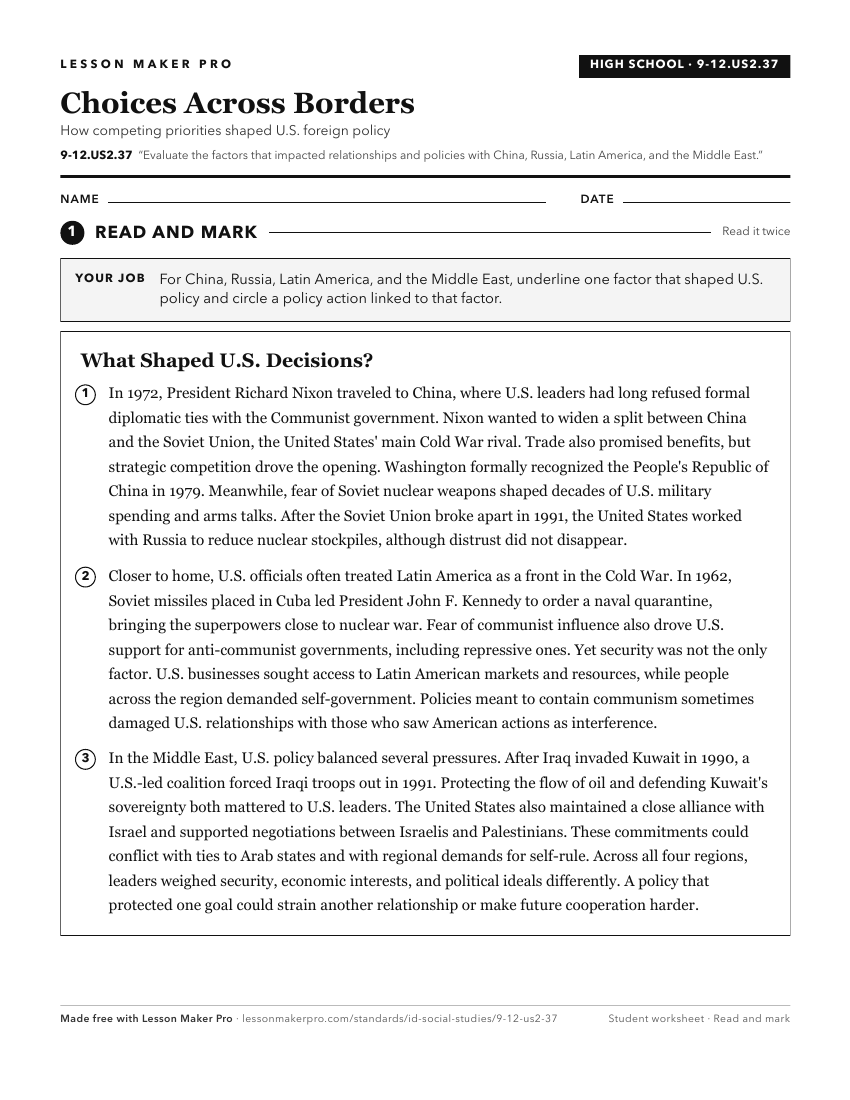
A ready-to-print activity worksheet aligned to 9-12.US2.37, with an answer key for the teacher on its own page. No account needed.
PDF, US Letter, prints cleanly in black and white.
Download the worksheetKeep exploring
Related Standards
- 6-12.US1.36
Analyze how foreign policy during the 1820s to 1860s impacted relations with sovereign powers outside the United States, for example, tariff policies and treati...
- 9-12.US2.39
Evaluate the factors that contributed to the end of the Cold War. These may include:
- 9-12.US2.24
Analyze various foreign policy events through the lens of the Cold War, military engagements, and covert actions during this period. These may include:
- 9-12.US2.3
Evaluate the impact of racial, economic, moral, political, and strategic motives for the United States becoming an imperialist power.
Turn this exact standard into a lesson
Grade, subject, topic, and the complete standard are prefilled. Create one free, no account needed.
Also for this standard:Make a WorksheetMake a QuizMake a Sub Lesson