Idaho Social Studies 9-12.US2.24
The Standard
Analyze various foreign policy events through the lens of the Cold War, military engagements, and covert actions during this period. These may include: • Berlin Blockade • Rise of the Communist regime in China • Korean War • Central Intelligence Agency’s support of coups in Iran and Guatemala • Cuban Missile Crisis • U2 incident • Berlin Wall • Vietnam War
Idaho Content Standards: K-12 Social Studies · Affluence, Cold War, and Social Revolutions 1945-1974
Teacher's field guide
What This Standard Means
What Students Need to Do
- Students explain why U.S. leaders saw events abroad as Cold War threats. They compare military action, nonmilitary responses, and covert operations, then trace the effects on the countries involved.
What Mastery Looks Like
- A student can explain why the United States used an airlift in Berlin but sent troops to Korea. They can describe how CIA support for the 1953 Iran coup affected Iran, using evidence rather than just naming the event.
Common Misconceptions
- Students may assume every conflict was a direct fight between the United States and Soviet Union, ignoring local goals. They may confuse the Berlin Blockade with the later Berlin Wall or mistake a CIA-backed coup for an election.
How to Assess It
- Exit ticket: Choose two events from the Berlin Blockade, Korean War, and 1953 Iran coup. For each, name the U.S. action, the threat leaders perceived, and one consequence.
Lesson moves
Ways to Teach It
Place Berlin Blockade, Korean War, Iran coup, and Cuban Missile Crisis cards on a map; label each U.S. response.
Ask, 'Was the 1953 Iran coup more about containing communism or protecting oil interests?' Have students cite two details from a source sheet.
Play a matching game with Korean War, Cuban Missile Crisis, and Guatemala coup cards, pairing each event with a U.S. action and consequence.
Print an AP report on U.S. aid to Ukraine; compare its stated purpose with the 1950 U.S. decision to send troops to Korea.
Free download
Printable 9-12.US2.24 Worksheet
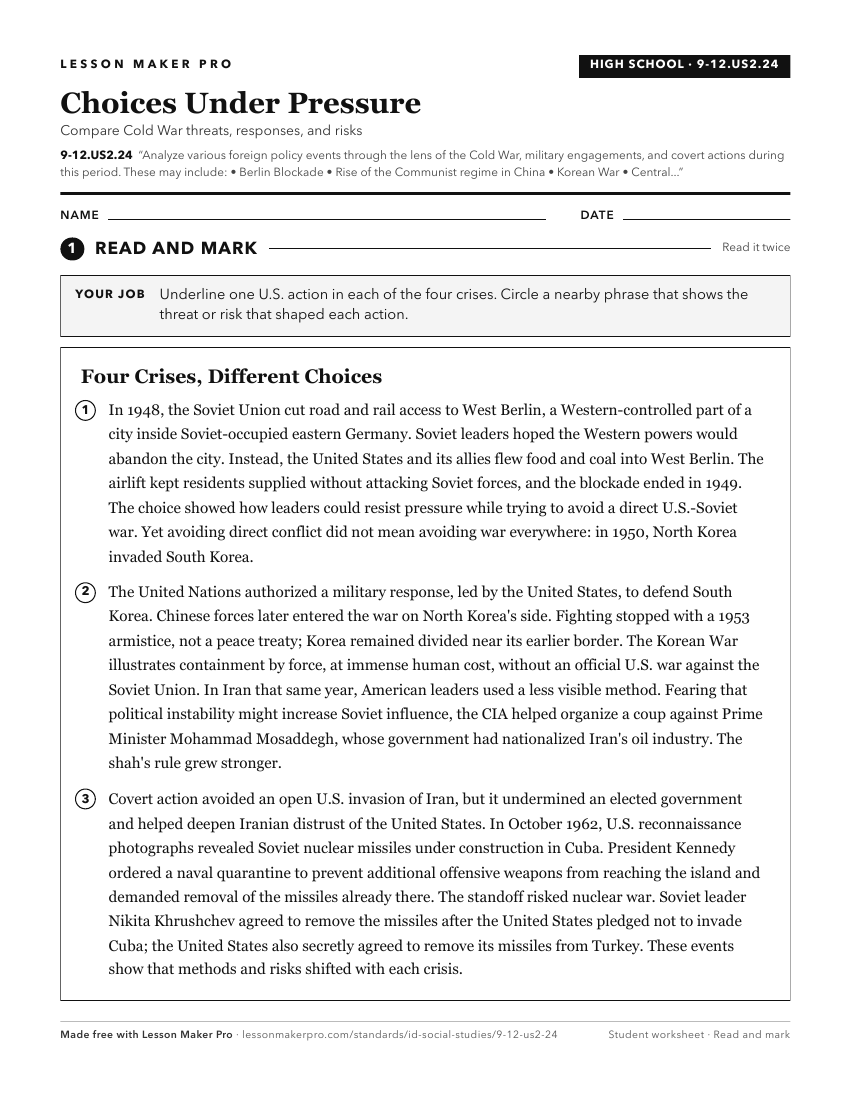
A ready-to-print activity worksheet aligned to 9-12.US2.24, with an answer key for the teacher on its own page. No account needed.
PDF, US Letter, prints cleanly in black and white.
Download the worksheetKeep exploring
Related Standards
- 9-12.US2.39
Evaluate the factors that contributed to the end of the Cold War. These may include:
- 9-12.US2.26
Examine the influence of the Cold War on United States politics and society. Including:
- 9-12.US2.37
Evaluate the factors that impacted relationships and policies with China, Russia, Latin America, and the Middle East.
- 9-12.US2.25
Compare various ways the United States and the Soviet Union built and strengthened economic, political, and military alliances with countries during this period...
Turn this exact standard into a lesson
Grade, subject, topic, and the complete standard are prefilled. Create one free, no account needed.
Also for this standard:Make a WorksheetMake a QuizMake a Sub Lesson