Idaho Social Studies 9-12.US2.3
The Standard
Evaluate the impact of racial, economic, moral, political, and strategic motives for the United States becoming an imperialist power.
Idaho Content Standards: K-12 Social Studies · Progressivism and Imperialism, 1890 - 1920
Teacher's field guide
What This Standard Means
What Students Need to Do
- Students identify how racist beliefs, trade interests, moral claims, political ambitions, and military goals drove U.S. expansion. They use speeches, cartoons, and maps to connect those motives to decisions about Hawaii and the Philippines. They explain consequences for people living under U.S. rule.
What Mastery Looks Like
- A student can find several motives in a speech supporting annexation and check its claims against an opposing source. They can explain how those motives shaped U.S. policy and affected Filipino self-rule.
Common Misconceptions
- Students may see expansion as only a search for markets or assume all Americans supported it. They may treat claims about helping Filipinos as proof that Filipinos welcomed U.S. rule.
How to Assess It
- Give students a short excerpt from Albert Beveridge’s 1900 Senate speech on the Philippines. Ask: “Name two motives for U.S. control, quote evidence for each, and explain one effect on Filipino self-rule.”
Lesson moves
Ways to Teach It
Use string on a Pacific map to link Hawaii and the Philippines to U.S. ports and Asian markets; label trade and naval gains.
Read a Beveridge speech excerpt aloud, then ask: “How did his claims about Filipinos support annexation, and whose views are missing?”
Run a card sort: match a naval base, overseas market, missionary, racial cartoon, and election speech to motives, then defend two matches.
Compare an 1898 Pacific map with a current U.S. military base map; ask which strategic goals seem similar and which differ.
Free download
Printable 9-12.US2.3 Worksheet
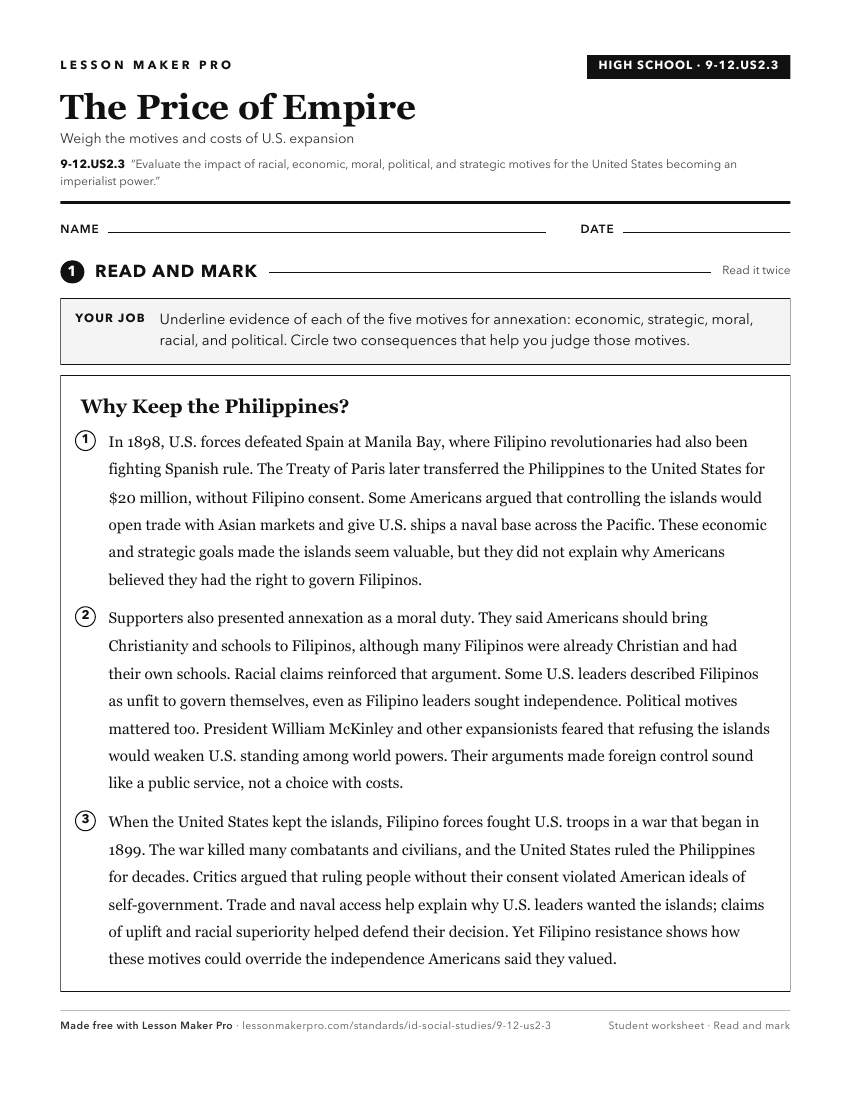
A ready-to-print activity worksheet aligned to 9-12.US2.3, with an answer key for the teacher on its own page. No account needed.
PDF, US Letter, prints cleanly in black and white.
Download the worksheetKeep exploring
Related Standards
- 9-12.US2.4
Analyze the origins and the impacts of the Spanish-American War and American involvement in Latin America, Hawaii, the Philippines, China, and Japan.
- 9-12.WC.39
Analyze the causes and consequences of the Age of Discovery and the rise of European Empires.
- 6-12.US1.36
Analyze how foreign policy during the 1820s to 1860s impacted relations with sovereign powers outside the United States, for example, tariff policies and treati...
- 9-12.US2.37
Evaluate the factors that impacted relationships and policies with China, Russia, Latin America, and the Middle East.
Turn this exact standard into a lesson
Grade, subject, topic, and the complete standard are prefilled. Create one free, no account needed.
Also for this standard:Make a WorksheetMake a QuizMake a Sub Lesson