Idaho Social Studies 9-12.GOV.41
The Standard
Describe the Supreme Court’s role, established by Marbury vs. Madison, in determining the constitutionality of laws and acts of the legislative and executive branches.
Idaho Content Standards: K-12 Social Studies · Function And Structure of the U.S. Political System
Teacher's field guide
What This Standard Means
What Students Need to Do
- Students explain how the Supreme Court can decide whether a law or presidential action conflicts with the Constitution. They trace that power, called judicial review, to Marbury v. Madison.
What Mastery Looks Like
- Students can explain why the Court refused Marbury's requested order and set aside the law it said gave the Court that power. Given a new case, they identify the challenged action, the constitutional conflict, and the effect of the ruling.
Common Misconceptions
- Students may think the Court writes or vetoes laws, or checks every law before it takes effect. Some think a president's actions cannot be reviewed.
How to Assess It
- Exit ticket: Congress bans newspapers from criticizing the president. Name the constitutional protection at stake and explain what the Supreme Court could do if the law is challenged.
Lesson moves
Ways to Teach It
Give pairs Article III, Judiciary Act, and Marbury request cards; have them arrange the cards to show why the Court refused his request.
Ask students to write: Should the Court block a law that voters support if it conflicts with the Constitution? Why?
Sort three scenario cards, a congressional speech ban, a presidential newspaper ban, and a private club rule, by whether constitutional review applies.
Read a short summary of United States v. Nixon and identify the presidential claim the Court rejected.
Free download
Printable 9-12.GOV.41 Worksheet
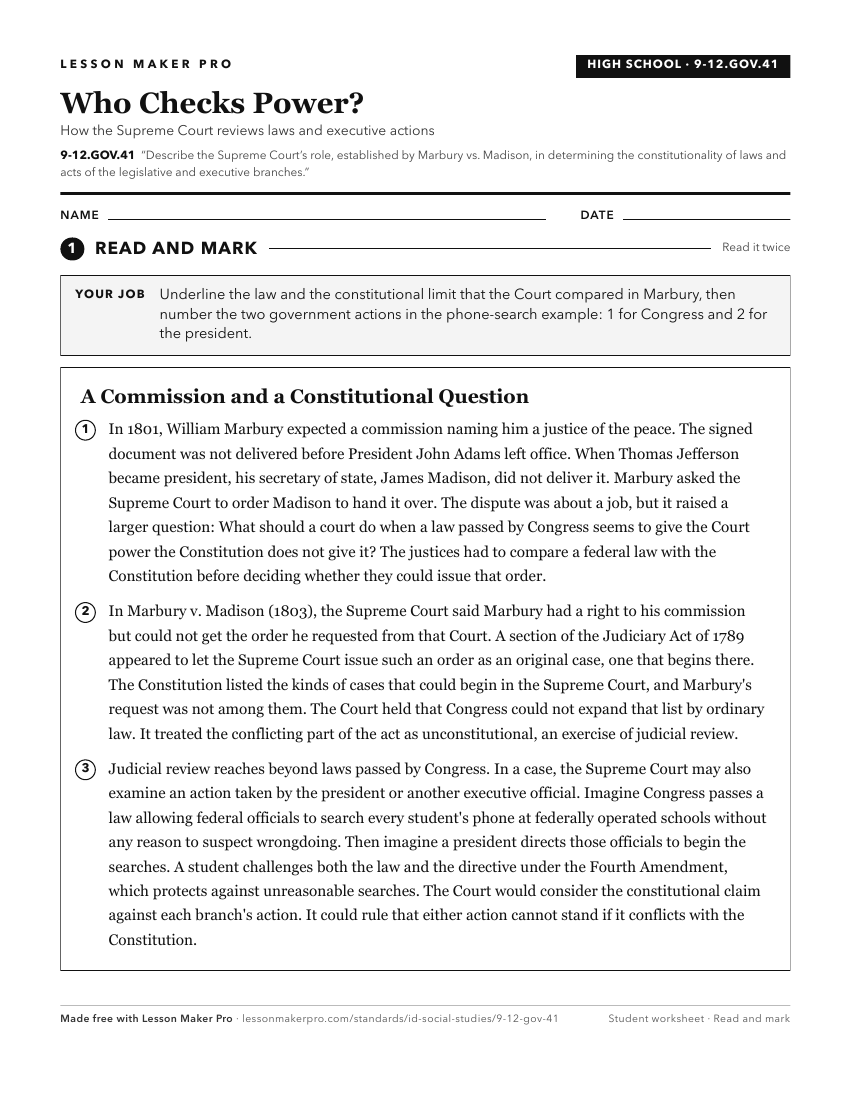
A ready-to-print activity worksheet aligned to 9-12.GOV.41, with an answer key for the teacher on its own page. No account needed.
PDF, US Letter, prints cleanly in black and white.
Download the worksheetKeep exploring
Related Standards
- 9-12.GOV.25
Evaluate the Supreme Court’s interpretations of the freedoms in the 14th Amendment, equal protection, and due process clauses including Plessy v. Ferguson, Roe ...
- 9-12.GOV.39
Analyze the origin and evolution of the modern federal court structure including the Judiciary Act of 1789.
- 9-12.GOV.38
Analyze Article III of the Constitution as it relates to judicial power, including the length of terms and the jurisdiction of the U.S. Supreme Court.
- 9-12.GOV.40
Explain the processes of selection and confirmation of Supreme Court justices.
Turn this exact standard into a lesson
Grade, subject, topic, and the complete standard are prefilled. Create one free, no account needed.
Also for this standard:Make a WorksheetMake a QuizMake a Sub Lesson