Idaho Social Studies 9-12.GOV.39
The Standard
Analyze the origin and evolution of the modern federal court structure including the Judiciary Act of 1789.
Idaho Content Standards: K-12 Social Studies · Function And Structure of the U.S. Political System
Teacher's field guide
What This Standard Means
What Students Need to Do
- Students trace how Congress built the federal courts from the Constitution's broad outline. They explain what the Judiciary Act of 1789 set up and why Congress added separate appeals courts in 1891. They compare early court roles with the ones courts have now.
What Mastery Looks Like
- A student can draw a timeline showing district and circuit courts created in 1789 and appeals courts added in 1891. They can explain that the early circuit courts heard trials, while today's circuit courts hear appeals.
Common Misconceptions
- Students may think the Constitution spelled out every level of the federal court system. They may mistake the original circuit courts for today's appeals courts, though the early courts also heard trials.
How to Assess It
- Exit ticket: What did the Constitution leave for Congress to decide, what courts did Congress set up in 1789, and what changed in 1891?
Lesson moves
Ways to Teach It
Give students Constitution, 1789, 1891, and 1911 event cards to arrange, then have them draw how the court structure changed.
Ask students to write two sentences explaining why a growing Supreme Court caseload might lead Congress to create separate appeals courts.
Pairs sort court and date cards into two case-route diagrams, one for 1800 and one for today, then check against a key.
Use a U.S. Courts circuit map to find Idaho's district court and the Ninth Circuit, then trace the path of a federal appeal.
Free download
Printable 9-12.GOV.39 Worksheet
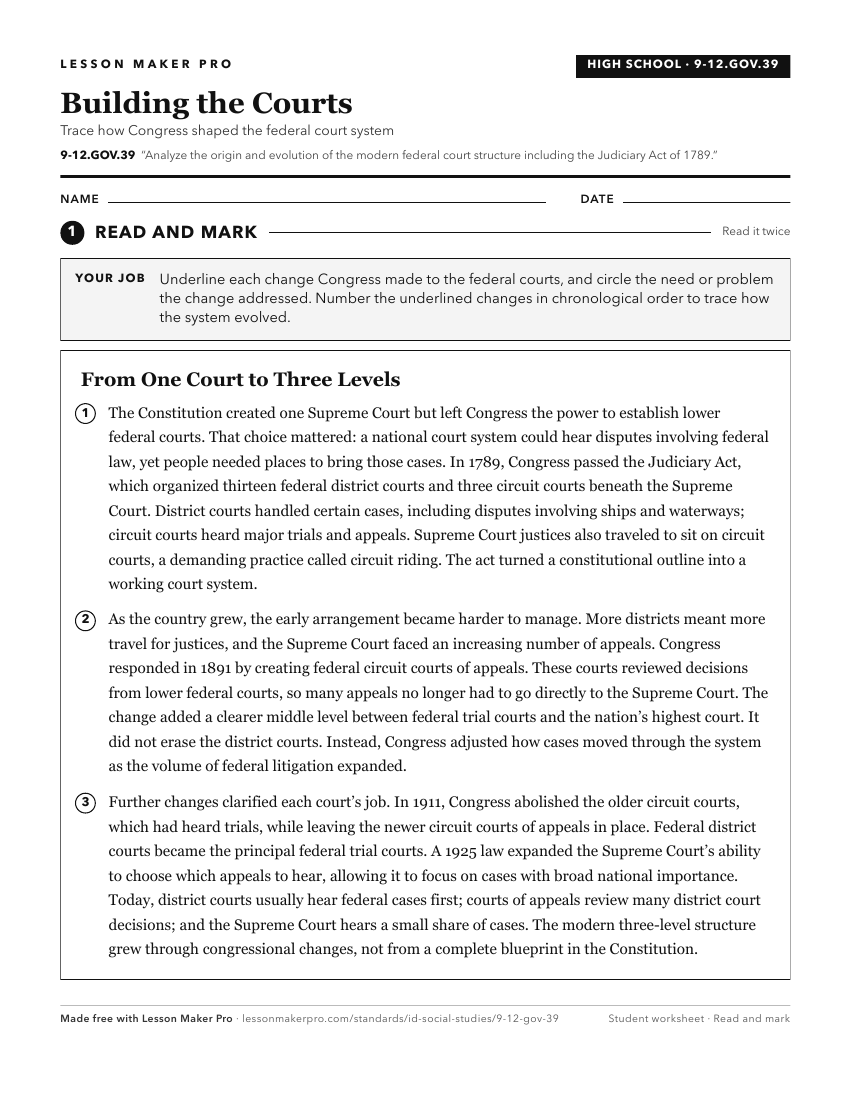
A ready-to-print activity worksheet aligned to 9-12.GOV.39, with an answer key for the teacher on its own page. No account needed.
PDF, US Letter, prints cleanly in black and white.
Download the worksheetKeep exploring
Related Standards
- 9-12.GOV.4
Analyze the Constitutional Convention of 1787, including the Great Compromise and the ensuing debate over ratification between the Federalists and Anti-Federali...
- 6-12.US1.13
Analyze the successes and failures of the Articles of Confederation and the events that led to the Constitutional Convention of 1787.
- 9-12.GOV.38
Analyze Article III of the Constitution as it relates to judicial power, including the length of terms and the jurisdiction of the U.S. Supreme Court.
- 6-12.US1.16
Analyze the original Constitution by comparing the powers of government branches, assessing its response to Revolutionary causes and alignment with Declaration ...
Turn this exact standard into a lesson
Grade, subject, topic, and the complete standard are prefilled. Create one free, no account needed.
Also for this standard:Make a WorksheetMake a QuizMake a Sub Lesson