Idaho Social Studies 9-12.GOV.24
The Standard
Evaluate the Supreme Court’s interpretations of freedoms in the Fourth through Eighth Amendments, including Mapp v. Ohio, Gideon v. Wainwright, and Miranda v. Arizona.
Idaho Content Standards: K-12 Social Studies · Citizenship and Civic Participation
Teacher's field guide
What This Standard Means
What Students Need to Do
- Students explain how the Court applies protections for searches, police questioning, lawyers, juries, and punishment. They use case facts to decide whether a government action violates a person's rights.
What Mastery Looks Like
- A student can explain why illegally seized evidence was barred in Mapp, why Gideon was entitled to appointed counsel, and when Miranda warnings are required. They can also identify the protections at issue in a civil jury dispute or an excessive fine claim.
Common Misconceptions
- Students may think every search without a warrant is illegal, or that police must give Miranda warnings whenever they speak to someone. They may assume a person gets a free lawyer in any court case, or confuse civil juries with criminal juries.
How to Assess It
- Exit ticket: Police use evidence a judge found illegally seized, question a suspect in custody without warnings, and charge a person with a felony who cannot afford a lawyer. For each situation, name the relevant case and explain the protection in one sentence.
Lesson moves
Ways to Teach It
Give pairs cards about a search, custodial questioning, a felony lawyer, a civil jury, and an excessive fine; have them sort by amendment.
Ask: Should courts exclude reliable evidence if police obtained it illegally? Have students use Mapp to defend an answer.
Read three short case summaries aloud; have teams hold up Mapp, Gideon, or Miranda and give a one-sentence reason.
Show a printed Miranda warning from a police department website; students mark the lines about silence and access to a lawyer.
Free download
Printable 9-12.GOV.24 Worksheet
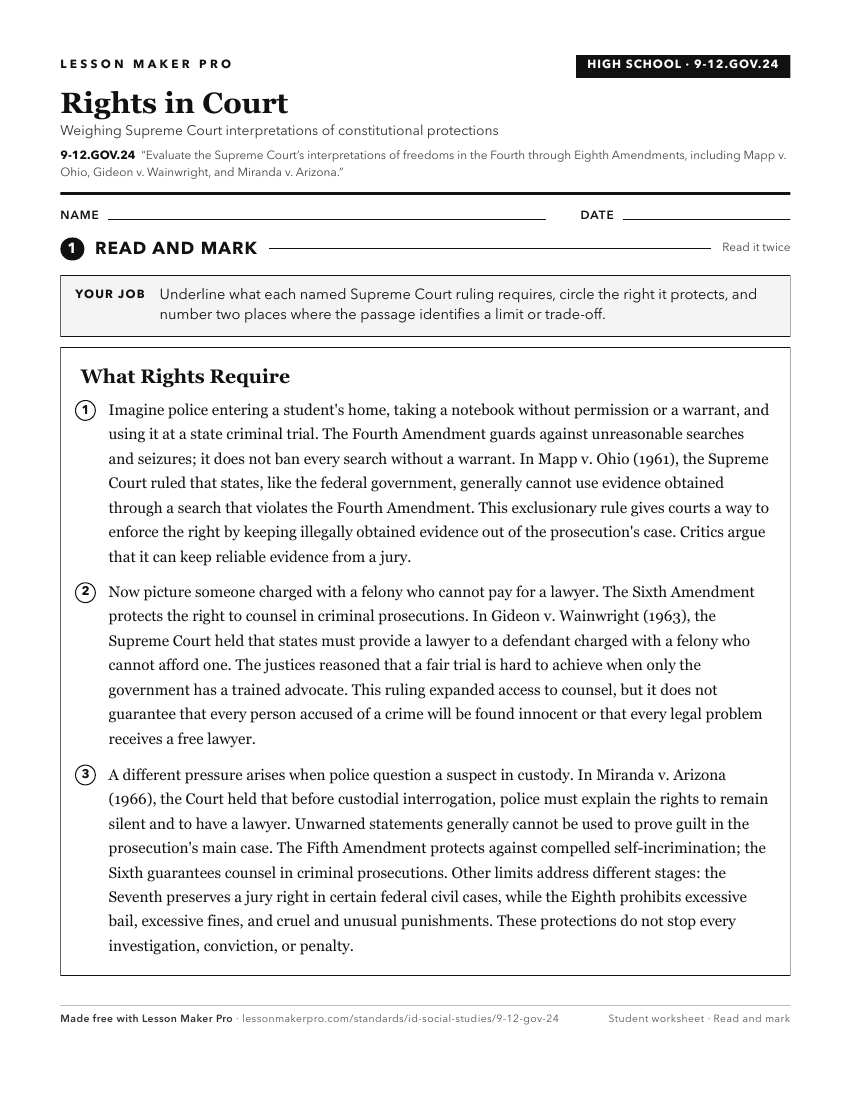
A ready-to-print activity worksheet aligned to 9-12.GOV.24, with an answer key for the teacher on its own page. No account needed.
PDF, US Letter, prints cleanly in black and white.
Download the worksheetKeep exploring
Related Standards
- 9-12.GOV.25
Evaluate the Supreme Court’s interpretations of the freedoms in the 14th Amendment, equal protection, and due process clauses including Plessy v. Ferguson, Roe ...
- 9-12.US2.46
Evaluate the progress of civil rights and immigration issues in recent United States history.
- 9-12.GOV.23
Evaluate the Supreme Court’s interpretations of the freedoms articulated in the First Amendment, including Schenck v. United States, New York Times v. United St...
- 9-12.GOV.38
Analyze Article III of the Constitution as it relates to judicial power, including the length of terms and the jurisdiction of the U.S. Supreme Court.
Turn this exact standard into a lesson
Grade, subject, topic, and the complete standard are prefilled. Create one free, no account needed.
Also for this standard:Make a WorksheetMake a QuizMake a Sub Lesson