Idaho Social Studies 9-12.GOV.23
The Standard
Evaluate the Supreme Court’s interpretations of the freedoms articulated in the First Amendment, including Schenck v. United States, New York Times v. United States, Engel v. Vitale, Miller v. California, Tinker v. Des Moines, Texas v. Johnson, and Kennedy v. Bremerton.
Idaho Content Standards: K-12 Social Studies · Citizenship and Civic Participation
Teacher's field guide
What This Standard Means
What Students Need to Do
- Students explain how the Court has ruled on speech, press, and religion in different settings. They identify the facts that shaped each ruling and apply those rulings to new situations.
What Mastery Looks Like
- A student can explain what the Court protected or limited in each case and name a fact that mattered. They can explain why a school-led prayer and a coach's personal prayer received different rulings.
Common Misconceptions
- Students may think flag burning is unprotected or that any offensive material counts as obscenity. They may treat school-led prayer and private prayer as the same. Some assume the wartime speech test used in Schenck is the rule for all political speech today.
How to Assess It
- Exit ticket: A principal broadcasts a school-written prayer. After a game, a coach prays quietly on his own. Which case applies to each situation, and why?
Lesson moves
Ways to Teach It
Give pairs seven case cards with facts and rulings; have them sort the cards by freedom and circle the fact that shaped each decision.
Ask: Why did the Court uphold a conviction for anti-draft leaflets but protect students wearing black armbands? Cite one fact from each case.
Run a ruling-match relay with New York Times, Miller, and Texas v. Johnson cards; have teams state the rule that decided each case.
Compare a teacher leading class prayer with a coach praying alone after a game; have students apply Engel and Kennedy to each situation.
Free download
Printable 9-12.GOV.23 Worksheet
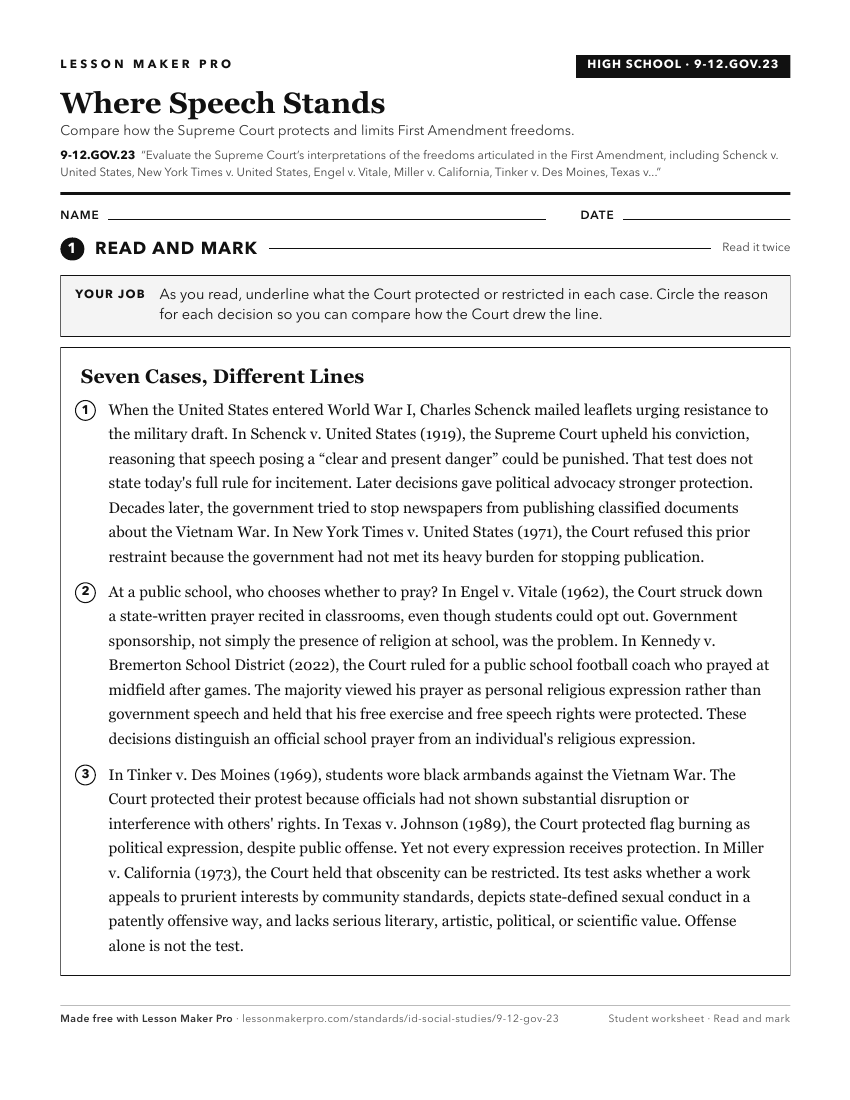
A ready-to-print activity worksheet aligned to 9-12.GOV.23, with an answer key for the teacher on its own page. No account needed.
PDF, US Letter, prints cleanly in black and white.
Download the worksheetKeep exploring
Related Standards
- 9-12.GOV.25
Evaluate the Supreme Court’s interpretations of the freedoms in the 14th Amendment, equal protection, and due process clauses including Plessy v. Ferguson, Roe ...
- 9-12.GOV.24
Evaluate the Supreme Court’s interpretations of freedoms in the Fourth through Eighth Amendments, including Mapp v. Ohio, Gideon v. Wainwright, and Miranda v. A...
- 9-12.GOV.42
Compare and contrast different judicial philosophies including activism vs. conservatism, originalism vs. living constitution, and textualism.
- 9-12.GOV.38
Analyze Article III of the Constitution as it relates to judicial power, including the length of terms and the jurisdiction of the U.S. Supreme Court.
Turn this exact standard into a lesson
Grade, subject, topic, and the complete standard are prefilled. Create one free, no account needed.
Also for this standard:Make a WorksheetMake a QuizMake a Sub Lesson