Idaho Social Studies 6-9.WH.1.1
The Standard
Analyze types of evidence used by anthropologists, archaeologists, and other scholars to reconstruct early human and cultural development.
Idaho Content Standards: K-12 Social Studies
Teacher's field guide
What This Standard Means
What Students Need to Do
- Students examine fossils, tools, cave art, and ancient DNA to learn about early humans. They explain what each type of evidence can show about bodies, movement, and daily life, and what it cannot show.
What Mastery Looks Like
- A student can use details from a stone tool to support a claim about toolmaking. They can explain why a fossil skull helps scholars study physical traits but cannot reveal a person's beliefs.
Common Misconceptions
- Students may call a stone tool a fossil instead of a human-made artifact. They may think a cave painting proves exactly what its makers believed, or that DNA reveals how people lived each day.
How to Assess It
- Show a photo of a stone blade and a fossil skull. Ask students to write one thing each could tell scholars about early humans and one thing neither could tell them for sure.
Lesson moves
Ways to Teach It
Have groups sort photo cards of a skull, stone blade, and cave painting, then write one supported inference for each.
Ask, 'Can beads in a grave prove people believed in an afterlife?' Have students write one possible inference and one reason for caution.
Play evidence match: pair worn teeth, burnt animal bones, and ancient DNA with possible claims about diet, cooking, and migration.
Show a museum label for a prehistoric tool; ask students to underline the evidence behind one claim and circle a word that signals uncertainty.
Free download
Printable 6-9.WH.1.1 Worksheet
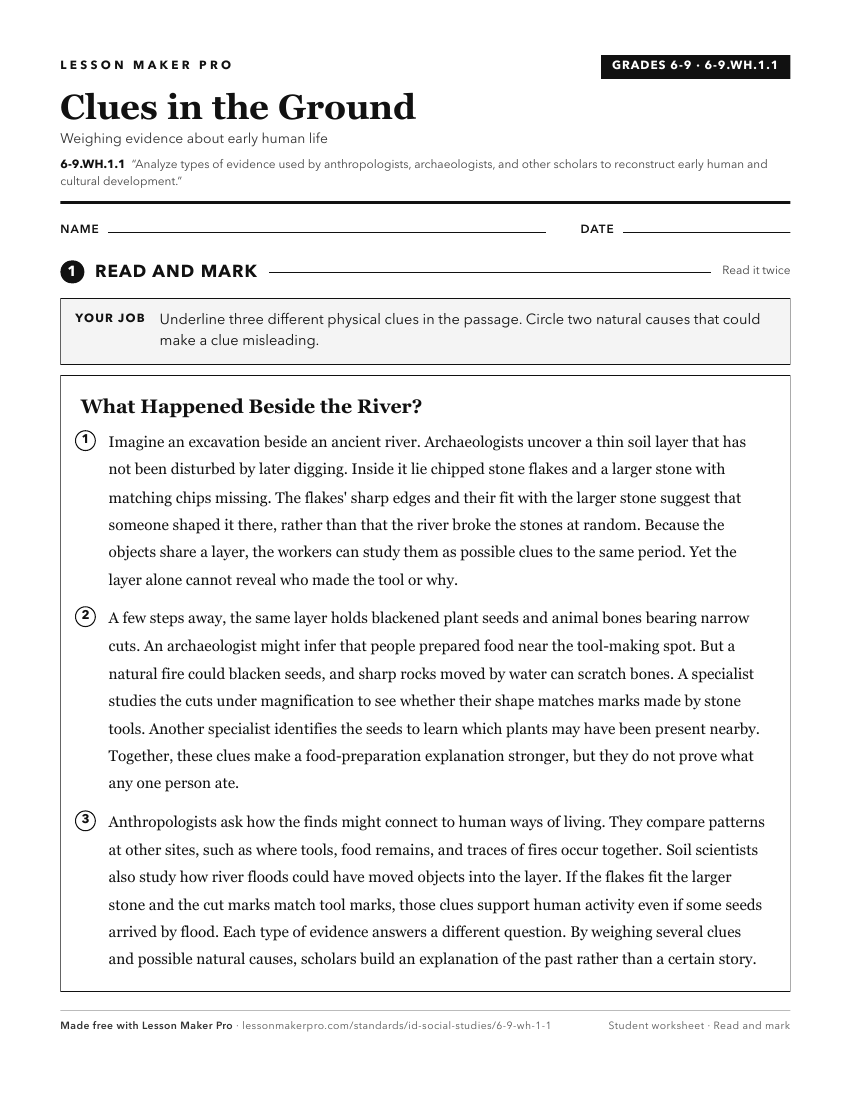
A ready-to-print activity worksheet aligned to 6-9.WH.1.1, with an answer key for the teacher on its own page. No account needed.
PDF, US Letter, prints cleanly in black and white.
Download the worksheetKeep exploring
Related Standards
- 6-9.WH.6.1
Synthesize evidence from information sources including, but not limited to artifacts, primary and secondary sources, charts, graphs, and/ or images to interpret...
- 6-9.WH.1.4
Analyze the characteristics of early civilizations throughout the world including government, religion/belief systems, arts/architecture, technology, physical g...
- 6-12.HT2.8
Construct historical arguments distinguishing the differences between long-term causes and triggering events using evidence from multiple relevant historical so...
- 6-9.WH.1.8
Analyze different social classes and their impact on societies and civilizations throughout the world, including Ancient, Middle Age, Early-Modern, and Modern.
Turn this exact standard into a lesson
Grade, subject, topic, and the complete standard are prefilled. Create one free, no account needed.
Also for this standard:Make a WorksheetMake a QuizMake a Sub Lesson