Idaho Social Studies 6-9.WG.2.14
The Standard
Give examples of how landforms, water, climate, and natural vegetation have influenced historical trends and developments in regions throughout the world.
Idaho Content Standards: K-12 Social Studies
Teacher's field guide
What This Standard Means
What Students Need to Do
- Students explain how land, water, climate, and vegetation shaped where people lived, farmed, and traded. They give examples from different world regions and explain the link between a physical feature and a human choice.
What Mastery Looks Like
- A student can explain how Nile floods supported farming and settlements in ancient Egypt. They can also explain how monsoon winds shaped sailing between East Africa and India.
Common Misconceptions
- Students may treat deserts and mountains as complete barriers, missing oasis routes and mountain passes. They may name a feature without explaining how it affected people's choices.
How to Assess It
- Give students a map of ancient Egypt showing the Nile and several settlements. Ask: "Why did these settlements grow near the river, and how did the river help farmers?"
Lesson moves
Ways to Teach It
Overlay tracing paper on a physical map of Egypt, trace the Nile and desert, then mark likely ancient settlement sites.
Show a monsoon wind map and ask students how seasonal winds affected trade between East Africa and India.
Give pairs cards labeled Nile floods, Sahara oases, Andean slopes, and monsoon winds to match with farming, caravans, terraces, and sailing.
On a current map of Egypt, circle towns along the Nile and explain why river access mattered then and now.
Free download
Printable 6-9.WG.2.14 Worksheet
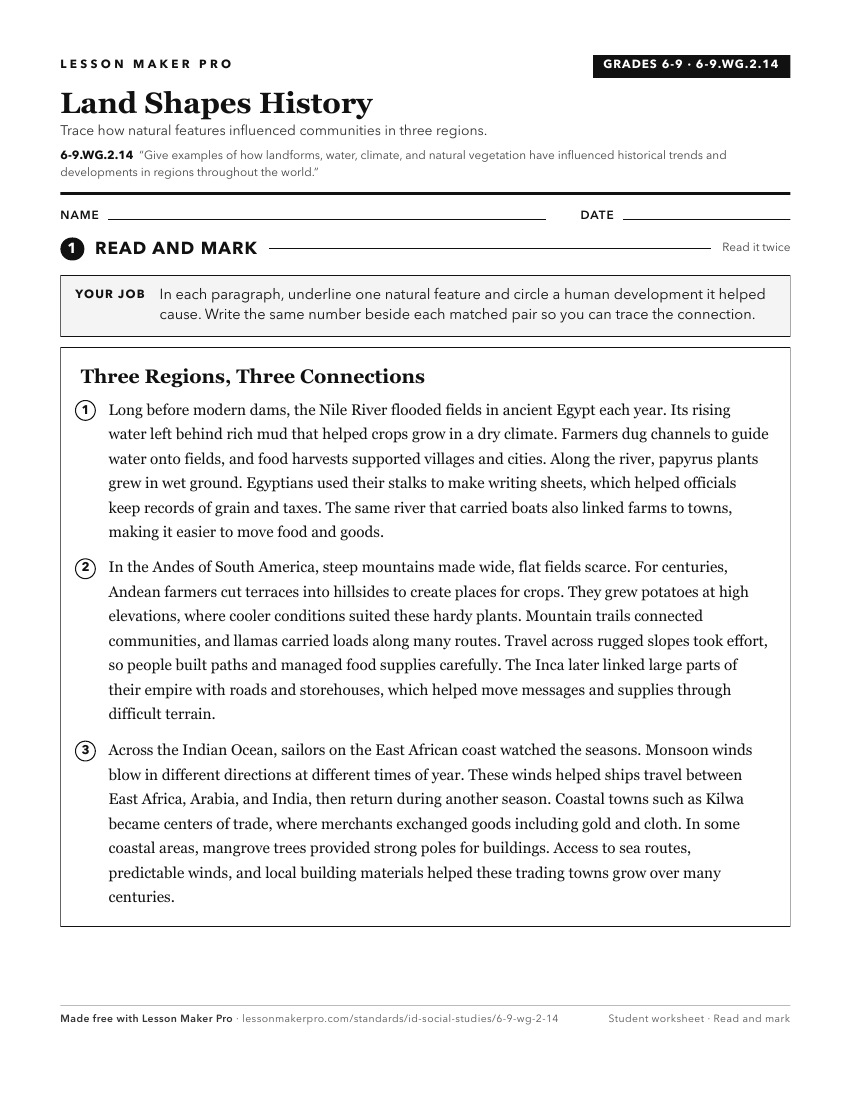
A ready-to-print activity worksheet aligned to 6-9.WG.2.14, with an answer key for the teacher on its own page. No account needed.
PDF, US Letter, prints cleanly in black and white.
Download the worksheetKeep exploring
Related Standards
- 6-9.WG.2.8
Describe major physical characteristics of regions throughout the world.
- 6-9.WG.5.2
Give examples of how language, literature, and the arts shape the development and transmission of culture in regions throughout the world.
- 6-9.WG.2.13
Give examples of how both natural and technological hazards have impacted the physical environment and human populations in regions throughout the world.
- 6-9.WH.2.4
Describe how physical features, such as mountain ranges, fertile plains, and rivers led to the development of cultural regions.
Turn this exact standard into a lesson
Grade, subject, topic, and the complete standard are prefilled. Create one free, no account needed.
Also for this standard:Make a WorksheetMake a QuizMake a Sub Lesson