Idaho Social Studies 6-9.WG.2.13
The Standard
Give examples of how both natural and technological hazards have impacted the physical environment and human populations in regions throughout the world.
Idaho Content Standards: K-12 Social Studies
Teacher's field guide
What This Standard Means
What Students Need to Do
- Students identify natural hazards, such as Japan's 2011 tsunami, and technological hazards, such as the 2010 Gulf oil spill. They explain how each changed land or water and affected people.
What Mastery Looks Like
- Students can locate each event on a map and name a specific environmental change and human consequence. They explain that the tsunami flooded coastal land and displaced families, while the oil spill polluted Gulf waters and closed fishing grounds.
Common Misconceptions
- Students may call the Fukushima reactor accident a natural hazard because an earthquake triggered it. They may name damaged buildings but overlook polluted water, lost homes, or lost work.
How to Assess It
- Give students a blank world map. Ask them to locate Japan and the Gulf of Mexico, then name each hazard type, one change to land or water, and one effect on people.
Lesson moves
Ways to Teach It
On a printed world map, place impact cards for the 2011 Japan tsunami and 2010 Gulf oil spill beside each location.
Show photos of Japan's flooded coastline and Louisiana's oil-coated marshes; ask, 'How might each change affect nearby families and workers?'
Play a card sort matching Haiti's 2010 earthquake and the 2010 Gulf oil spill to hazard types, environmental changes, and human effects.
On a local flood-risk map, find a road in a floodplain; predict one physical change and one problem for people using it.
Free download
Printable 6-9.WG.2.13 Worksheet
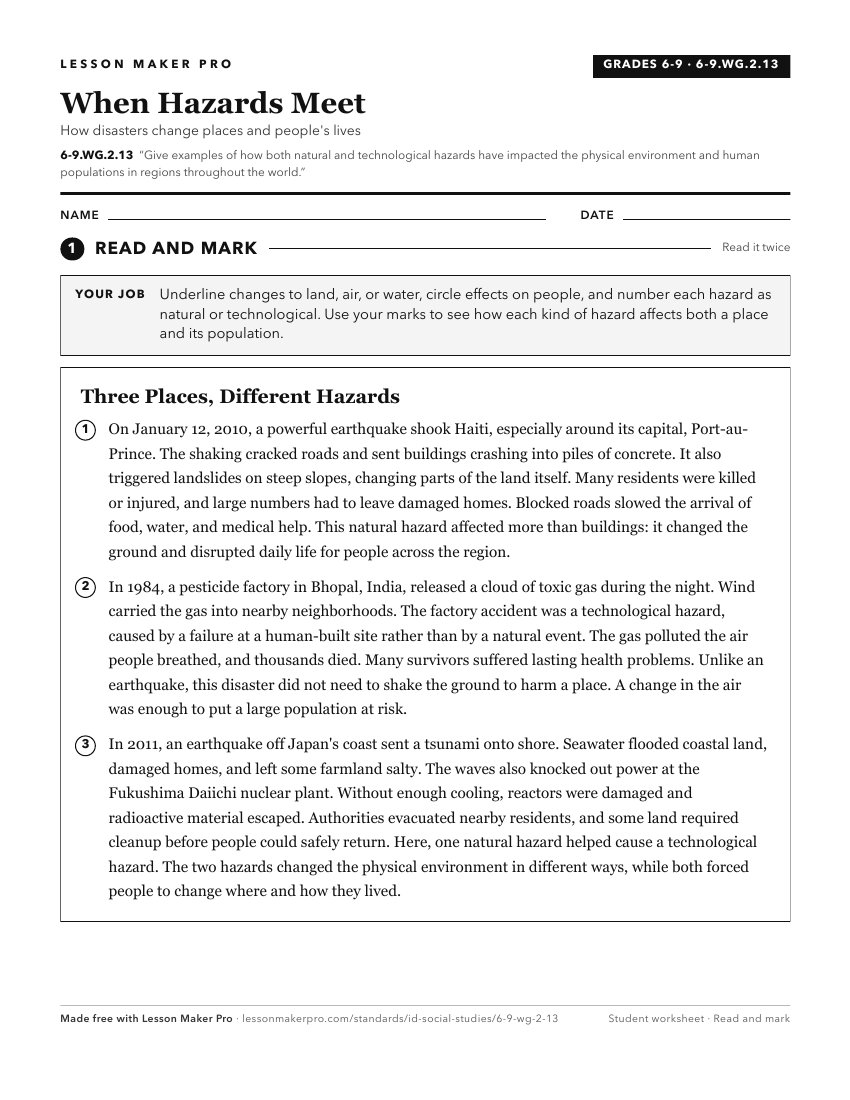
A ready-to-print activity worksheet aligned to 6-9.WG.2.13, with an answer key for the teacher on its own page. No account needed.
PDF, US Letter, prints cleanly in black and white.
Download the worksheetKeep exploring
Related Standards
- 6-9.WG.2.15
Describe various views that affect environmental issues in regions throughout the world.
- 6-9.WG.2.14
Give examples of how landforms, water, climate, and natural vegetation have influenced historical trends and developments in regions throughout the world.
- 6-9.WG.2.6
Analyze and give examples of the consequences of human impact on the physical environment, including the role of technology.
- 6-9.WG.2.16
Explain how human-caused changes in the physical environment in one place can cause changes in another place such as irrigation, air pollution, water pollution,...
Turn this exact standard into a lesson
Grade, subject, topic, and the complete standard are prefilled. Create one free, no account needed.
Also for this standard:Make a WorksheetMake a QuizMake a Sub Lesson