Idaho Social Studies 6-9.WH.2.4
The Standard
Describe how physical features, such as mountain ranges, fertile plains, and rivers led to the development of cultural regions.
Idaho Content Standards: K-12 Social Studies
Teacher's field guide
What This Standard Means
What Students Need to Do
- Students use maps to connect land and water to where people settled and how they traveled. They explain how those patterns helped communities share practices or limited contact between them.
What Mastery Looks Like
- A student can use a map to explain how the Nile supported farming and travel between towns. They can also explain how mountains made contact between some communities harder, without claiming travel was impossible.
Common Misconceptions
- Students may think rivers only divide people, rather than also providing travel routes. They may assume mountains stop all contact or that fertile land makes every community develop the same customs.
How to Assess It
- On an exit ticket, show a map of the Nile and nearby desert. Ask: How could this landscape help towns along the river develop shared farming practices? Use two map details.
Lesson moves
Ways to Teach It
Place tracing paper over a Nile map, then mark the river, desert, towns, and likely routes for people to exchange crops and ideas.
Ask: Why might towns along one river share farming practices while towns separated by mountains develop different ones? Use two map details.
Give pairs Nile and Andes maps; have them match feature cards to settlement patterns and explain each match.
Show a Louisiana bayou map and a Cajun fishing village photo; ask how waterways support fishing and local seafood dishes.
Free download
Printable 6-9.WH.2.4 Worksheet
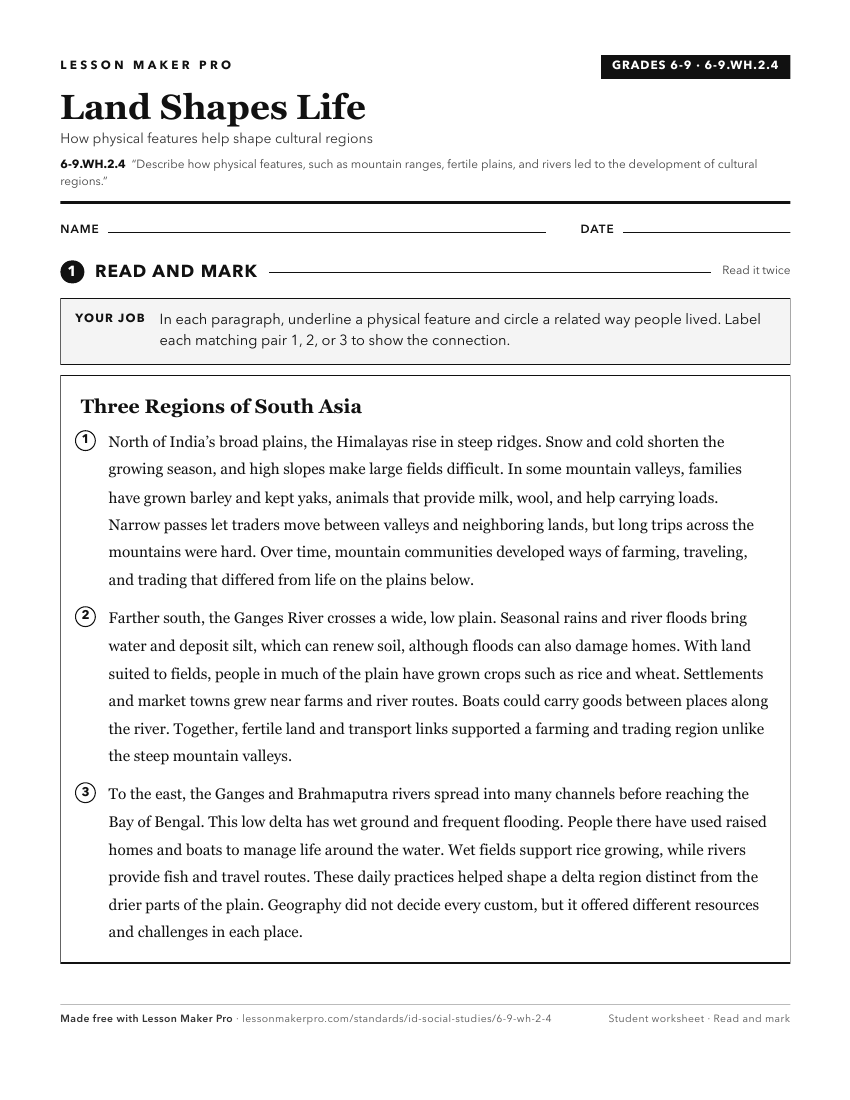
A ready-to-print activity worksheet aligned to 6-9.WH.2.4, with an answer key for the teacher on its own page. No account needed.
PDF, US Letter, prints cleanly in black and white.
Download the worksheetKeep exploring
Related Standards
- 6-9.WG.2.8
Describe major physical characteristics of regions throughout the world.
- 6-9.WG.5.2
Give examples of how language, literature, and the arts shape the development and transmission of culture in regions throughout the world.
- 2.SS.2.1.e
identifying major rivers, mountain ranges, lakes, and other physical features
- 6-9.WG.2.14
Give examples of how landforms, water, climate, and natural vegetation have influenced historical trends and developments in regions throughout the world.
Turn this exact standard into a lesson
Grade, subject, topic, and the complete standard are prefilled. Create one free, no account needed.
Also for this standard:Make a WorksheetMake a QuizMake a Sub Lesson