Idaho Social Studies 6-12.US1.44
The Standard
Identify how continued land and natural resource competition affected political, cultural, and economic development of the western United States, including, but not limited to: • Homestead Act of 1862 • Transcontinental Railroad • Fur trade, cattle drives, end of “open range” era, destruction of the bison population • Land Rush of 1889
Idaho Content Standards: K-12 Social Studies · Civil War and Reconstruction 1860s-1890
Teacher's field guide
What This Standard Means
What Students Need to Do
- Students trace how settlers, railroad companies, ranchers, fur traders, and Native nations competed for land, grazing, and wildlife in the West. They explain who gained land and income, who lost access, and how federal policies shaped those changes.
What Mastery Looks Like
- A student can link the Homestead Act and railroad to settlement, land claims, and Native displacement. They can explain how fur trading, cattle drives, bison hunting, and fencing changed work and Native life. They can explain why land opened for the 1889 Oklahoma land rush was not empty.
Common Misconceptions
- Students may describe western land as empty and the 1889 land rush as harmless settlement. They may think bison disappeared naturally or that barbed wire ended cattle ranching, rather than ending unfenced grazing. They may see the railroad only as a source of jobs and miss its role in Native displacement.
How to Assess It
- Exit ticket: How did the Homestead Act and railroad change who controlled land and earned money in the West? Add one effect of bison loss on Native communities.
Lesson moves
Ways to Teach It
Use colored pencils on a western map to mark the railroad, cattle trails, former bison range, and land opened in Oklahoma in 1889.
Give students a homestead advertisement and a Native account of land loss; ask, "Who describes the land as available, and who disagrees?"
Make event-and-effect cards for fur trading, the railroad, barbed wire, and bison hunting; students match each event to a political, cultural, or economic change.
Compare an 1880 cattle trail map with a current Bureau of Land Management grazing allotment map; identify who sets grazing boundaries today.
Free download
Printable 6-12.US1.44 Worksheet
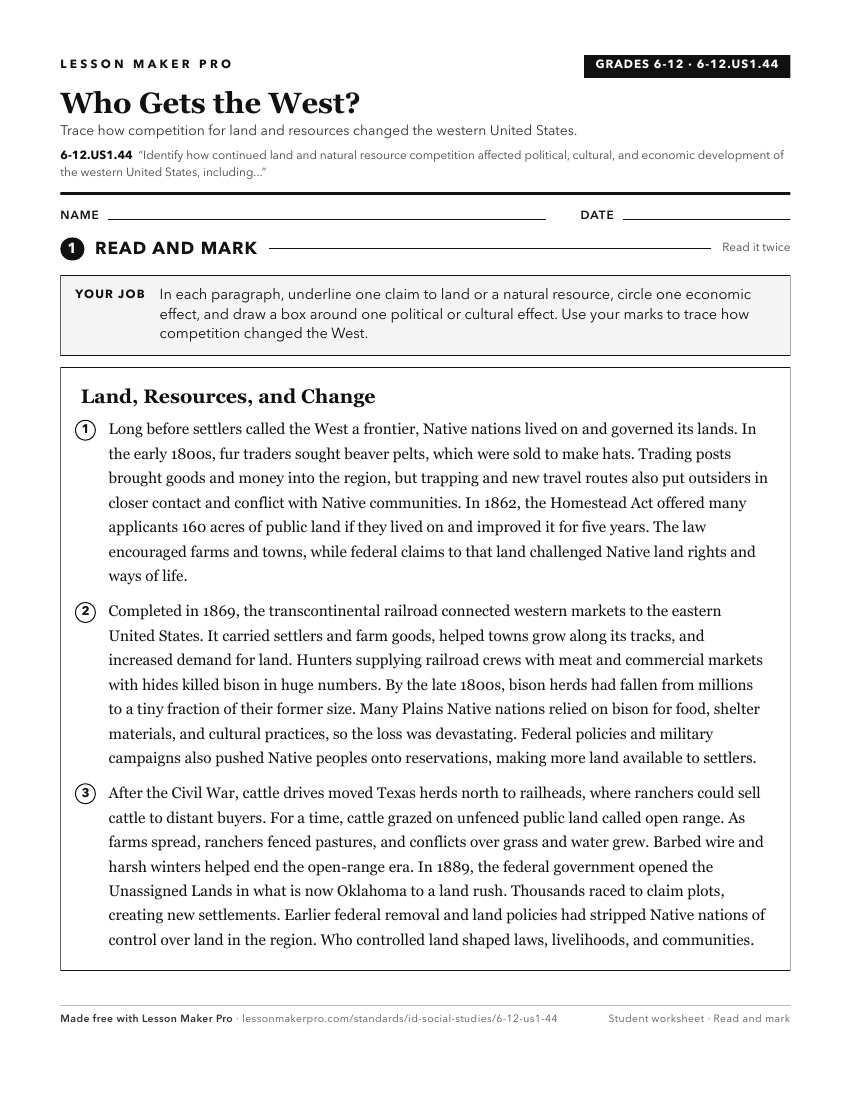
A ready-to-print activity worksheet aligned to 6-12.US1.44, with an answer key for the teacher on its own page. No account needed.
PDF, US Letter, prints cleanly in black and white.
Download the worksheetKeep exploring
Related Standards
- 6-12.US1.29
Analyze the political and individual motivations and the social, political, economic, environmental impacts of individuals who moved West.
- 6-12.US1.35
Describe the policies, motivations, and events, and subsequent policies that led to the westward expansion of the United States from 1820-1860, including, but n...
- 6-12.US1.30
Describe the impact of westward expansion, treaties, and federal policies on American-tribal relations including, but not limited to a discussion of:
- 4.SS.1.3
Identify the impact on western expansion and the creation of the State of Idaho through contributions of major groups, including but not limited to explorers, m...
Turn this exact standard into a lesson
Grade, subject, topic, and the complete standard are prefilled. Create one free, no account needed.
Also for this standard:Make a WorksheetMake a QuizMake a Sub Lesson