Idaho Social Studies 6-12.US1.30
The Standard
Describe the impact of westward expansion, treaties, and federal policies on American-tribal relations including, but not limited to a discussion of: • Indian Removal Act of 1830 • Cherokee Nation v. Georgia • Trail of Tears • Five Civilized Tribes • Establishment of Indian Territory and other reservations • Americanization/assimilation
Idaho Content Standards: K-12 Social Studies · Geographic Expansion and Political and Social Changes 1820-1860
Teacher's field guide
What This Standard Means
What Students Need to Do
- Students trace how demand for land, federal policy, and disputed treaties forced tribal nations from their homelands. They explain the Cherokee court case, forced removal, and the creation of Indian Territory and reservations. They describe pressure on tribes to adopt settler customs.
What Mastery Looks Like
- A student can explain that the Supreme Court declined to hear the Cherokee Nation's case and that a disputed treaty was used to justify removal. They can locate the homelands of the Cherokee, Choctaw, Chickasaw, Muscogee, and Seminole nations and Indian Territory on a map. They can connect removal to deaths, lost land, and limits on self-government.
Common Misconceptions
- Students may think all five nations agreed to leave or that only Cherokee people endured forced removal. Some assume adopting English or settler farming protected tribes from removal. Others think the Supreme Court ordered the Cherokee to leave.
How to Assess It
- Exit ticket: Why did the Cherokee Nation's court case not stop removal? Name one effect of the Trail of Tears on Cherokee communities.
Lesson moves
Ways to Teach It
Give students blank U.S. maps, a labeled 1830 homelands map, and colored pencils; have them trace removal routes to Indian Territory.
Read a short summary of Cherokee Nation v. Georgia; ask why the Court declined the case and what options remained for Cherokee leaders.
Hand out cards for the 1830 act, 1831 ruling, 1835 treaty, and 1838 removal; teams sequence them and explain each link.
Compare an 1830s Indian Territory map with a current Oklahoma tribal jurisdiction map; identify one difference and investigate why it changed.
Free download
Printable 6-12.US1.30 Worksheet
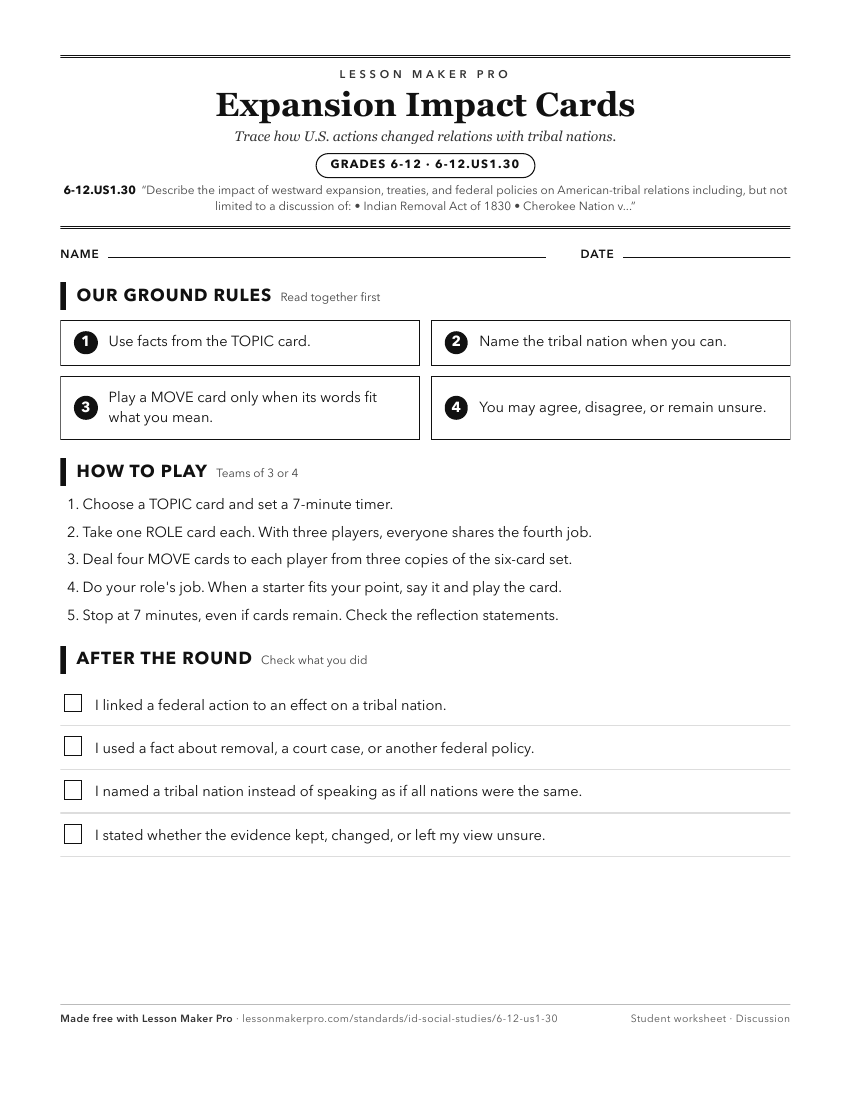
A ready-to-print activity worksheet aligned to 6-12.US1.30, with an answer key for the teacher on its own page. No account needed.
PDF, US Letter, prints cleanly in black and white.
Download the worksheetKeep exploring
Related Standards
- 6-12.US1.23
Describe how American westward expansion during the Early Republic affected tribal relations; understand how intertribal relations lead to American alliances wi...
- 6-12.US1.31
Trace and explain how settlement patterns, federal policies, and treaties impacted American Indians through reservations, removal, and forced assimilation.
- 4.SS.1.5
Describe the federal policies and the motivations that led to westward expansion and subsequent consequences that impacted American Indian tribes in Idaho.
- 9-12.US2.1
Analyze how federal policies established the relationship between the United States government and American Indian tribes, and the intended and unintended outco...
Turn this exact standard into a lesson
Grade, subject, topic, and the complete standard are prefilled. Create one free, no account needed.
Also for this standard:Make a WorksheetMake a QuizMake a Sub Lesson