Idaho Social Studies 6-12.US1.23
The Standard
Describe how American westward expansion during the Early Republic affected tribal relations; understand how intertribal relations lead to American alliances with the Muscogee, Choctaw, Cherokee, and Chickasaw and how other tribal confederacies formed to resist American expansion with the support of foreign European powers, including, but not limited to a discussion of: • Lewis and Clark Expedition • The Northwest Indian War, including St. Clair’s Defeat and the Battle of Fallen Timbers • Tecumseh’s Rebellion • Creek War • First Seminole War • Cherokee delegation to Washington (1824)
Idaho Content Standards: K-12 Social Studies · Early Republic 1787-1825
Teacher's field guide
What This Standard Means
What Students Need to Do
- Students describe how U.S. expansion and the Lewis and Clark expedition affected Native nations. They explain how relations among Native nations shaped alliances with the U.S. and resistance to it. They connect wars in the Northwest and South to land pressure and foreign support.
What Mastery Looks Like
- A student can explain that some Muscogee, Choctaw, Cherokee, and Chickasaw leaders allied with the U.S., while others resisted. They can place St. Clair's Defeat before Fallen Timbers and identify it as a U.S. loss. They can explain why Tecumseh sought British support and why Cherokee delegates went to Washington in 1824.
Common Misconceptions
- Students may treat Native nations as one group with one position on U.S. expansion. They may call St. Clair's Defeat a Native loss, though U.S. forces lost. They may assume British aid meant Tecumseh's confederacy fought under British orders.
How to Assess It
- Exit ticket: Why did some Muscogee leaders fight alongside U.S. forces in the Creek War while others resisted? Name one effect on relations among Native nations.
Lesson moves
Ways to Teach It
Lay a transparent Lewis and Clark route map over an 1804 tribal homelands map; pairs label three nations the expedition encountered.
Ask, 'Why did some Muscogee leaders fight alongside U.S. troops in the Creek War while others fought against them?'
Give pairs cards for St. Clair's Defeat, Fallen Timbers, Tippecanoe, the Creek War, and the First Seminole War; students sequence them.
Compare 1824 and current Cherokee Nation maps; students label each location and write one question about land rights.
Free download
Printable 6-12.US1.23 Worksheet
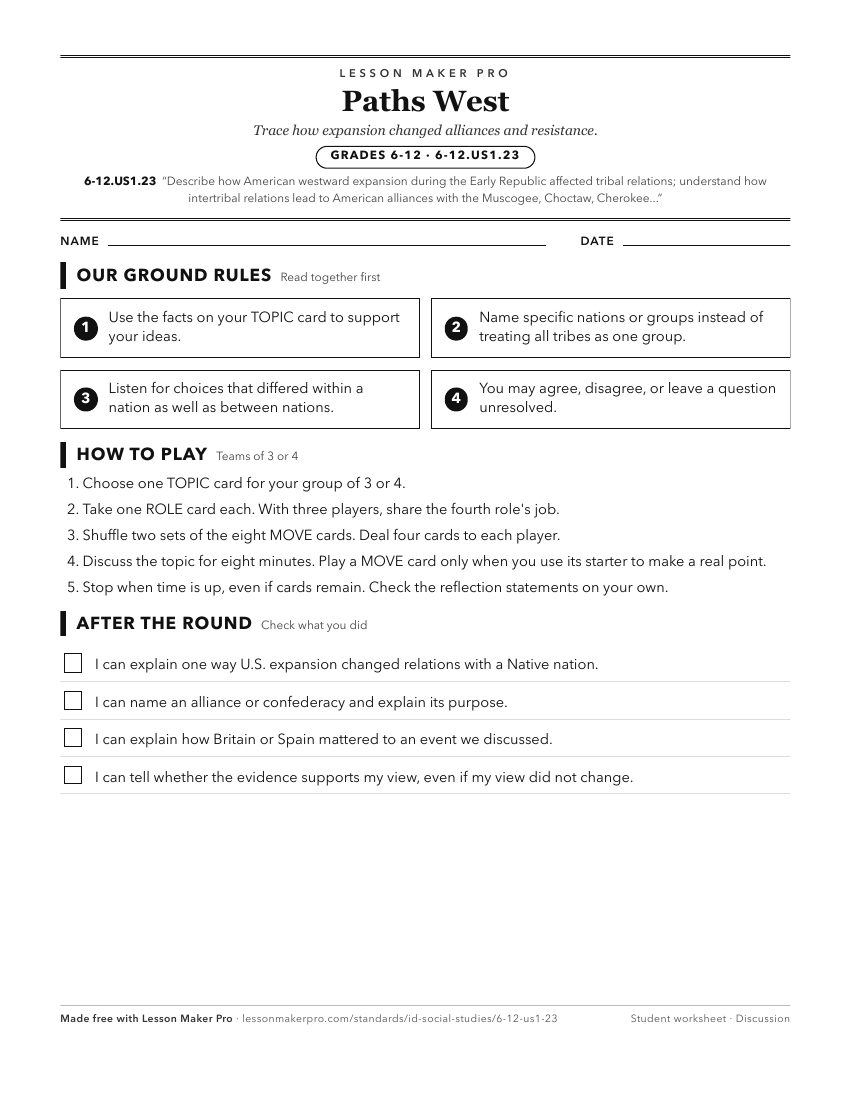
A ready-to-print activity worksheet aligned to 6-12.US1.23, with an answer key for the teacher on its own page. No account needed.
PDF, US Letter, prints cleanly in black and white.
Download the worksheetKeep exploring
Related Standards
- 6-12.US1.8
Analyze how the French and Indian War influenced British imperial policies, North American-Indian alliances, and the colonial response to these policies, includ...
- 6-12.US1.30
Describe the impact of westward expansion, treaties, and federal policies on American-tribal relations including, but not limited to a discussion of:
- 6-12.US1.48
Describe relations between American Indians and the United States government following the Civil War, including conflict, treaties, containment, reservation, an...
- 5.SS.1.10
Review that American Indians were the first inhabitants of the United States and analyze the impact of westward expansion on North American tribes.
Turn this exact standard into a lesson
Grade, subject, topic, and the complete standard are prefilled. Create one free, no account needed.
Also for this standard:Make a WorksheetMake a QuizMake a Sub Lesson