Idaho Social Studies 6-12.US1.35
The Standard
Describe the policies, motivations, and events, and subsequent policies that led to the westward expansion of the United States from 1820-1860, including, but not limited to: • Manifest Destiny • Texas Revolution and annexation • Mexican American War • Expeditions of John C. Fremont • California Gold Rush • Acquisition of Oregon Territory • Acquisition of Alaska Territory • Oregon, California, Sante Fe, and Mormon Trails
Idaho Content Standards: K-12 Social Studies · Geographic Expansion and Political and Social Changes 1820-1860
Teacher's field guide
What This Standard Means
What Students Need to Do
- Students map how Texas annexation, the Mexican-American War, and the Oregon Treaty changed U.S. borders. They explain how Manifest Destiny, Fremont's reports, the Gold Rush, and western trails encouraged migration. They describe effects on Native nations and slavery debates, and place Alaska's purchase in 1867.
What Mastery Looks Like
- On a map and timeline, students place Texas annexation in 1845, the Oregon Treaty in 1846, the Mexican Cession in 1848, and Alaska's purchase in 1867. They match the Oregon, California, Santa Fe, and Mormon Trails to reasons for travel. They explain one result, such as California's statehood under the Compromise of 1850 or Native land loss.
Common Misconceptions
- Students often confuse Texas independence in 1836 with U.S. annexation in 1845. They may think the Santa Fe Trail was mainly for settlers, rather than trade, or place Alaska's purchase before 1860. Some describe western lands as empty, overlooking Native nations and Mexican residents.
How to Assess It
- Give students four cards labeled Texas annexation, Oregon Treaty, Mexican Cession, and Alaska purchase. Ask them to put the cards in date order, identify which falls after 1860, and write one effect of the Mexican Cession.
Lesson moves
Ways to Teach It
Give pairs a blank map and four colored pencils to shade Texas, Oregon, the Mexican Cession, and Alaska, then add acquisition dates.
Ask students to write: How did Manifest Destiny help justify the Mexican-American War, and how did the war affect Mexican residents and Native nations?
Run a trail sort: match Oregon, California, Santa Fe, and Mormon Trail cards to settlement, gold, trade, and religious migration.
Trace the Oregon Trail and Interstate 84 across southern Idaho on a map, then label the Snake River, which guided both routes.
Free download
Printable 6-12.US1.35 Worksheet
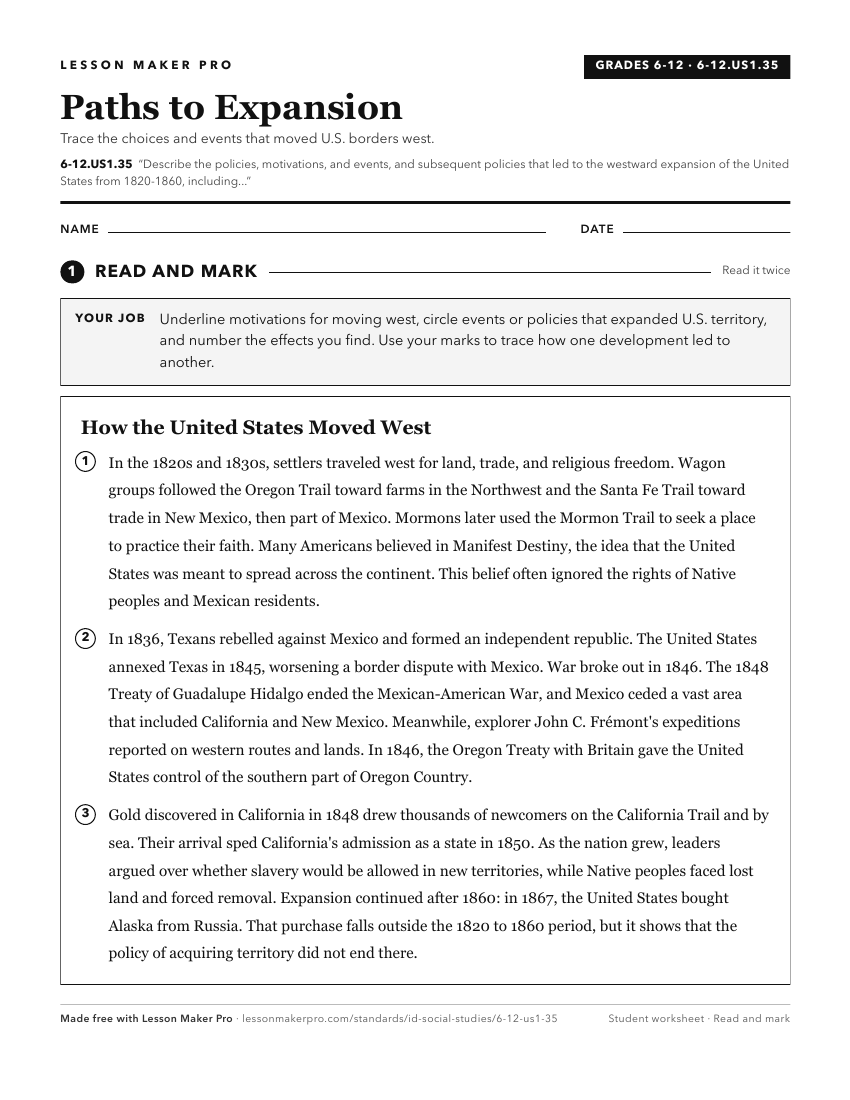
A ready-to-print activity worksheet aligned to 6-12.US1.35, with an answer key for the teacher on its own page. No account needed.
PDF, US Letter, prints cleanly in black and white.
Download the worksheetKeep exploring
Related Standards
- 6-12.US1.44
Identify how continued land and natural resource competition affected political, cultural, and economic development of the western United States, including, but...
- 6-12.US1.29
Analyze the political and individual motivations and the social, political, economic, environmental impacts of individuals who moved West.
- 6-12.US1.30
Describe the impact of westward expansion, treaties, and federal policies on American-tribal relations including, but not limited to a discussion of:
- 4.SS.1.5
Describe the federal policies and the motivations that led to westward expansion and subsequent consequences that impacted American Indian tribes in Idaho.
Turn this exact standard into a lesson
Grade, subject, topic, and the complete standard are prefilled. Create one free, no account needed.
Also for this standard:Make a WorksheetMake a QuizMake a Sub Lesson