Idaho Social Studies 3.SS.2.4
The Standard
Compare and contrast city/suburb/town and urban/rural farm/factory, as well as agriculture/industry.
Idaho Content Standards: K-12 Social Studies
Teacher's field guide
What This Standard Means
What Students Need to Do
- Students compare cities, suburbs, and towns by looking at buildings, space, and jobs. They identify urban and rural features, then connect farms with agriculture and factories with industry.
What Mastery Looks Like
- Given photos, a student can identify a city, suburb, town, farm, and factory and point to a clue for each. They can describe which scenes look urban or rural and why. They explain that agriculture grows crops or raises animals, while factories make goods.
Common Misconceptions
- Students may think every town is rural and every factory is in a city. They may think agriculture and industry are places, rather than types of work.
How to Assess It
- Show photos of a city street, a suburb, a small town main street, a farm, and a factory. Ask students to label each photo, point out one urban or rural clue, and write how work on a farm differs from work in a factory.
Lesson moves
Ways to Teach It
Give pairs photo cards of a city, suburb, town, farm, and factory; have them sort the cards and mark visible clues with sticky notes.
Ask, “How is a small town different from a city, and how could either have a factory nearby?”
Play Clue Match: read “crops grown for sale” or “goods made by machines”; teams hold up agriculture or industry cards.
Use satellite view to find a city center, housing area, and farmland in your region; compare the buildings and open space.
Free download
Printable 3.SS.2.4 Worksheet
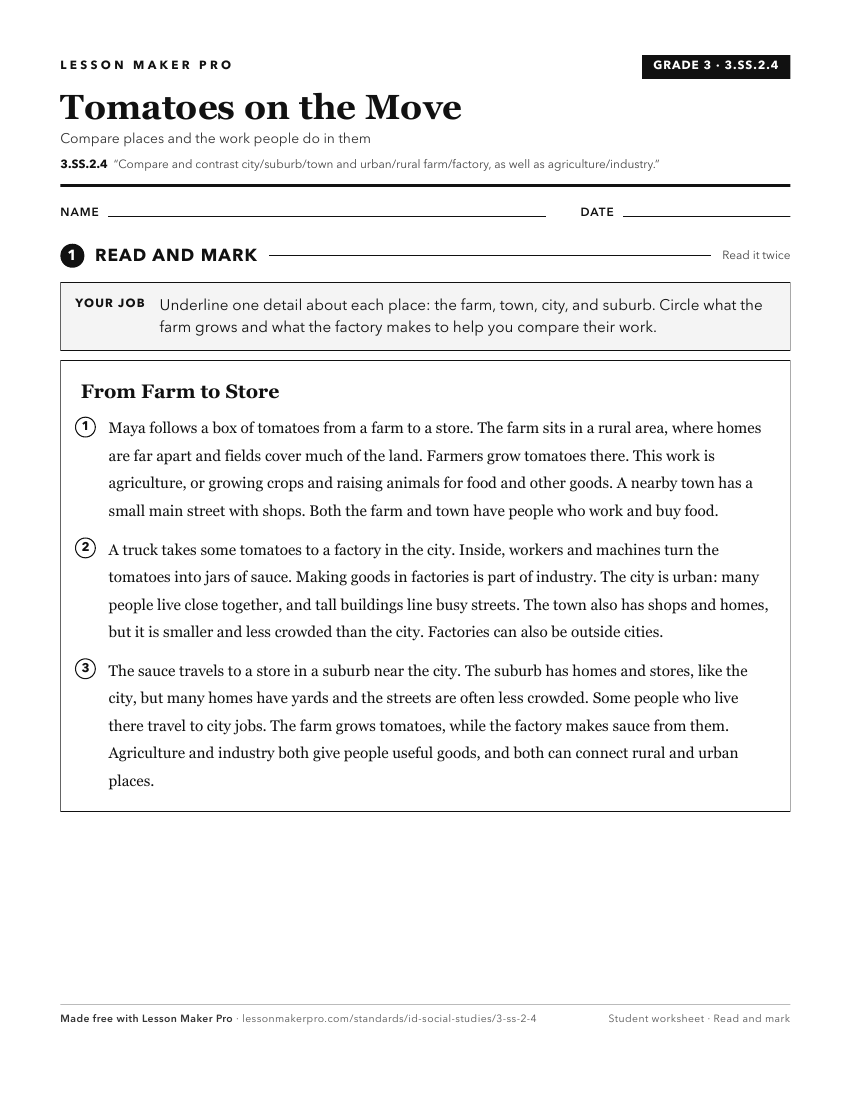
A ready-to-print activity worksheet aligned to 3.SS.2.4, with an answer key for the teacher on its own page. No account needed.
PDF, US Letter, prints cleanly in black and white.
Download the worksheetKeep exploring
Related Standards
- 2.SS.2.4
Define city/suburb/town and urban/rural.
- 2.SS.2.2
Compare how environmental conditions affect living styles and clothing in different parts of the country.
- 2.SS.3.3
Examine different types of producers and consumers as well as goods and services.
- 6-9.WG.2.11
Analyze the locations of the major manufacturing and agricultural areas in regions throughout the world.
Turn this exact standard into a lesson
Grade, subject, topic, and the complete standard are prefilled. Create one free, no account needed.
Also for this standard:Make a WorksheetMake a QuizMake a Sub Lesson