Georgia SS7H1.c
The Standard
- SS7H1
- Analyze continuity and change in Africa.
Explain the creation and end of apartheid in South Africa and the roles of Nelson Mandela and F.W.de Klerk.
Georgia Standards of Excellence for Social Studies · Analyze continuity and change in Africa.
Teacher's field guide
What This Standard Means
What Students Need to Do
- Students trace how racial segregation became a legal system after 1948 and how resistance weakened it. They explain how Mandela, de Klerk, negotiations, and public pressure contributed to democratic elections.
What Mastery Looks Like
- Students can build an accurate timeline from apartheid laws to the 1994 election. They describe Mandela’s leadership and negotiations, along with de Klerk’s legalization of opposition groups, release of political prisoners, and repeal of laws.
Common Misconceptions
- Students may treat apartheid as personal prejudice rather than a system enforced through laws. They may claim Mandela ended it alone or that de Klerk created it. They may also assume the 1994 election immediately erased inequality.
How to Assess It
- Exit ticket: Summarize the rise and fall of apartheid in four ordered steps. Include one action by Mandela and one by de Klerk.
Lesson moves
Ways to Teach It
Give pairs dated event cards to arrange from the 1948 election through Mandela’s release, negotiations, and the 1994 election.
Ask students to write: Which actions by Mandela and de Klerk made negotiation possible, and what pressures shaped their choices?
Run a cause, action, or effect sorting race using cards for laws, protests, sanctions, negotiations, and the 1994 election.
Compare a current South African inequality map with an apartheid-era residence map, then identify one lasting effect of enforced segregation.
Free download
Printable SS7H1.c Worksheet
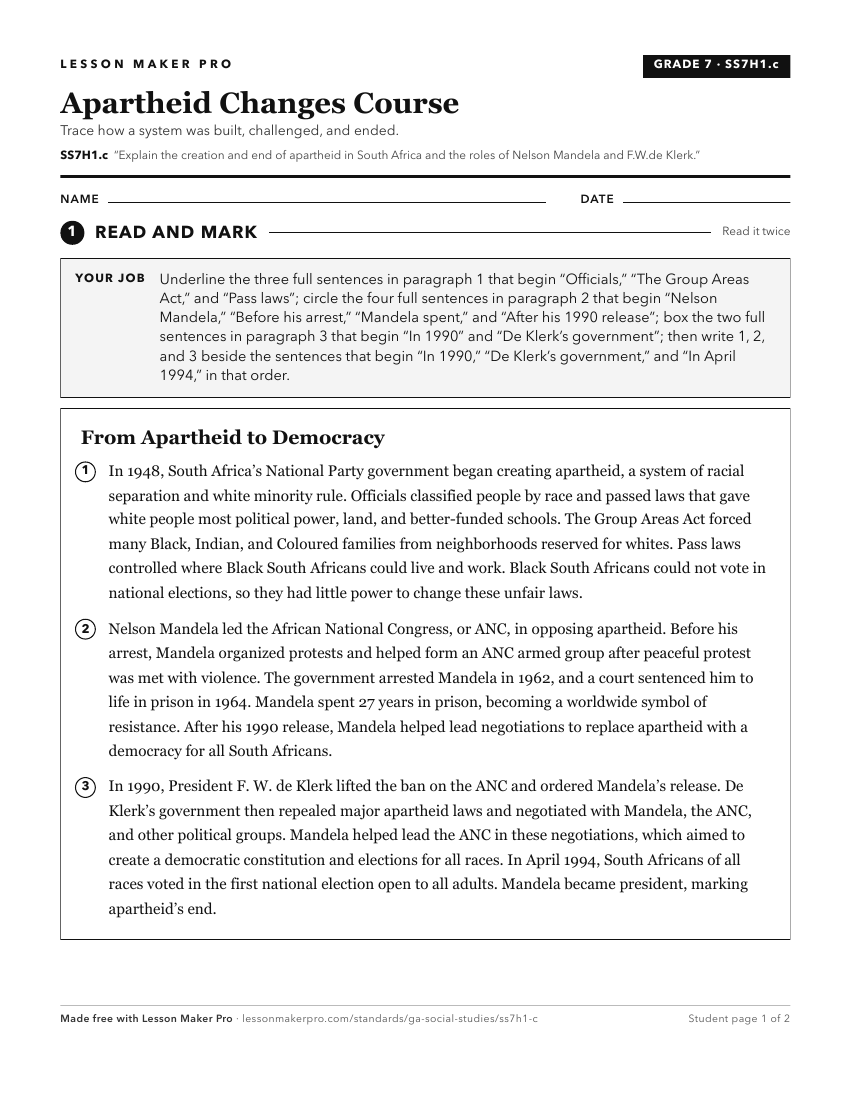
A ready-to-print activity worksheet aligned to SS7H1.c, with an answer key for the teacher on its own page. No account needed.
PDF, US Letter, prints cleanly in black and white.
Download the worksheetKeep exploring
Related Standards
- SS8H6.a
Explain the roles of the 13th, 14th, and 15th Amendments in Reconstruction.
- SS7H1.b
Explain how the Pan-African movement and nationalism led to independence in Kenya and Nigeria.
- SS7CG1.c
Explain the role of citizens in choosing the leaders of South Africa (parliamentary democracy), Nigeria (presidential democracy), and Kenya (presidential democr...
- SS4H6.c
Explain how slavery was replaced by sharecropping and how freed African Americans or Blacks were prevented from exercising their newly won rights.
Turn this exact standard into a lesson
Grade, subject, topic, and the complete standard are prefilled. Create one free, no account needed.
Also for this standard:Make a WorksheetMake a QuizMake a Sub Lesson