Georgia SS7G12.b
The Standard
- SS7G12
- Analyze the diverse cultural characteristics of the people who live in Southern and Eastern Asia.
Compare and contrast the belief systems originating in Southern and Eastern Asia: Buddhism, Hinduism, Shintoism, and Confucianism.
Georgia Standards of Excellence for Social Studies · Analyze the diverse cultural characteristics of the people who live in Southern and Eastern Asia.
Teacher's field guide
What This Standard Means
What Students Need to Do
- Students identify key beliefs and practices associated with Buddhism, Hinduism, Shinto, and Confucianism. They compare how each addresses duty, harmony, rebirth, ancestors, and the natural world.
What Mastery Looks Like
- A student can place details under the correct tradition and explain why. The student can name one accurate similarity and one meaningful difference between two or more traditions. Comparisons use specific beliefs or practices, not broad labels.
Common Misconceptions
- Students may call all four religions and miss that Confucianism is often described as an ethical and social philosophy. They may think Buddhism centers on worshipping Buddha, or that Hinduism has one founder and one required form of worship. They may also merge Shinto with Buddhism because both are practiced in Japan.
How to Assess It
- Exit ticket: Complete four rows by writing one defining belief or practice for each tradition. Then write one similarity and one difference between any two, using details from the rows.
Lesson moves
Ways to Teach It
Give pairs belief, practice, founder, and origin cards to sort beneath four labeled table tents, then require corrections using a reference sheet.
Ask students to write: How do Hinduism and Buddhism differ on rebirth, and how do Shinto and Confucianism each describe harmony?
Play four corners: read a belief or practice, students move to the matching tradition, then one student explains the match.
Analyze photos of a Shinto shrine, Hindu puja, Buddhist temple, and Confucian family rite, noting how beliefs shape visible practices.
Free download
Printable SS7G12.b Worksheet
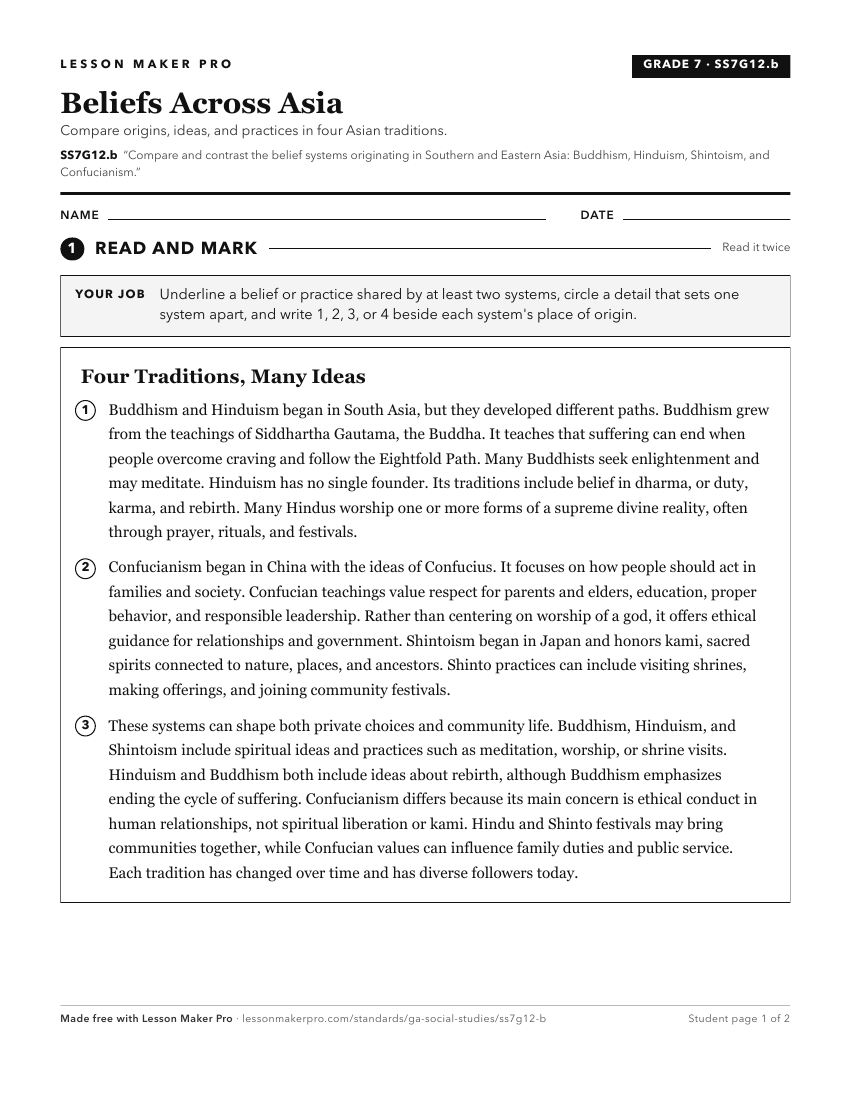
A ready-to-print activity worksheet aligned to SS7G12.b, with an answer key for the teacher on its own page. No account needed.
PDF, US Letter, prints cleanly in black and white.
Download the worksheetKeep exploring
Related Standards
- SS7H3
Analyze continuity and change in Southern and Eastern Asia.
- SS7E7.c
Compare and contrast the economic systems in China, India, Japan, North Korea, and South Korea.
- SS7G12
Analyze the diverse cultural characteristics of the people who live in Southern and Eastern Asia.
- SS7G8.c
Compare and contrast the prominent religions in Southwest Asia (Middle East): Judaism, Islam, and Christianity.
Turn this exact standard into a lesson
Grade, subject, topic, and the complete standard are prefilled. Create one free, no account needed.
Also for this standard:Make a WorksheetMake a QuizMake a Sub Lesson