Georgia SS6H3.b
The Standard
- SS6H3
- Explain conflict and change in Europe.
Explain the rise of Nazism including preexisting prejudices, the use of propaganda, and events which resulted in the Holocaust.
Georgia Standards of Excellence for Social Studies · Explain conflict and change in Europe.
Teacher's field guide
What This Standard Means
What Students Need to Do
- Students explain how long-standing antisemitism and other prejudices helped Nazis gain support and target groups. They identify propaganda methods such as scapegoating, repetition, fear, and dehumanizing images. They trace the shift from Nazi political power to discriminatory laws, organized violence, ghettos, deportations, and mass murder.
What Mastery Looks Like
- A student can build an accurate timeline and explain how each step increased Nazi control or reduced Jewish rights and safety. They can identify a propaganda source’s audience, message, and purpose using specific details. They describe the Holocaust as the systematic, state-sponsored murder of six million European Jews.
Common Misconceptions
- Students may think Nazi rule and the Holocaust began suddenly, rather than developing through years of prejudice, propaganda, laws, and escalating violence. They may assume every German supported Hitler or that propaganda persuaded everyone. They may confuse concentration camps with killing centers or overlook other groups persecuted by the Nazis.
How to Assess It
- Exit ticket: Put the Nuremberg Laws, Kristallnacht, ghettos, and deportations in order, then explain how prejudice and propaganda helped drive the sequence.
Lesson moves
Ways to Teach It
Give pairs printed source cards to sort as prejudice, propaganda, discrimination, or mass violence, then justify each placement with one detail.
Ask students to write: How can repeated lies and scapegoating make unfair laws seem acceptable to ordinary people?
Run a timeline card challenge with Hitler’s appointment, the Nuremberg Laws, Kristallnacht, ghettos, deportations, and killing centers.
Compare a modern public message with a Nazi propaganda example, identifying audience, emotion, claim, and evidence without treating them as equivalent.
Free download
Printable SS6H3.b Worksheet
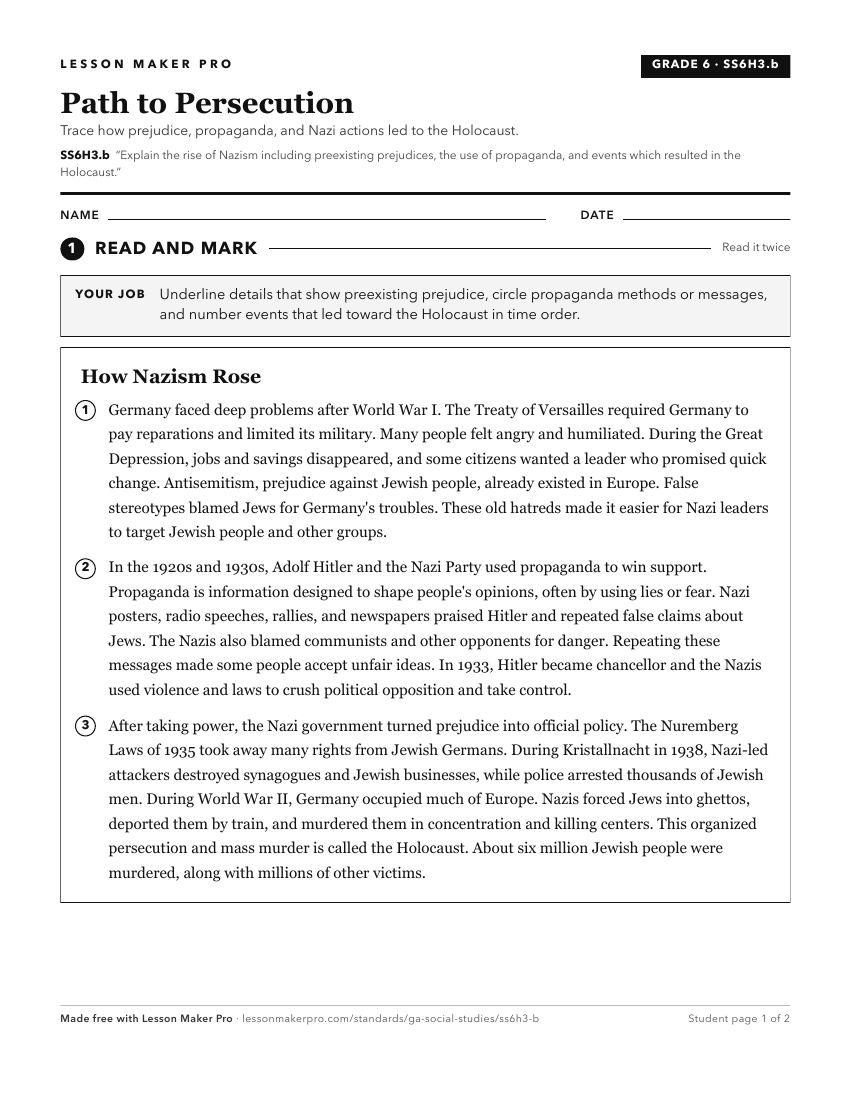
A ready-to-print activity worksheet aligned to SS6H3.b, with an answer key for the teacher on its own page. No account needed.
PDF, US Letter, prints cleanly in black and white.
Download the worksheetKeep exploring
Related Standards
- SS5H4
Explain America's involvement in World War II.
- SS7H2.b
Explain the historical factors contributing to the establishment of the modern State of Israel in 1948; include the Jewish religious connection to the land, ant...
- SS5H4.b
Describe major events in the war in both Europe and the Pacific; include Pearl Harbor, Iwo Jima, D-Day, VE and VJ Days, and the Holocaust.
- SS6H3.a
Describe the aftermath of World War I: the rise of communism, the Treaty of Versailles, the rise of Nazism, and worldwide depression.
Turn this exact standard into a lesson
Grade, subject, topic, and the complete standard are prefilled. Create one free, no account needed.
Also for this standard:Make a WorksheetMake a QuizMake a Sub Lesson