Georgia S8P3.a
The Standard
- S8P3
- Obtain, evaluate, and communicate information about cause and effect relationships between force, mass, and the motion of objects.
Analyze and interpret data to identify patterns in the relationships between speed and distance, and velocity and acceleration.
Georgia Standards of Excellence for Science · Obtain, evaluate, and communicate information about cause and effect relationships between force, mass, and the motion of objects.
Teacher's field guide
What This Standard Means
What Students Need to Do
- Students read motion tables and graphs to find patterns. They explain that, over the same time, greater speed produces greater distance, while acceleration appears as a change in velocity.
What Mastery Looks Like
- Given a table or graph, students identify constant speed, changing velocity, and acceleration. They cite specific values to explain whether an object is speeding up, slowing down, or moving steadily.
Common Misconceptions
- Students may compare distance without checking whether elapsed times are equal. They often treat speed and velocity as the same and ignore direction. They may think acceleration only means speeding up, not slowing down or changing direction.
How to Assess It
- Exit ticket: Cart A moves at 2 m/s for 4 seconds and Cart B at 5 m/s for 4 seconds. Identify which travels farther, then describe the acceleration shown by velocities of 1, 3, 5, and 7 m/s at one-second intervals.
Lesson moves
Ways to Teach It
Roll toy cars from two ramp heights, mark positions every second, and graph how distance and velocity change.
Show two motion graphs and ask students to write which object travels farther and which accelerates, citing two data points.
Play a card sort matching distance, speed, velocity, and acceleration tables to graph cards and motion descriptions.
Compare bicycle app data from equal time intervals to explain how speed affects distance and how braking changes velocity.
Free download
Printable S8P3.a Worksheet
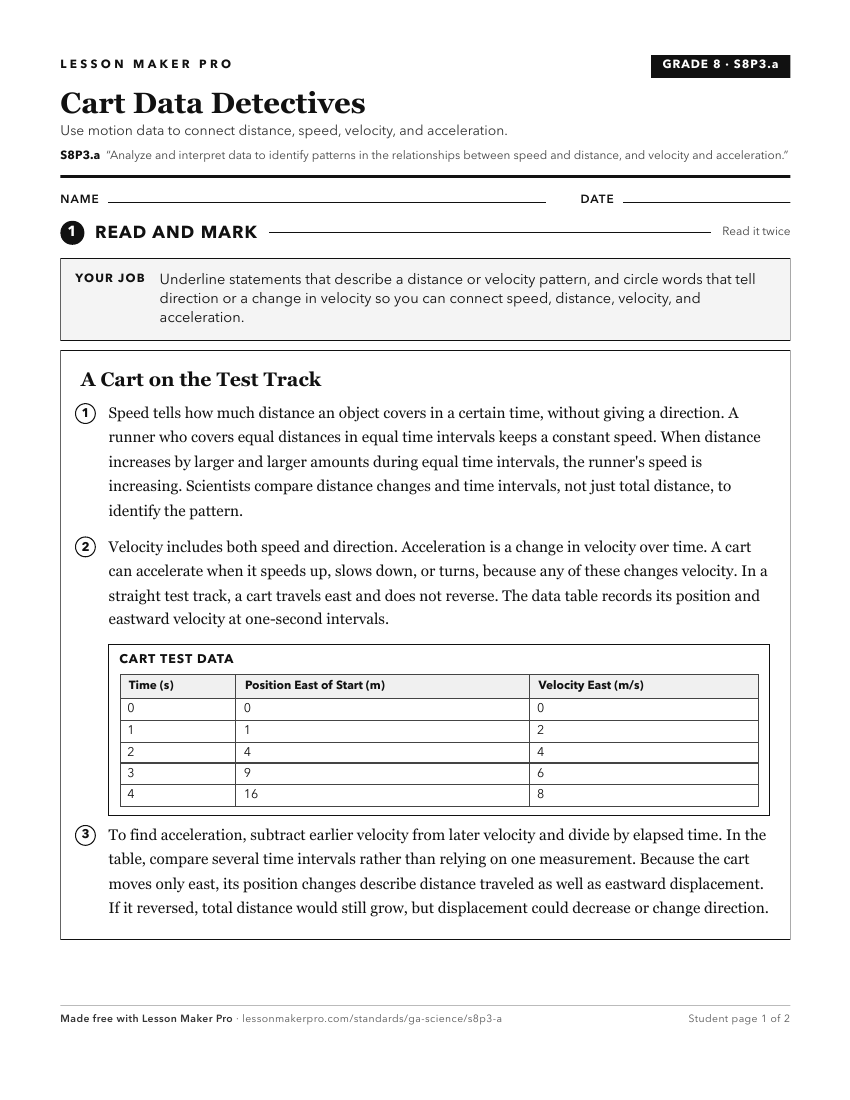
A ready-to-print activity worksheet aligned to S8P3.a, with an answer key for the teacher on its own page. No account needed.
PDF, US Letter, prints cleanly in black and white.
Download the worksheetKeep exploring
Related Standards
- S8P3
Obtain, evaluate, and communicate information about cause and effect relationships between force, mass, and the motion of objects.
- S8P2.a
Analyze and interpret data to create graphical displays that illustrate the relationships of kinetic energy to mass and speed, and potential energy to mass and ...
- S8P4.e
Analyze and interpret data to predict patterns in the relationship between density of media and wave behavior (i.e., speed).
- SKP2
Obtain, evaluate, and communicate information to compare and describe different types of motion.
Turn this exact standard into a lesson
Grade, subject, topic, and the complete standard are prefilled. Create one free, no account needed.
Also for this standard:Make a WorksheetMake a QuizMake a Sub Lesson