Georgia S7L2.c
The Standard
- S7L2
- Obtain, evaluate, and communicate information to describe how cell structures, cells, tissues, organs, and organ systems interact to maintain the basic needs of organisms.
Construct an argument that systems of the body (Cardiovascular, Excretory, Digestive, Respiratory, Muscular, Nervous, and Immune) interact with one another to carry out life processes.
Georgia Standards of Excellence for Science · Obtain, evaluate, and communicate information to describe how cell structures, cells, tissues, organs, and organ systems interact to maintain the basic needs of organisms.
Teacher's field guide
What This Standard Means
What Students Need to Do
- Students explain how body systems depend on one another to move oxygen, nutrients, wastes, signals, and immune cells. They make a claim and support it with evidence about specific system interactions.
What Mastery Looks Like
- Given a situation such as exercise, eating, or infection, students identify the systems involved and trace what each contributes. They explain cause and effect and use accurate evidence to defend their claim.
Common Misconceptions
- Students may describe each system separately instead of showing how they interact. They may confuse excretion with digestion, assume breathing alone delivers oxygen, or treat the immune system as isolated from circulation.
How to Assess It
- Give this exit ticket: “How do the respiratory, cardiovascular, and muscular systems work together during a sprint?” Require one claim and two supporting details.
Lesson moves
Ways to Teach It
Use tubing, colored water, filters, and sponges to model how organs exchange materials through connected body systems.
Ask students to write which three systems matter most after eating lunch, then defend their choices with evidence.
Play a system connection card game where students match organs, transported materials, and life processes, then explain each match.
Analyze why heart rate and breathing rate rise during exercise, linking measured pulse data to muscle needs and waste removal.
Free download
Printable S7L2.c Worksheet
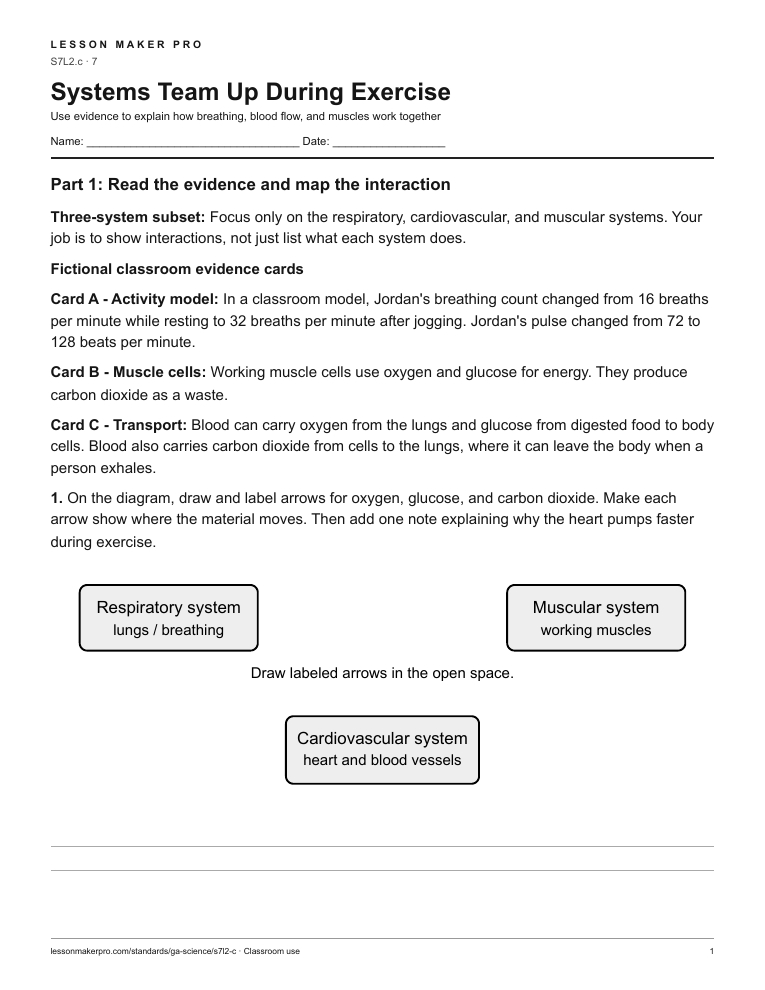
A ready-to-print activity worksheet aligned to S7L2.c, with an answer key for the teacher on its own page. No account needed.
PDF, US Letter, prints cleanly in black and white.
Download the worksheetKeep exploring
Related Standards
- S7L2.b
Develop and use a conceptual model of how cells are organized into tissues, tissues into organs, organs into systems, and systems into organisms.
- S7L2.a
Develop a model and construct an explanation of how cell structures (specifically the nucleus, cytoplasm, cell membrane, cell wall, chloroplasts, lysosome, and ...
- S7L2
Obtain, evaluate, and communicate information to describe how cell structures, cells, tissues, organs, and organ systems interact to maintain the basic needs of...
- S7L4.a
Construct an explanation for the patterns of interactions observed in different ecosystems in terms of the relationships among and between organisms and abiotic...
Turn this exact standard into a lesson
Grade, subject, topic, and the complete standard are prefilled. Create one free, no account needed.
Also for this standard:Make a WorksheetMake a QuizMake a Sub Lesson