Georgia S6E6.a
The Standard
- S6E6
- Obtain, evaluate, and communicate information about the uses and conservation of various natural resources and how they impact the Earth.
Ask questions to determine the differences between renewable/sustainable energy resources (examples: hydro, solar, wind, geothermal, tidal, biomass) and nonrenewable energy resources (examples: nuclear: uranium, fossil fuels: oil, coal, and natural gas), and how they are used in our everyday lives.
Georgia Standards of Excellence for Science · Obtain, evaluate, and communicate information about the uses and conservation of various natural resources and how they impact the Earth.
Teacher's field guide
What This Standard Means
What Students Need to Do
- Students compare energy resources by how quickly nature replaces them and whether the supply can run out. They connect each resource to electricity, heating, transportation, and other daily uses, then ask questions that clarify differences.
What Mastery Looks Like
- Given an energy resource, students can classify it and justify the choice using supply and replacement rate. They can name an everyday use and ask a focused question that helps compare two resources.
Common Misconceptions
- Students may think renewable resources have no environmental effects or that biomass is always sustainable. They may label nuclear energy renewable because it does not burn fossil fuels. Some call electricity a resource instead of energy produced from a resource.
How to Assess It
- Give students solar, coal, biomass, and uranium. Ask them to classify each, name one daily use, and write one question comparing two resources.
Lesson moves
Ways to Teach It
Give pairs energy source cards and household item cards, then have them match, sort by renewability, and explain each choice.
Write three questions you would ask before choosing solar, natural gas, or nuclear power for a community.
Play Resource Relay, where teams classify energy cards and earn a point only when they give an accurate reason.
Use a local electric bill or utility website to identify likely energy sources and list five daily activities that depend on them.
Free download
Printable S6E6.a Worksheet
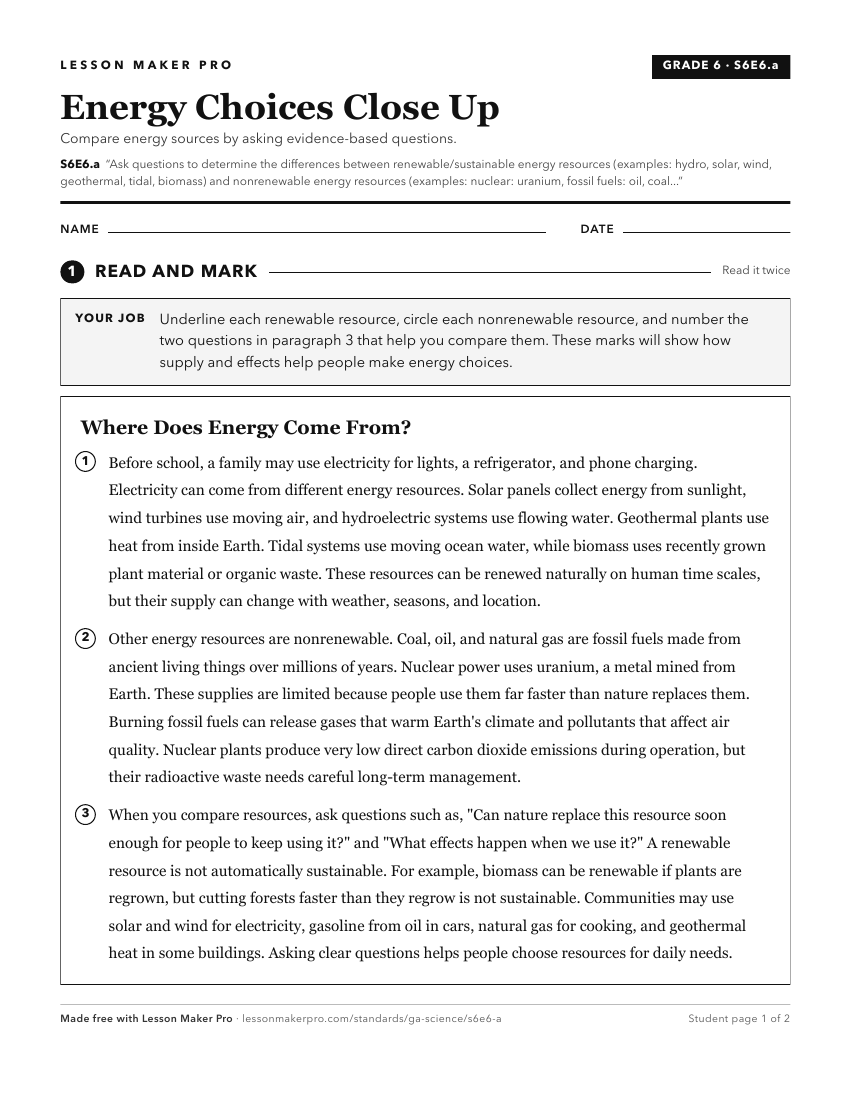
A ready-to-print activity worksheet aligned to S6E6.a, with an answer key for the teacher on its own page. No account needed.
PDF, US Letter, prints cleanly in black and white.
Download the worksheetKeep exploring
Related Standards
- S7L4.d
Ask questions to gather and synthesize information from multiple sources to differentiate between Earth's major terrestrial biomes (i.e., tropical rain forest, ...
- S6E6
Obtain, evaluate, and communicate information about the uses and conservation of various natural resources and how they impact the Earth.
- S1L1.b
Ask questions to compare and contrast the basic needs of plants (air, water, light, and nutrients) and animals (air, water, food, and shelter).
- S3P1.a
Ask questions to identify sources of heat energy.
Turn this exact standard into a lesson
Grade, subject, topic, and the complete standard are prefilled. Create one free, no account needed.
Also for this standard:Make a WorksheetMake a QuizMake a Sub Lesson