Georgia S3E2.b
The Standard
- S3E2
- Obtain, evaluate, and communicate information on how fossils provide evidence of past organisms.
Develop a model to describe the sequence and conditions required for an organism to become fossilized.
Georgia Standards of Excellence for Science · Obtain, evaluate, and communicate information on how fossils provide evidence of past organisms.
Teacher's field guide
What This Standard Means
What Students Need to Do
- Students build and explain a labeled model that puts fossil formation events in order. They show how burial, sediment buildup, pressure, minerals, and erosion affect remains over time.
What Mastery Looks Like
- A student can place death, rapid burial, decay, sediment buildup, mineral change, and later exposure in a sensible order. The student explains why quick burial and limited disturbance make fossilization more likely.
Common Misconceptions
- Students may think every dead organism becomes a fossil or that fossils form in days. They may picture fossils as unchanged bones only, missing molds, casts, traces, and the role of minerals.
How to Assess It
- Exit ticket: Draw a four-panel model showing an organism becoming a fossil, and label two conditions that make preservation more likely. Explain why rapid burial matters.
Lesson moves
Ways to Teach It
Build sediment layers in clear cups with sand, soil, and a shell, then label burial, compaction, mineral change, and exposure.
Discuss why a fish buried quickly in mud is more likely to fossilize than a rabbit left on open ground.
Teams race to arrange fossilization event cards, then remove one condition card and explain how the outcome changes.
Use a museum fossil photo to identify preserved parts, infer burial conditions, and sketch how erosion may have exposed it.
Free download
Printable S3E2.b Worksheet
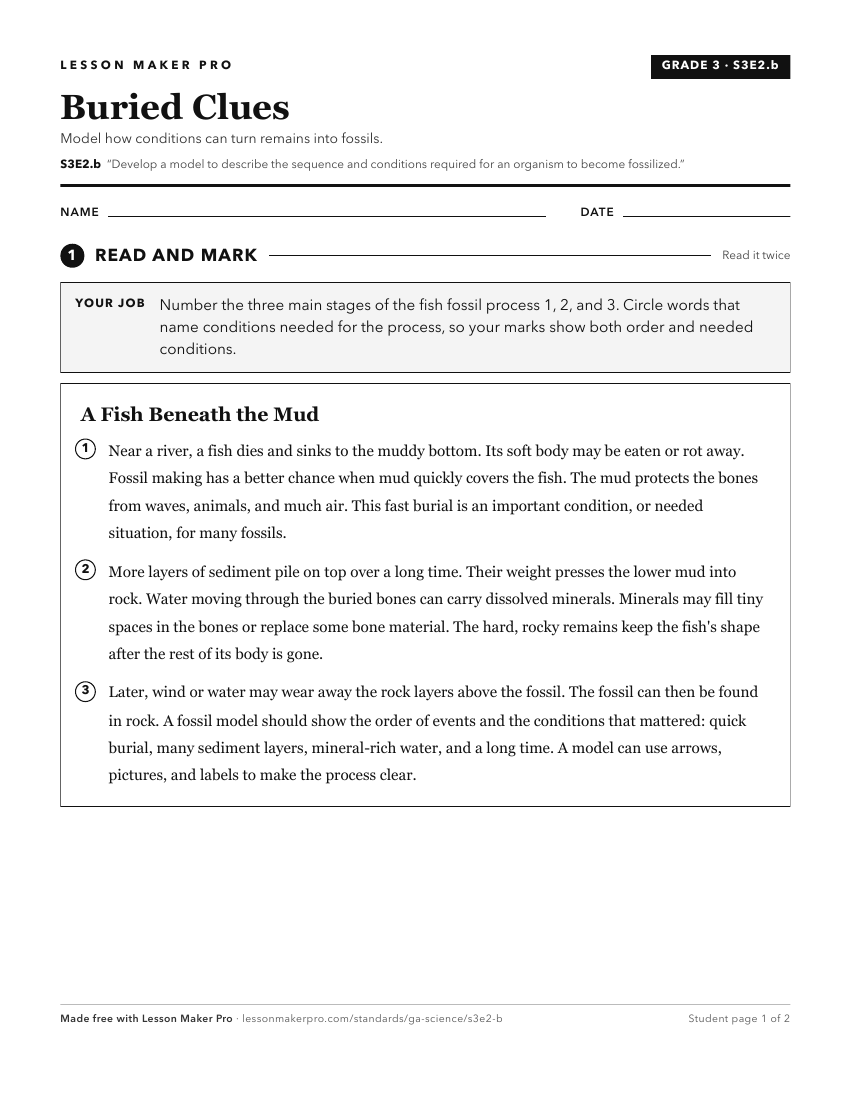
A ready-to-print activity worksheet aligned to S3E2.b, with an answer key for the teacher on its own page. No account needed.
PDF, US Letter, prints cleanly in black and white.
Download the worksheetKeep exploring
Related Standards
- S6E5.e
Develop a model to demonstrate how natural processes (weathering, erosion, and deposition) and human activity change rocks and the surface of the Earth.
- S7L5.c
Analyze and interpret data for patterns in the fossil record that document the existence, diversity, and extinction of organisms and their relationships to mode...
- S3E2
Obtain, evaluate, and communicate information on how fossils provide evidence of past organisms.
- S3E2.a
Construct an argument from observations of fossils (authentic or reproductions) to communicate how they serve as evidence of past organisms and the environments...
Turn this exact standard into a lesson
Grade, subject, topic, and the complete standard are prefilled. Create one free, no account needed.
Also for this standard:Make a WorksheetMake a QuizMake a Sub Lesson