Georgia S2L1.a
The Standard
- S2L1
- Obtain, evaluate, and communicate information about the life cycles of different living organisms.
Ask questions to determine the sequence of the life cycle of common animals in your area: a mammal such as a cat, dog or classroom pet, a bird such as a chicken, an amphibian such as a frog, and an insect such as a butterfly.
Georgia Standards of Excellence for Science · Obtain, evaluate, and communicate information about the life cycles of different living organisms.
Teacher's field guide
What This Standard Means
What Students Need to Do
- Students ask questions about how common animals grow and change. They use answers and observations to place each animal's life stages in order.
What Mastery Looks Like
- Students correctly sequence the life stages of a mammal, bird, frog, and butterfly. They ask clear questions that help identify missing or uncertain stages.
Common Misconceptions
- Students may put frog or butterfly stages in the wrong order. They may assume every animal hatches from an egg or that all young animals look like adults. They may show a life cycle as a straight line rather than a repeating cycle.
How to Assess It
- Give students four shuffled frog stage cards. Ask them to order the cards, draw arrows, and write one question they could ask to check the order.
Lesson moves
Ways to Teach It
Students use clay to model the stages of a chicken, frog, butterfly, or cat, then arrange the models in a cycle.
Ask, "How is a butterfly's life cycle different from a cat's life cycle?" Students write two differences and one similarity.
Play a stage-card relay where teams race to sequence picture cards, then explain how they know each stage comes next.
Take a schoolyard walk to look for eggs, nests, young animals, or adults, then connect each observation to a life cycle.
Free download
Printable S2L1.a Worksheet
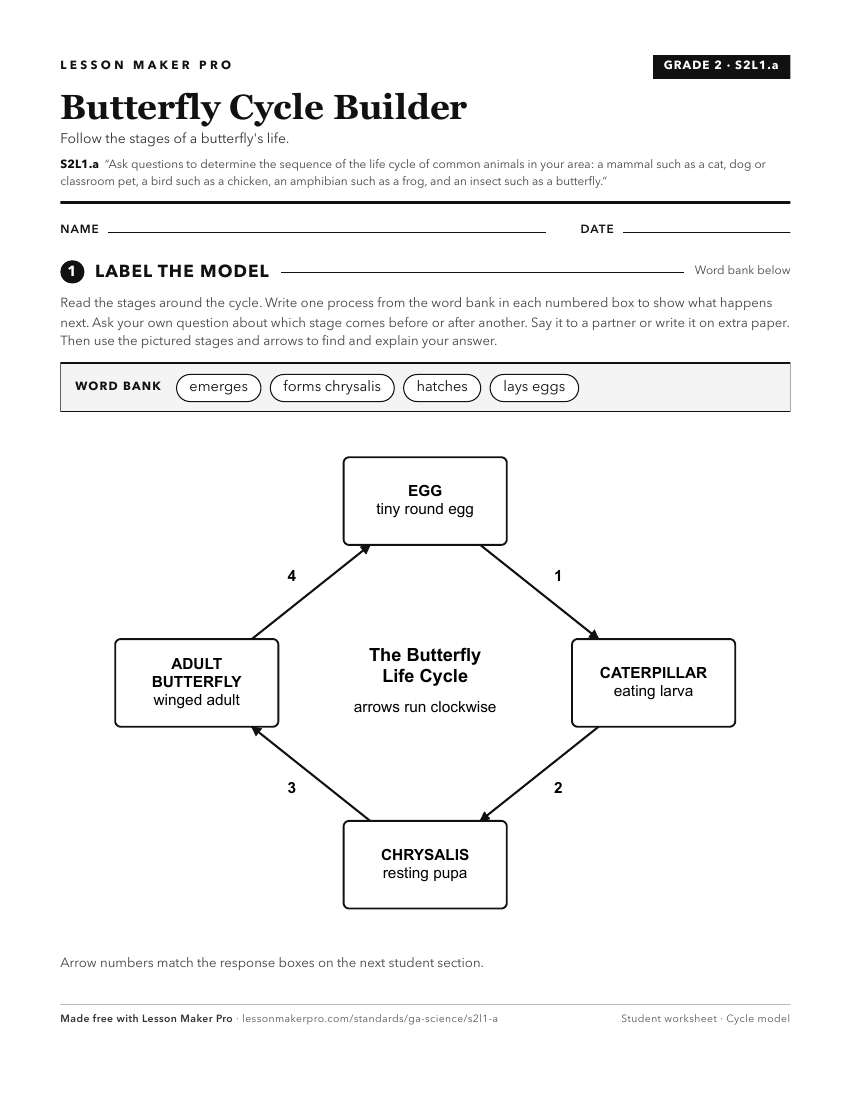
A ready-to-print activity worksheet aligned to S2L1.a, with an answer key for the teacher on its own page. No account needed.
PDF, US Letter, prints cleanly in black and white.
Download the worksheetKeep exploring
Related Standards
- S3L1.a
Ask questions to differentiate between plants, animals, and habitats found within Georgia's geographic regions.
- SKL2.c
Ask questions and make observations to identify the similarities and differences of offspring to their parents and to other members of the same species.
- S1L1.b
Ask questions to compare and contrast the basic needs of plants (air, water, light, and nutrients) and animals (air, water, food, and shelter).
- S2L1
Obtain, evaluate, and communicate information about the life cycles of different living organisms.
Turn this exact standard into a lesson
Grade, subject, topic, and the complete standard are prefilled. Create one free, no account needed.
Also for this standard:Make a WorksheetMake a QuizMake a Sub Lesson