Georgia 4.MDR.6.1
The Standard
Use the four operations to solve problems involving elapsed time to the nearest minute, intervals of time, metric measurements of liquid volumes, lengths, distances, and masses of objects, including problems involving fractions with like denominators, and also problems that require expressing measurements given in a larger unit in terms of a smaller unit, and expressing a smaller unit in terms of a larger unit based on the idea of equivalence.
Georgia's K-12 Mathematics Standards · Measure time and objects that exist in the world to solve real-life, mathematical problems and analyze graphical displays of data to answer relevant questions.
Teacher's field guide
What This Standard Means
What Students Need to Do
- Students decide whether to add, subtract, multiply, or divide in problems about time and metric measurements. They find elapsed time to the nearest minute, combine fractions with the same denominator, and convert between larger and smaller units.
What Mastery Looks Like
- A student can read a clock or schedule, show an accurate strategy, and explain why the chosen operation fits. The student converts units in the correct direction, labels answers, and checks whether results are reasonable. The student also combines fractional measurements with a shared denominator accurately.
Common Misconceptions
- Students may treat 1 hour as 100 minutes or subtract clock digits without regrouping across 60 minutes. They may reverse the conversion direction or drop the unit label. Some add denominators when combining fractional measurements or choose an operation from a keyword alone.
How to Assess It
- Use a three question exit ticket: find the time from 2:38 to 4:07, subtract 650 mL from 2 L, and add 3/8 m plus 2/8 m. Require equations, conversions, and labeled answers.
Lesson moves
Ways to Teach It
Set up stations with meter sticks, metric scales, graduated cylinders, and clock models; students measure, convert units, and solve one posted problem.
Have students write why 2 meters equals 200 centimeters while 200 centimeters equals 2 meters, using a place value diagram.
Play Measurement Match: students pair equivalent time, length, mass, or volume cards, then draw an operation card and solve.
Give teams a class trip schedule, route distances, and water amounts; they find travel times, total distance, and water needed per student.
Free download
Printable 4.MDR.6.1 Worksheet
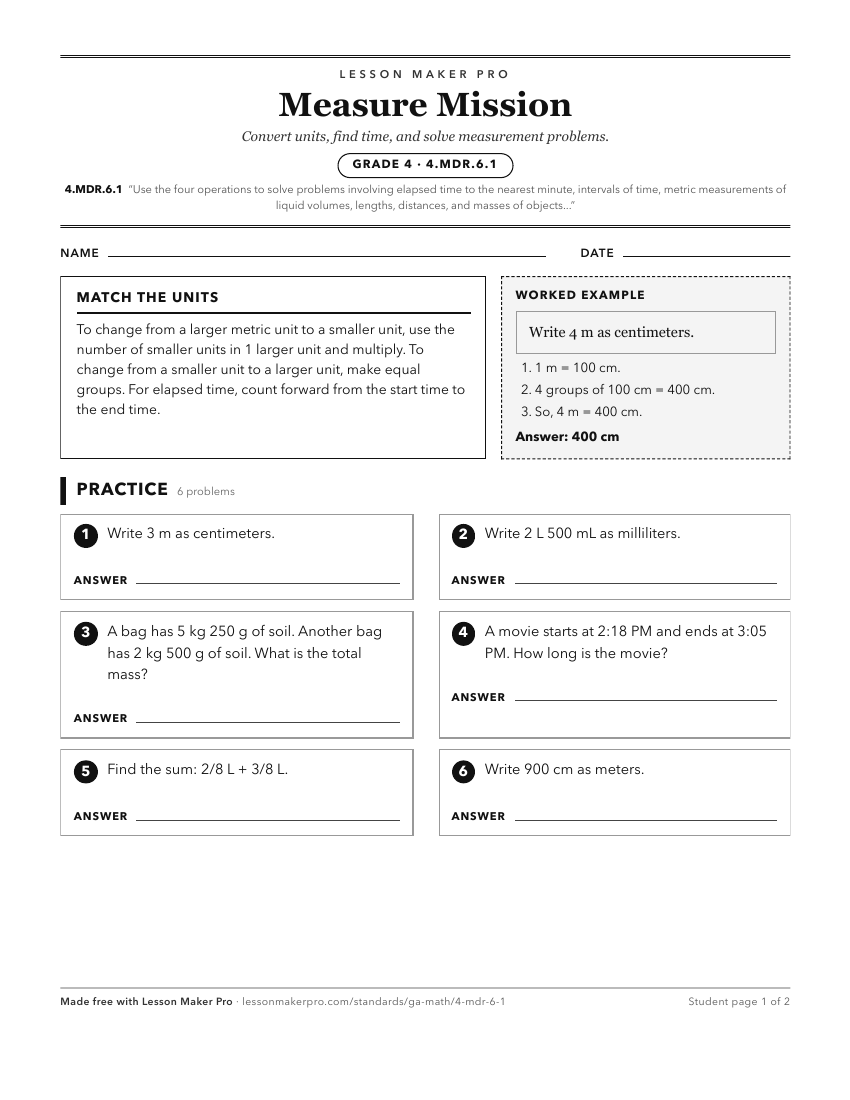
A ready-to-print activity worksheet aligned to 4.MDR.6.1, with an answer key for the teacher on its own page. No account needed.
PDF, US Letter, prints cleanly in black and white.
Download the worksheetKeep exploring
Related Standards
- 1.MDR.6
Use appropriate tools to measure, order, and compare intervals of length and time, as well as denominations of money to solve real-life, mathematical problems a...
- 3.MDR.5.3
Solve meaningful problems involving elapsed time, including intervals of time to the hour, half hour, and quarter hour where the times presented are only on the...
- 3.MDR.5.5
Estimate and measure liquid volumes, lengths and masses of objects using customary units. Solve problems involving mass, length, and volume given in the same un...
- 5.MDR.7.1
Explore realistic problems involving different units of measurement, including distance, mass, weight, volume, and time.
Turn this exact standard into a lesson
Grade, subject, topic, and the complete standard are prefilled. Create one free, no account needed.
Also for this standard:Make a WorksheetMake a QuizMake a Sub Lesson