Georgia 2.GSR.7
Georgia Standard (Expectation Cluster)
Draw and partition shapes and other objects with specific attributes, and conduct observations of everyday items and structures to identify how shapes exist in the world.
Georgia's K-12 Mathematics Standards
Cluster contents
Expectations in This Standard
2.GSR.7 is a Georgia mathematics standard. These are the expectations under it.
- 2.GSR.7.1
Describe, compare and sort 2-D shapes including polygons, triangles, quadrilaterals, pentagons, hexagons, and 3-D shapes including rectangular prisms and cones,...
- 2.GSR.7.2
Identify at least one line of symmetry in everyday objects to describe each object as a whole.
- 2.GSR.7.3
Partition circles and rectangles into two, three, or four equal shares. Identify and describe equal-sized parts of the whole using fractional names (“halves,” “...
- 2.GSR.7.4
Recognize that equal shares of identical wholes may be different shapes within the same whole.
Teacher's field guide
What This Cluster Means
What Students Need to Do
- Students make figures from clues such as the number of sides, vertices, or equal sides. They split figures and objects into requested parts and describe the results. They also find geometric forms in familiar objects and structures.
What Mastery Looks Like
- Given a clue such as “draw a closed figure with six sides,” a student draws a matching figure and explains why it fits. The student partitions a rectangle into equal parts and identifies geometric forms in familiar objects.
Common Misconceptions
- Students may think a figure changes its name when it is turned or resized. They may call unequal sections halves or fourths. They may also count sides or vertices incorrectly, especially on irregular figures.
How to Assess It
- Give students an exit slip: “Draw a closed figure with five sides, divide a rectangle into four equal parts, and circle two shapes in a house picture.”
Lesson moves
Ways to Teach It
Give students paper circles and rectangles to fold or cut into two, three, and four equal shares, then compare their solutions.
Show three differently oriented triangles and ask, “What stays the same, and how do you know each one is a triangle?”
Play Shape Clue Bingo by calling an attribute clue and having students cover a matching figure on their boards.
Take a school walk, sketch shapes in doors, tiles, signs, and playground frames, then label the attributes that prove each match.
Free download
Printable 2.GSR.7 Worksheet
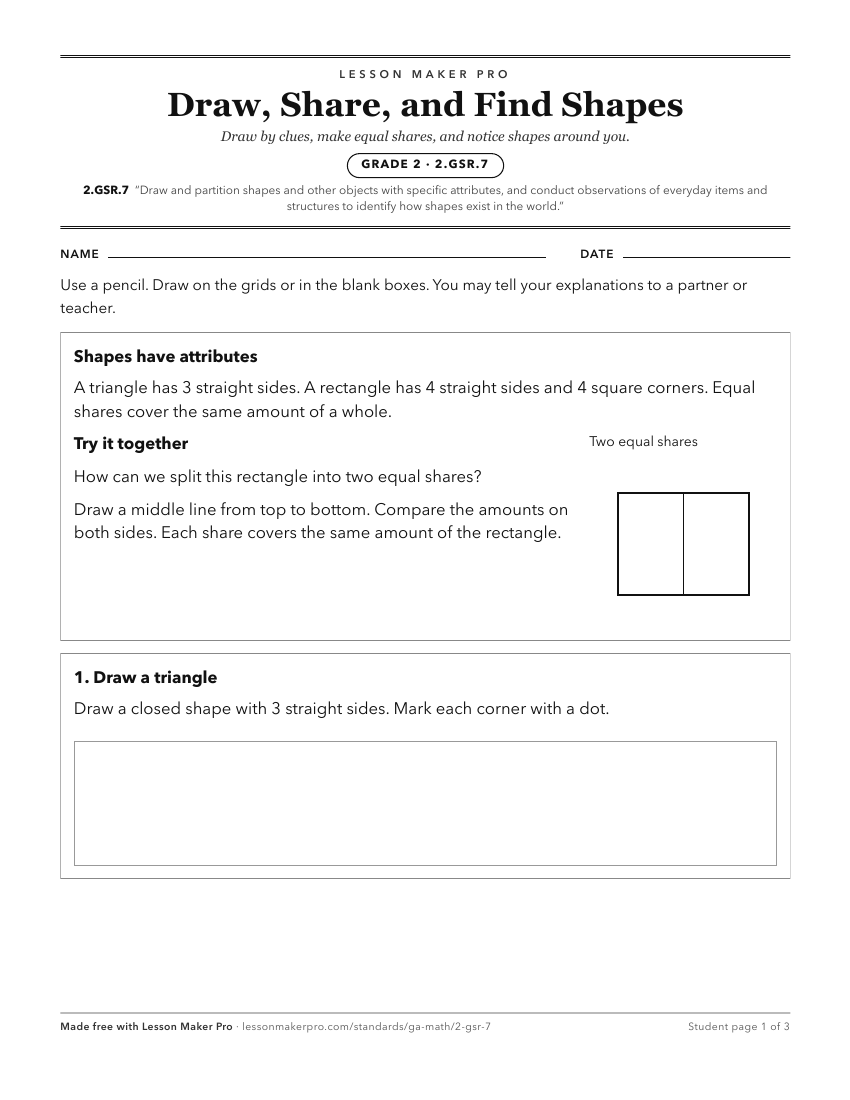
A ready-to-print activity worksheet aligned to 2.GSR.7, with an answer key for the teacher on its own page. No account needed.
PDF, US Letter, prints cleanly in black and white.
Download the worksheetKeep exploring
Related Standards
- 1.GSR.4
Compose shapes, analyze the attributes of shapes, and relate their parts to the whole.
- K.GSR.8
Identify, describe, and compare basic shapes encountered in the environment, and form two-dimensional shapes and three-dimensional figures.
- 1.GSR.4.1
Identify common two-dimensional shapes and three-dimensional figures, sort and classify them by their attributes and build and draw shapes that possess defining...
- K.GSR.8.3
Use basic shapes to represent specific shapes found in the environment by creating models and drawings.
Turn this cluster into a lesson
Grade, subject, topic, and the complete cluster are prefilled. Create one free, no account needed.
Also for this cluster:Make a WorksheetMake a QuizMake a Sub Lesson