Georgia 2.GSR.7.4
The Standard
Recognize that equal shares of identical wholes may be different shapes within the same whole.
Georgia's K-12 Mathematics Standards · Draw and partition shapes and other objects with specific attributes, and conduct observations of everyday items and structures to identify how shapes exist in the world.
Teacher's field guide
What This Standard Means
What Students Need to Do
- Students examine matching squares, circles, or rectangles divided in different ways. They decide whether pieces represent halves, thirds, or fourths by comparing area rather than outline.
What Mastery Looks Like
- A student can identify a triangular half and a rectangular half when both come from same-sized wholes. The student can justify the match using folding, covering, or area reasoning.
Common Misconceptions
- Students may think two shares cannot be equal unless they have the same outline. They may also count pieces without checking whether each piece covers the same amount.
How to Assess It
- Show two equal-sized squares, one split down the middle and one split corner to corner. Ask, “Does one piece from each square show the same amount? Explain.”
Lesson moves
Ways to Teach It
Give students identical paper squares to fold into halves two ways, then cut and compare the rectangular and triangular shares.
Show one square split into rectangles and another into triangles, then ask, “Can both show halves? Explain without using shape names.”
Play Share Sort: students sort partition cards into equal or unequal groups and defend one choice to a partner.
Compare two same-sized sandwiches cut straight across and diagonally, then decide whether each child still receives the same amount.
Free download
Printable 2.GSR.7.4 Worksheet
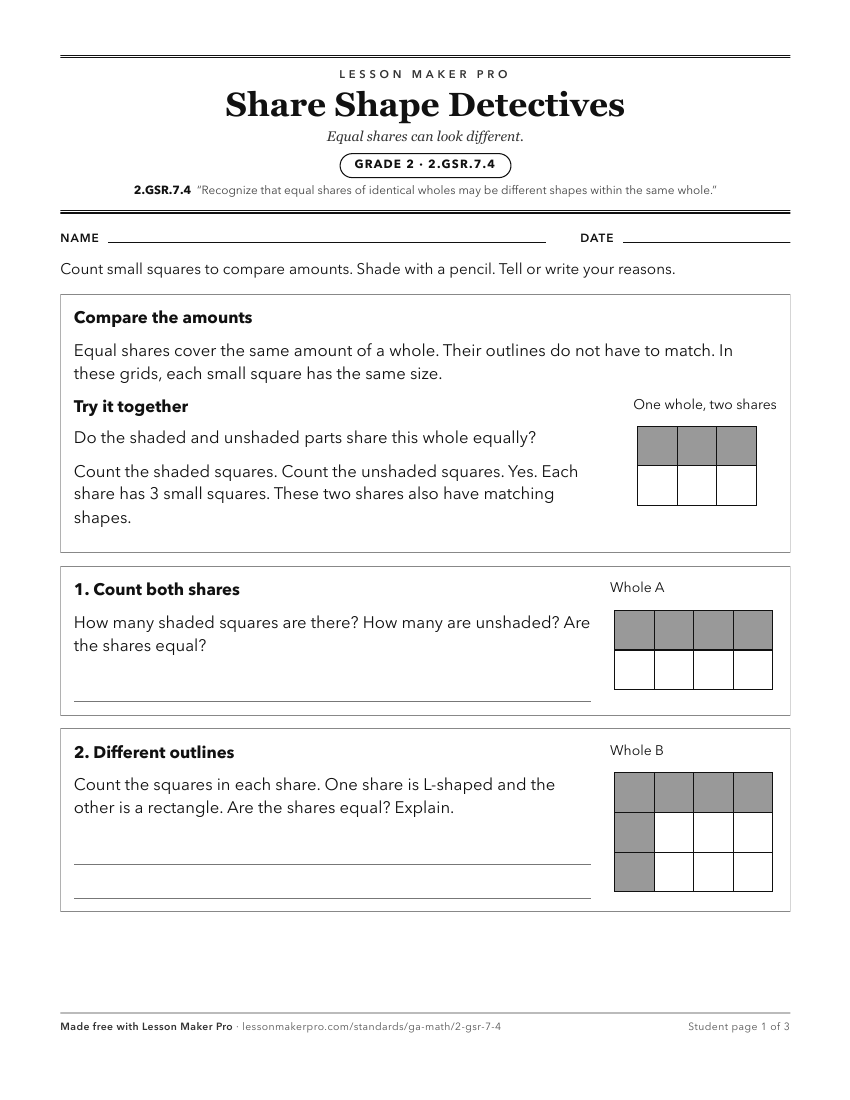
A ready-to-print activity worksheet aligned to 2.GSR.7.4, with an answer key for the teacher on its own page. No account needed.
PDF, US Letter, prints cleanly in black and white.
Download the worksheetKeep exploring
Related Standards
- 1.GSR.4
Compose shapes, analyze the attributes of shapes, and relate their parts to the whole.
- 4.NR.4.2
Compare two fractions with the same numerator or the same denominator by reasoning about their size and recognize that comparisons are valid only when the two f...
- 2.GSR.7.2
Identify at least one line of symmetry in everyday objects to describe each object as a whole.
- 2.GSR.7.3
Partition circles and rectangles into two, three, or four equal shares. Identify and describe equal-sized parts of the whole using fractional names (“halves,” “...
Turn this exact standard into a lesson
Grade, subject, topic, and the complete standard are prefilled. Create one free, no account needed.
Also for this standard:Make a WorksheetMake a QuizMake a Sub Lesson