Georgia K.T.T.3.a
The Standard
Explain the difference between opinions and facts about a topic. (I)
Georgia's K-12 English Language Arts Standards · Texts (T) · Techniques
Teacher's field guide
What This Standard Means
What Students Need to Do
- Students decide whether a statement can be checked or tells what someone thinks or feels. They explain their choice using simple reasons.
What Mastery Looks Like
- Students correctly sort simple statements and explain their choices. They say that a fact can be checked, while an opinion tells what someone thinks, feels, or prefers.
Common Misconceptions
- Students may call a statement a fact because they agree with it. They may also think an unfamiliar fact is an opinion or that every sentence using “I” is an opinion.
How to Assess It
- Read, “Cats have whiskers” and “Cats are the best pets.” Ask students to label each statement and explain how they know.
Lesson moves
Ways to Teach It
Give pairs picture cards about dogs, then have them sort matching statements onto mats labeled fact and opinion.
Ask, “Which is better, recess or lunch?” Students state an opinion, then name one checkable fact about each.
Play Fact or Opinion Corners by reading statements and having students move to the matching corner, then explain their choice.
Examine a cereal box and compare checkable details, such as serving size, with opinion claims, such as “tastes great.”
Free download
Printable K.T.T.3.a Worksheet
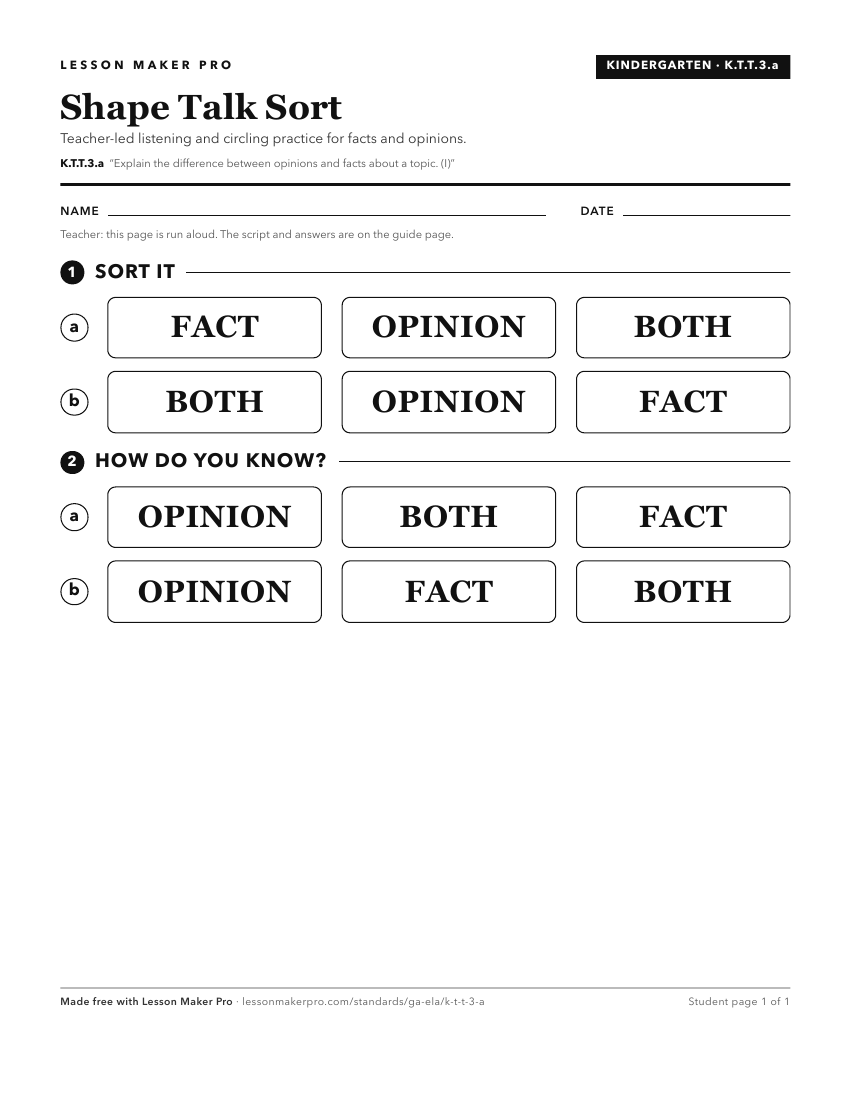
A ready-to-print activity worksheet aligned to K.T.T.3.a, with an answer key for the teacher on its own page. No account needed.
PDF, US Letter, prints cleanly in black and white.
Download the worksheetKeep exploring
Related Standards
- 1.T.T.3.a
Identify techniques used to craft opinion texts, including the author’s opinion and supporting reasons. (I)
- 1.T.T.3.c
Use knowledge of opinion techniques to create opinion pieces that introduce the topic, state an opinion about the topic, and provide two or more reasons to supp...
- 2.T.T.3.c
Use knowledge of opinion techniques to create opinion pieces that introduce the topic, state an opinion about the topic, supply reasons to support the opinion w...
- 2.T.T.3.a
Identify and describe techniques used to craft opinion texts, including the author’s opinion, supporting reasons, and facts. (I)
Turn this exact standard into a lesson
Grade, subject, topic, and the complete standard are prefilled. Create one free, no account needed.
Also for this standard:Make a WorksheetMake a QuizMake a Sub Lesson