Georgia 1.T.T.3.a
The Standard
Identify techniques used to craft opinion texts, including the author’s opinion and supporting reasons. (I)
Georgia's K-12 English Language Arts Standards · Texts (T) · Techniques
Teacher's field guide
What This Standard Means
What Students Need to Do
- Students find what a writer believes or wants the reader to think. They point to reasons the writer gives and notice words such as because, should, and best.
What Mastery Looks Like
- A student can name the writer’s view in a short passage and match each reason to it. The student can explain how those reasons support the writer’s view.
Common Misconceptions
- Students may choose an interesting detail instead of the writer’s main view. They may label any fact as a reason or give their own reason instead of one from the text.
How to Assess It
- Give students: “Recess should be longer because children need exercise and time to play.” Ask them to circle the writer’s view and underline two reasons.
Lesson moves
Ways to Teach It
Give pairs sentence strips from a short opinion paragraph, then have them sort the writer’s view from the supporting reasons.
After reading a class review, ask, “What does the writer want us to believe, and which sentences explain why?”
Play Opinion Detective by reading short passages and awarding points when students find the writer’s view and a matching reason.
Let students choose the best playground game, then write one choice sentence and two reasons for a class vote.
Free download
Printable 1.T.T.3.a Worksheet
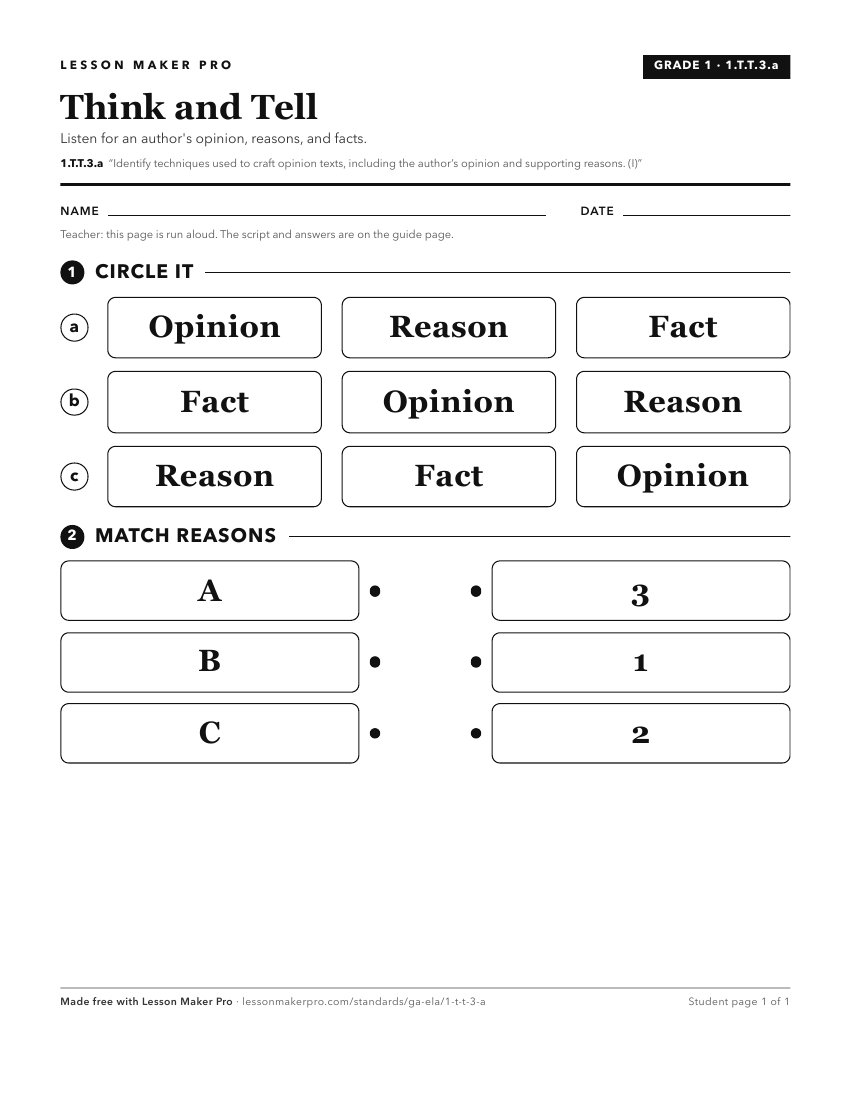
A ready-to-print activity worksheet aligned to 1.T.T.3.a, with an answer key for the teacher on its own page. No account needed.
PDF, US Letter, prints cleanly in black and white.
Download the worksheetKeep exploring
Related Standards
- 3.T.T.3.a
Describe and discuss the techniques used to present and design opinion texts, including author’s opinion statement, supporting reasons, and evidence. (I)
- 2.T.T.3.a
Identify and describe techniques used to craft opinion texts, including the author’s opinion, supporting reasons, and facts. (I)
- 5.T.T.3.a
Discuss and evaluate techniques used to present and design opinion and argumentative texts, including author’s opinion or claim, supporting reasons, and evidenc...
- 4.T.T.3.a
Discuss and evaluate techniques used to present and design opinion and argumentative texts, including author’s opinion or claim, supporting reasons, and evidenc...
Turn this exact standard into a lesson
Grade, subject, topic, and the complete standard are prefilled. Create one free, no account needed.
Also for this standard:Make a WorksheetMake a QuizMake a Sub Lesson