Georgia K.T.SS.1.a
The Standard
Identify and use text features, including titles, headings, photos, and illustrations, to determine if a text is fiction or nonfiction. (I)
Georgia's K-12 English Language Arts Standards · Texts (T) · Structure & Style
Teacher's field guide
What This Standard Means
What Students Need to Do
- Students examine book covers and pages for clues about whether a book tells an imagined story or gives facts. They use titles, headings, photographs, and drawings as evidence.
What Mastery Looks Like
- Given an unfamiliar picture book, a student correctly sorts it as fiction or nonfiction. The student points to a feature and gives a sensible reason, such as a heading that names an animal fact.
Common Misconceptions
- Students may think every book with photographs is nonfiction and every book with drawings is fiction. They may use the topic alone instead of checking page clues.
How to Assess It
- Show one book cover and an inside page. Ask students to choose fiction or nonfiction, point to one feature, and explain their choice.
Lesson moves
Ways to Teach It
Place classroom books in a basket, then have students sort them into fiction and nonfiction hoops using sticky notes to mark their clues.
Display two book pages and ask, “Which page teaches facts, and what title, heading, photograph, or drawing helped you decide?”
Play Feature Hunt by calling out title, heading, photograph, or illustration while pairs race to find that feature in a book.
Compare an animal storybook with a zoo brochure, then have students explain which one gives real information and name a page clue.
Free download
Printable K.T.SS.1.a Worksheet
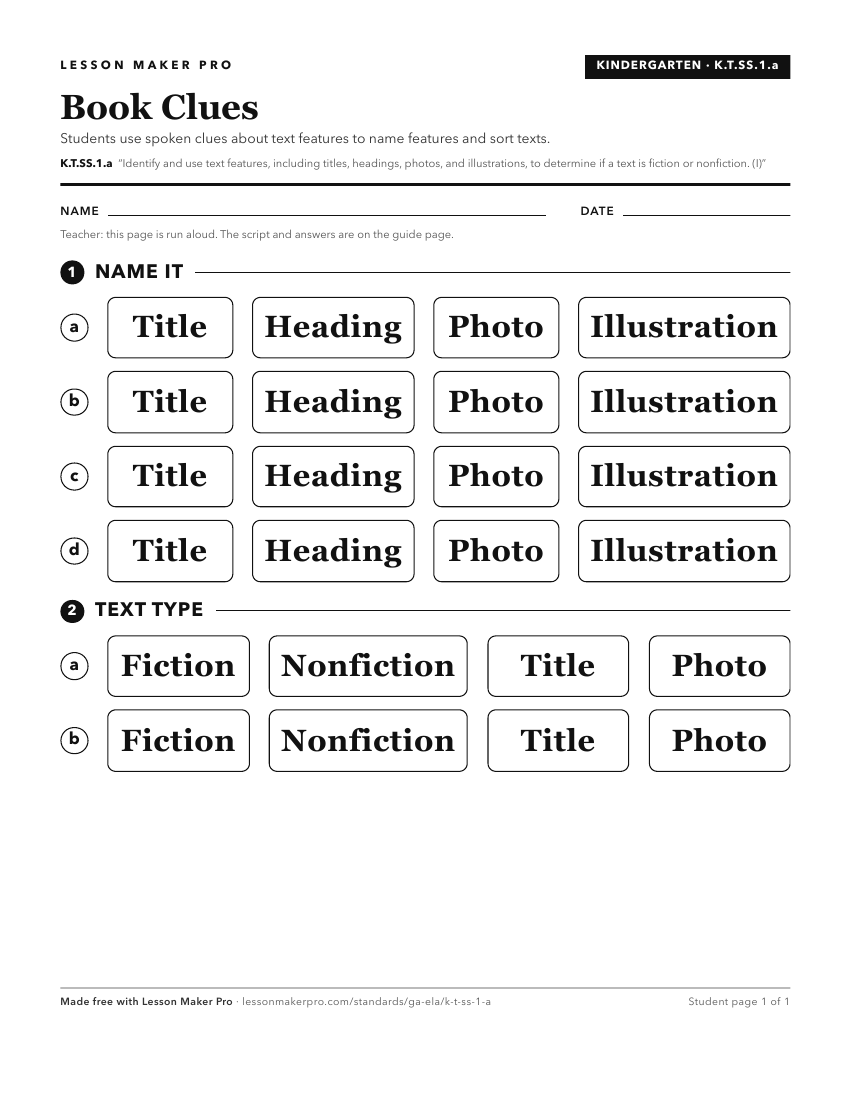
A ready-to-print activity worksheet aligned to K.T.SS.1.a, with an answer key for the teacher on its own page. No account needed.
PDF, US Letter, prints cleanly in black and white.
Download the worksheetKeep exploring
Related Standards
- 2.T.SS.2.a
Identify the difference between literal and nonliteral or figurative language in texts. (I)
- 1.T.SS.1.a
Identify and use various text features (e.g., diagrams, tables of contents) to locate information and make meaning in texts. (I)
- 5.T.SS.1.a
Describe how text features (e.g., chapter titles, diagrams) and organizational structure (e.g., chapters, problem/solution) function in conjunction to represent...
- 1.T.SS.2.a
Identify and explain the use of descriptive words in texts. (I)
Turn this exact standard into a lesson
Grade, subject, topic, and the complete standard are prefilled. Create one free, no account needed.
Also for this standard:Make a WorksheetMake a QuizMake a Sub Lesson