Georgia 1.T.SS.1.a
The Standard
Identify and use various text features (e.g., diagrams, tables of contents) to locate information and make meaning in texts. (I)
Georgia's K-12 English Language Arts Standards · Texts (T) · Structure & Style
Teacher's field guide
What This Standard Means
What Students Need to Do
- Students recognize common features in nonfiction texts and explain how each one helps a reader. They use features to find information and understand details quickly.
What Mastery Looks Like
- Students can name a table of contents, diagram, heading, caption, or label and tell what it does. They use the feature to find a page or explain a fact from the text.
Common Misconceptions
- Students may treat diagrams as pictures for decoration and ignore labels. They may confuse a table of contents with an index or read every page instead of using page numbers.
How to Assess It
- Give students a two-page nonfiction text with a table of contents and a labeled diagram. Ask, “Which feature helps you find the page about nests, and what does the diagram teach you?”
Lesson moves
Ways to Teach It
Give pairs nonfiction books and sticky notes to mark a table of contents, diagram, heading, caption, and label.
Show a labeled diagram and ask, “What can you learn here that the main paragraph does not tell you?”
Play Text Feature Hunt, where students draw a feature card and race to find an example in classroom books.
Use a zoo map and visitor guide to locate an animal, feeding time, and restroom using labels, symbols, and headings.
Free download
Printable 1.T.SS.1.a Worksheet
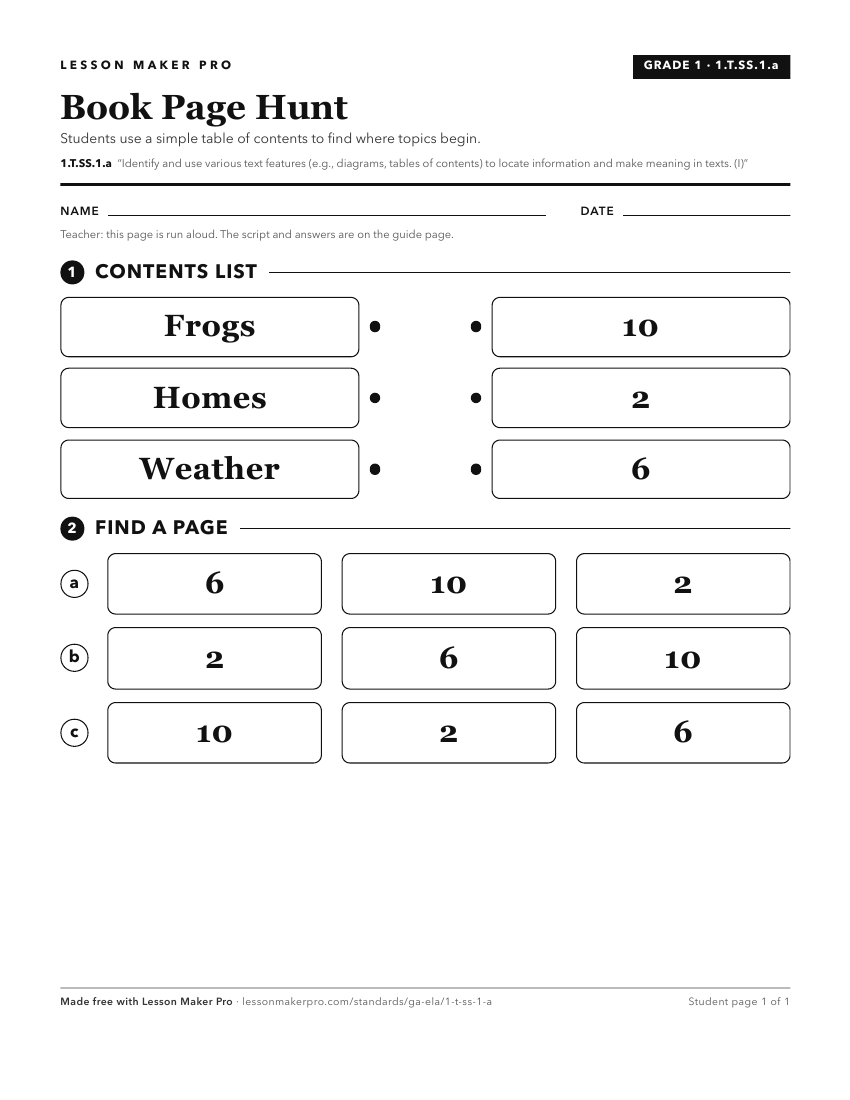
A ready-to-print activity worksheet aligned to 1.T.SS.1.a, with an answer key for the teacher on its own page. No account needed.
PDF, US Letter, prints cleanly in black and white.
Download the worksheetKeep exploring
Related Standards
- K.T.SS.1.a
Identify and use text features, including titles, headings, photos, and illustrations, to determine if a text is fiction or nonfiction. (I)
- 3.T.SS.1.a
Describe how texts are arranged to represent information and ideas using text features (e.g., map, captions) and organizational structures (e.g., cause/effect),...
- 2.T.SS.1.a
Explain how various text features (e.g., captions, subheadings, charts, indexes) contribute to meaning and organization of texts. (I)
- 5.T.SS.1.a
Describe how text features (e.g., chapter titles, diagrams) and organizational structure (e.g., chapters, problem/solution) function in conjunction to represent...
Turn this exact standard into a lesson
Grade, subject, topic, and the complete standard are prefilled. Create one free, no account needed.
Also for this standard:Make a WorksheetMake a QuizMake a Sub Lesson