Georgia 4.T.T.1
Georgia Standard (Expectation Cluster)
Narrative Techniques Explain, analyze, and use narrative techniques to shape understandings.
Georgia's K-12 English Language Arts Standards · Texts (T)
Cluster contents
Expectations in This Standard
4.T.T.1 is a Georgia English Language Arts standard. These are the expectations under it.
- 4.T.T.1.a
Analyze the use of narrative techniques to present ideas, design texts, and convey information about characters, setting, and plot. (I)
- 4.T.T.1.b
Describe how the text’s protagonist and antagonist function in the plot, drive the conflict, and contribute to the development of other characters. (I)
- 4.T.T.1.c
Identify and describe common themes in texts (e.g., good vs. evil) that are revealed through details about characters. (I)
- 4.T.T.1.d
Compare and contrast the approach to similar themes and topics (e.g., opposition of good and evil) and patterns of events (e.g., the quest) in stories, myths, a...
- 4.T.T.1.e
Apply narrative techniques (e.g., character, setting, problem, resolution, and dialogue) to develop a real or imagined experience using descriptive details, cle...
Teacher's field guide
What This Cluster Means
What Students Need to Do
- Students notice how writers use dialogue, description, pacing, sequence, and character thoughts to guide a reader’s understanding. They explain the effect of these choices and use them in their own stories.
What Mastery Looks Like
- Students can identify techniques such as dialogue, description, sequencing, pacing, and character thoughts in a story. They can explain each technique’s effect and use techniques deliberately in their own narrative.
Common Misconceptions
- Students may think narrative technique means adding many adjectives or making every event dramatic. They may identify dialogue or description but not explain how it reveals character, controls pacing, or shapes meaning.
How to Assess It
- Exit ticket: Read, “Maya opened the box, saw the puppy, and smiled.” Add one narrative technique, name it, and explain how it changes the reader’s understanding.
Lesson moves
Ways to Teach It
Cut apart a short narrative, label dialogue, description, action, and reflection, then rearrange sections to test how sequence changes meaning.
Read two versions of the same event and discuss which techniques make the character’s feelings and motives clearer.
Play Technique Swap: students replace plain sentences with dialogue, sensory detail, slowed pacing, or character thoughts, then compare the effects.
Turn a school event into a brief podcast script that uses dialogue, description, and pacing to guide the listener’s response.
Free download
Printable 4.T.T.1 Worksheet
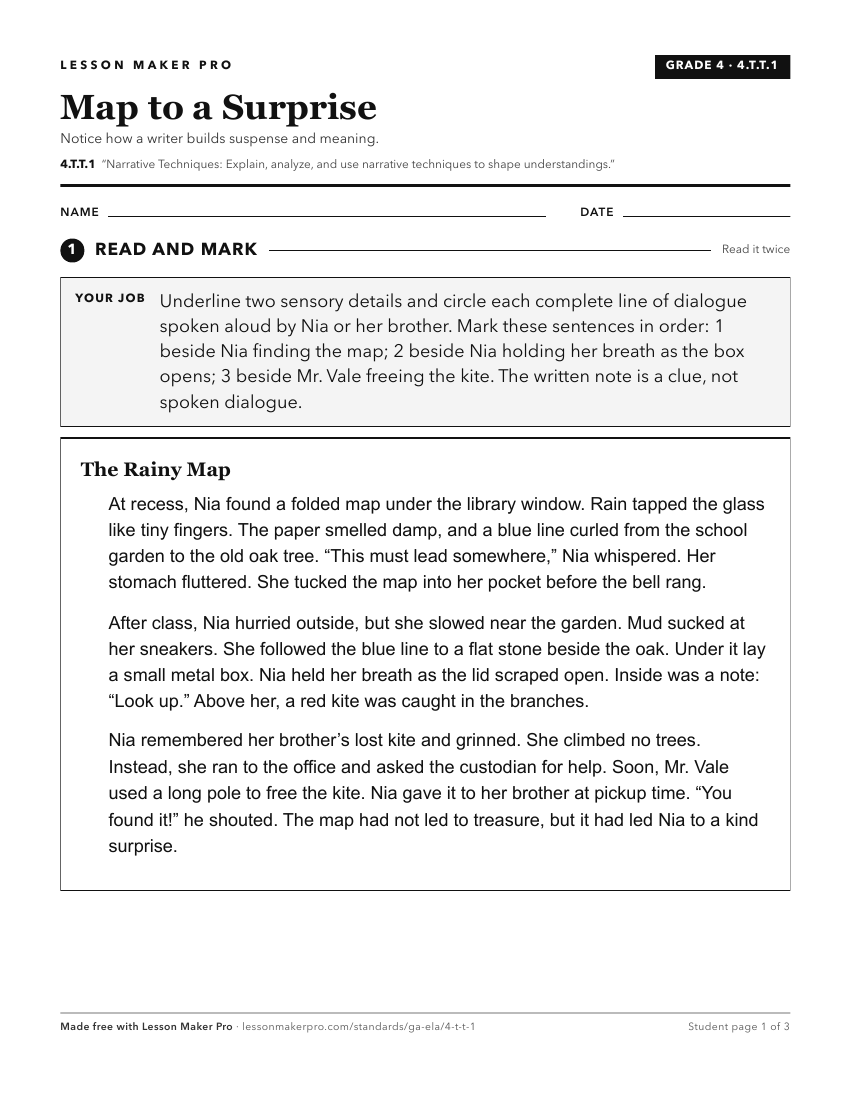
A ready-to-print activity worksheet aligned to 4.T.T.1, with an answer key for the teacher on its own page. No account needed.
PDF, US Letter, prints cleanly in black and white.
Download the worksheetKeep exploring
Related Standards
Turn this cluster into a lesson
Grade, subject, topic, and the complete cluster are prefilled. Create one free, no account needed.
Also for this cluster:Make a WorksheetMake a QuizMake a Sub Lesson