Georgia 4.T.C.2.c
The Standard
Identify the context in which a text is written (e.g., time period, individual, situational). (I)
Georgia's K-12 English Language Arts Standards · Texts (T) · Context
Teacher's field guide
What This Standard Means
What Students Need to Do
- Students examine clues that reveal when, why, or by whom a text was written. They use details from the text to explain their thinking.
What Mastery Looks Like
- Students can name a likely time period, author perspective, or situation surrounding a text. They point to specific words, details, or features that support their conclusion.
Common Misconceptions
- Students may confuse the story’s setting with the conditions in which the author wrote it. They may also make unsupported guesses based on one unfamiliar word or picture.
How to Assess It
- Give students a short passage and two possible contexts. Ask them to choose the stronger answer and underline two clues that support it.
Lesson moves
Ways to Teach It
Place dated letters, photographs, advertisements, and short passages at stations, then have students match each text to its likely historical context.
Ask students to write: How might this text change if it were written by a child instead of an adult?
Play Context Detective by giving teams clue cards to sort under time period, author background, or writing situation.
Compare two school announcements from different decades, then identify how technology, word choice, and school routines reveal when each was written.
Free download
Printable 4.T.C.2.c Worksheet
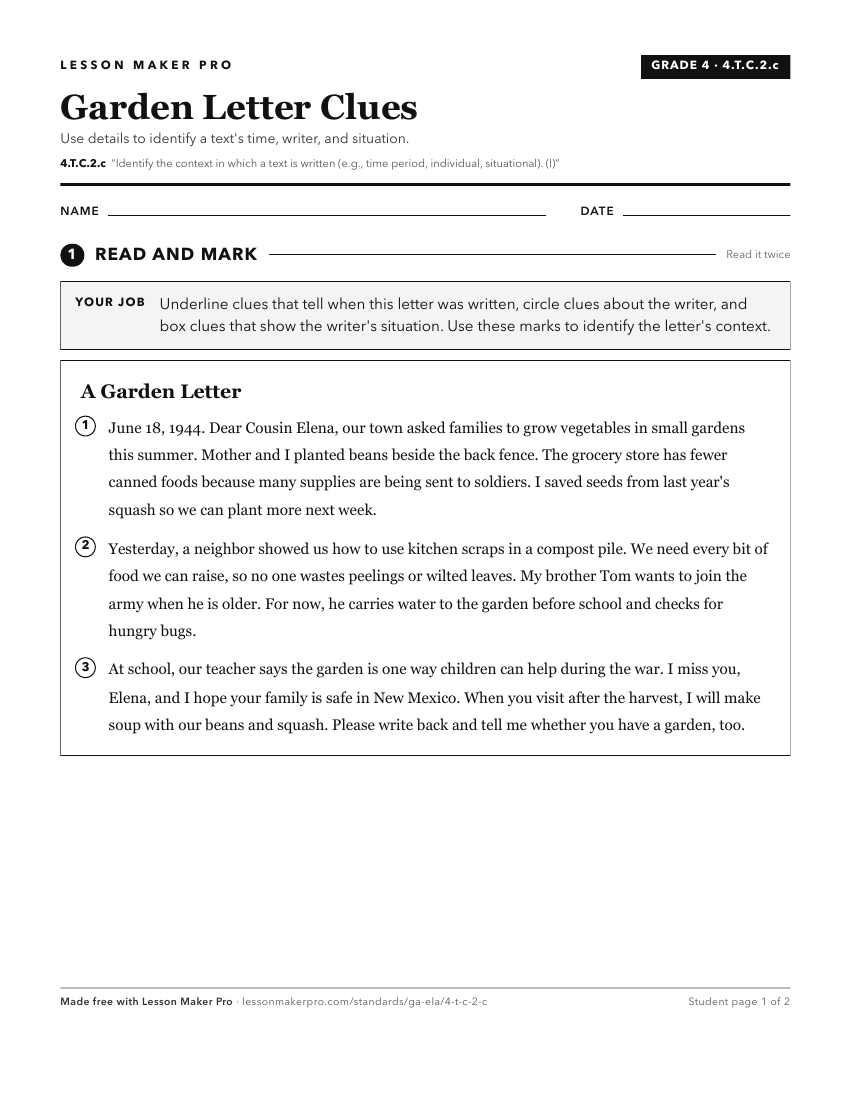
A ready-to-print activity worksheet aligned to 4.T.C.2.c, with an answer key for the teacher on its own page. No account needed.
PDF, US Letter, prints cleanly in black and white.
Download the worksheetKeep exploring
Related Standards
- 2.P.ST.1.b
Consider how context impacts the purposes of the author and the audience. (I/C)
- 9.T.C.1.b
Assess the impact of context and language on a text’s reception by the audience. (I)
- 3.T.C.2.c
With adult support, identify the context in which a text is written (e.g., time period, individual, situational). (I)
- 5.T.C.2.c
Make inferences about the context in which the text is written (e.g., time period, individual, situational). (I)
Turn this exact standard into a lesson
Grade, subject, topic, and the complete standard are prefilled. Create one free, no account needed.
Also for this standard:Make a WorksheetMake a QuizMake a Sub Lesson