Georgia 3.F.F.1
Georgia Standard (Expectation Cluster)
Oral & Silent Reading Fluency Demonstrate oral and silent reading fluency to read grade-level texts for understanding, self-correcting as necessary to ensure accuracy and aid comprehension.
Georgia's K-12 English Language Arts Standards · Foundations (F)
Cluster contents
Expectations in This Standard
3.F.F.1 is a Georgia English Language Arts standard. These are the expectations under it.
- 3.F.F.1.a
Increase sight word vocabulary by reading regularly and irregularly spelled words in isolation and context with accuracy and automaticity.
- 3.F.F.1.b
Read a variety of unfamiliar grade-level texts with increasing accuracy.
- 3.F.F.1.c
Read a wide range of grade-level texts aloud with appropriate prosody (phrasing, expression, juncture/pause, and intonation) to aid comprehension.
- 3.F.F.1.d
Self-correct while reading grade-level text (silently or aloud) to aid comprehension and fluency, rereading as necessary.
Teacher's field guide
What This Cluster Means
What Students Need to Do
- Students read grade-level passages accurately, at a steady pace, and with phrasing that matches the meaning. They notice when words or sentences do not make sense and reread to fix them. During silent reading, they maintain enough pace and attention to understand the text.
What Mastery Looks Like
- A student reads most words correctly at a steady, natural pace. The student uses punctuation and meaning to shape expression, then pauses and rereads when something sounds wrong. After reading, the student accurately explains the main idea and key details.
Common Misconceptions
- Some students think fluent reading means reading as fast as possible. Others ignore punctuation, guess at unfamiliar words, or continue after a sentence stops making sense. During silent reading, some skim without checking meaning.
How to Assess It
- Give students a 120-word grade-level passage to read silently, then ask one comprehension question. Have them reread one paragraph aloud while you note accuracy, phrasing, pace, and self-corrections.
Lesson moves
Ways to Teach It
Use phrase-marked sentence strips; students arrange clauses, then read the completed sentences aloud with pauses at punctuation.
Ask students to write: Where did your reading break down, and what did you reread to repair meaning?
Play Fluency Coach pairs: one student reads for one minute, the partner marks miscues and self-corrections, then they switch.
Have students rehearse and record a school announcement, aiming for clear words, natural phrasing, and a pace listeners can follow.
Free download
Printable 3.F.F.1 Worksheet
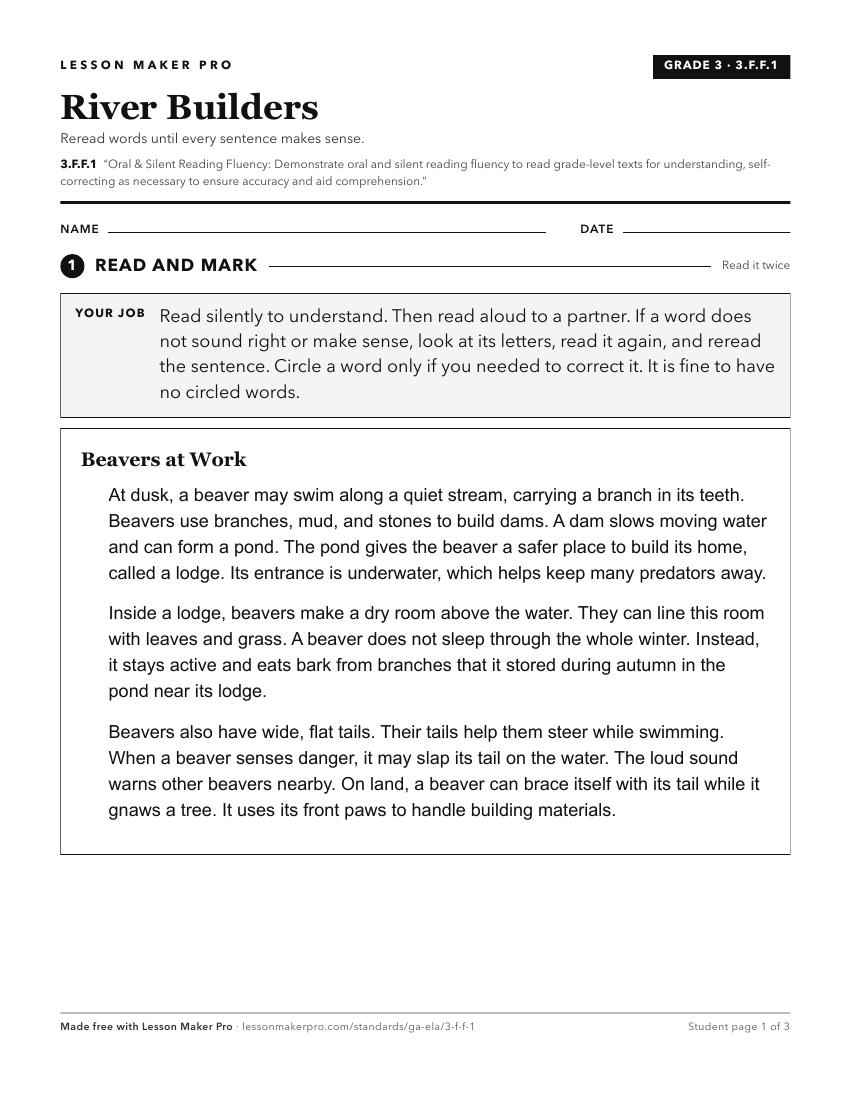
A ready-to-print activity worksheet aligned to 3.F.F.1, with an answer key for the teacher on its own page. No account needed.
PDF, US Letter, prints cleanly in black and white.
Download the worksheetKeep exploring
Related Standards
- 1.F.F.1
Oral & Silent Reading Fluency Demonstrate oral and silent reading fluency while reading texts for understanding, self-correcting as necessary to ensure accuracy...
- 5.F.F.1
The 5th Grade version of this standard.
- 4.F.F.1
The 4th Grade version of this standard.
- 2.F.F.1
Oral & Silent Reading Fluency Demonstrate oral and silent reading fluency while reading texts for understanding, self-correcting as necessary to ensure accuracy...
Turn this cluster into a lesson
Grade, subject, topic, and the complete cluster are prefilled. Create one free, no account needed.
Also for this cluster:Make a WorksheetMake a QuizMake a Sub Lesson