Georgia 2.F.P.3.b
The Standard
Identify and encode irregularly spelled words, including high-frequency words.
Georgia's K-12 English Language Arts Standards · Foundations (F) · Phonics
Teacher's field guide
What This Standard Means
What Students Need to Do
- Students notice when a familiar word cannot be spelled by sound alone. They remember its unexpected letter pattern and write it correctly by itself and within a sentence.
What Mastery Looks Like
- Students spell familiar high-frequency words correctly during dictation and sentence writing. They can point out the letters that do not match the sounds they expect.
Common Misconceptions
- Students may spell every word exactly as it sounds, producing forms such as sed for said or wuz for was. They may also recognize a word while reading but misspell it when writing.
How to Assess It
- Dictate said, was, does, people, and could, then ask students to circle the unexpected spelling in each word.
Lesson moves
Ways to Teach It
Use magnetic letters to build said, was, does, and could, then cover each model and have students write the word from memory.
Ask which part of the word is unexpected, then have partners explain the tricky spelling in because, people, or again.
Play spelling bingo with teacher-dictated high-frequency words, requiring students to read each completed row aloud before claiming bingo.
Have students write a lunch note using five target words, then check each word against a classroom word wall.
Free download
Printable 2.F.P.3.b Worksheet
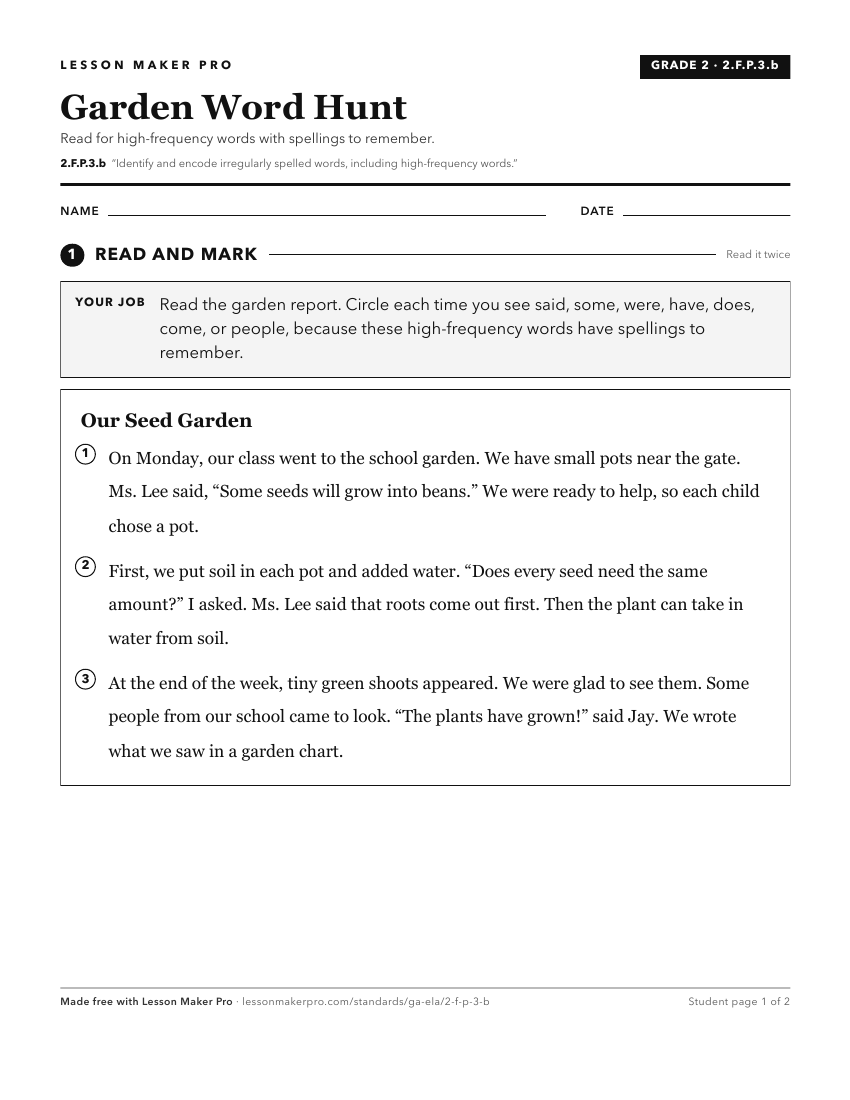
A ready-to-print activity worksheet aligned to 2.F.P.3.b, with an answer key for the teacher on its own page. No account needed.
PDF, US Letter, prints cleanly in black and white.
Download the worksheetKeep exploring
Related Standards
- K.F.P.3.b
Identify and encode irregularly spelled high- frequency words.
- 2.F.P.2.b
Identify and decode parts of irregularly spelled words, including high-frequency words.
- 1.F.P.2.b
Identify and decode parts of irregularly spelled words, including high-frequency words.
- 1.F.P.3.b
The 1st Grade version of this standard.
Turn this exact standard into a lesson
Grade, subject, topic, and the complete standard are prefilled. Create one free, no account needed.
Also for this standard:Make a WorksheetMake a QuizMake a Sub Lesson