Georgia 11.P.EICC.3.f
The Standard
- 11.P.EICC
- Engagement & Intention for Comprehension & Composition Students develop personal and academic identities as readers and writers, approaching texts for a variety of tasks and purposes and engaging in reading and writing processes in order to deepen comprehension and strengthen composition.
- 11.P.EICC.3
- Comprehension Strategies Engage with a range of complex texts for a variety of tasks and purposes, accessing and using strategies for comprehension* before, during, and after reading as part of the meaning-making process.
Make, track, and support inferences about different levels of meaning within the text. (I)
Georgia's K-12 English Language Arts Standards · Practices (P) · Engagement & Intention for Comprehension & Composition
Teacher's field guide
What This Standard Means
What Students Need to Do
- Students infer meanings that are suggested rather than directly stated, from character motives to larger themes. They track those ideas across a text and support or revise them with evidence.
What Mastery Looks Like
- Students explain implied motives, conflicts, irony, symbols, and themes using precise evidence. They revise an inference when later details complicate or contradict their first reading.
Common Misconceptions
- Students may treat an inference as a guess or repeat a literal detail as their claim. They may name a theme without tracing it to patterns, symbols, tone, or character choices. Some hold onto an early inference even when later evidence contradicts it.
How to Assess It
- Use this exit prompt after a short passage: “State one inference about a character’s motive and one about the larger message. Support each with a quoted phrase.”
Lesson moves
Ways to Teach It
Give pairs sentence strips from a short story to arrange into an evidence chain linking literal details, implied motives, and a larger theme.
Ask students to write: How does the narrator's stated belief differ from the belief revealed through choices and tone?
Play Inference Relay: teams add one claim, one quoted detail, and one explanation, then challenge an unsupported link.
Compare a product advertisement's direct claim with its implied message about status, identity, or happiness, citing visual and verbal evidence.
Free download
Printable 11.P.EICC.3.f Worksheet
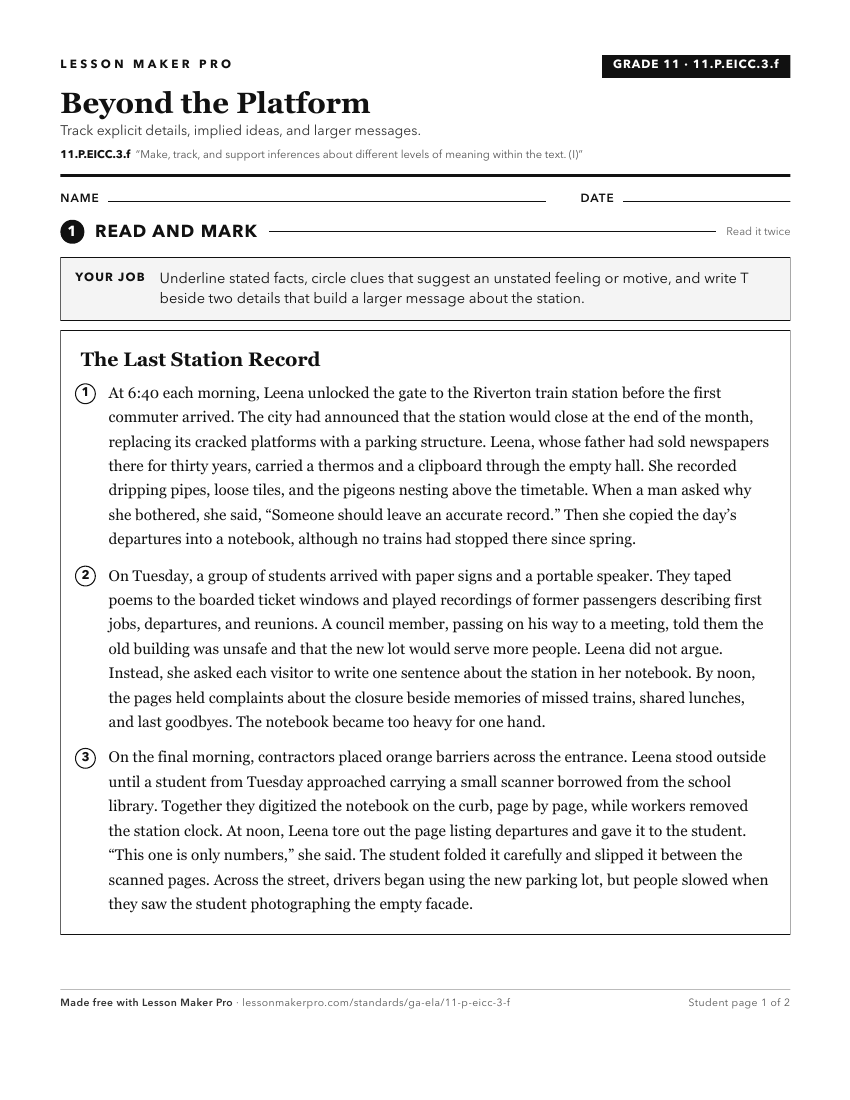
A ready-to-print activity worksheet aligned to 11.P.EICC.3.f, with an answer key for the teacher on its own page. No account needed.
PDF, US Letter, prints cleanly in black and white.
Download the worksheetKeep exploring
Related Standards
Turn this exact standard into a lesson
Grade, subject, topic, and the complete standard are prefilled. Create one free, no account needed.
Also for this standard:Make a WorksheetMake a QuizMake a Sub Lesson