Florida SS.K.G.3.3
The Standard
- SS.K.G.3
- Physical System
Describe and give examples of seasonal weather changes and illustrate how weather affects people and the environment.
Florida Next Generation Sunshine State Standards for Social Studies · Geography
Teacher's field guide
What This Standard Means
What Students Need to Do
- Students identify common weather patterns in each season. They draw or tell how those patterns change clothing, activities, plants, animals, or the land.
What Mastery Looks Like
- A student can match a season with likely weather and give a sensible example. The student can show one effect on people and one effect on the environment.
Common Misconceptions
- Students may think winter always means snow or that every place has the same seasonal weather. They may focus only on clothing and overlook effects on plants, animals, and land.
How to Assess It
- Ask students to draw weather in one season, then add one way it affects a person and one way it affects a plant or animal.
Lesson moves
Ways to Teach It
Make a four-part season wheel from a paper plate, adding weather symbols, clothing, and plant or animal changes to each section.
Ask, “How would a rainy week change what people do and what happens to plants?” Record student answers with pictures and labels.
Play a matching game with season, weather, clothing, activity, and nature cards, asking students to explain each match.
Observe the schoolyard weather, choose suitable recess clothing, and point out one effect on trees, soil, puddles, or animals.
Free download
Printable SS.K.G.3.3 Worksheet
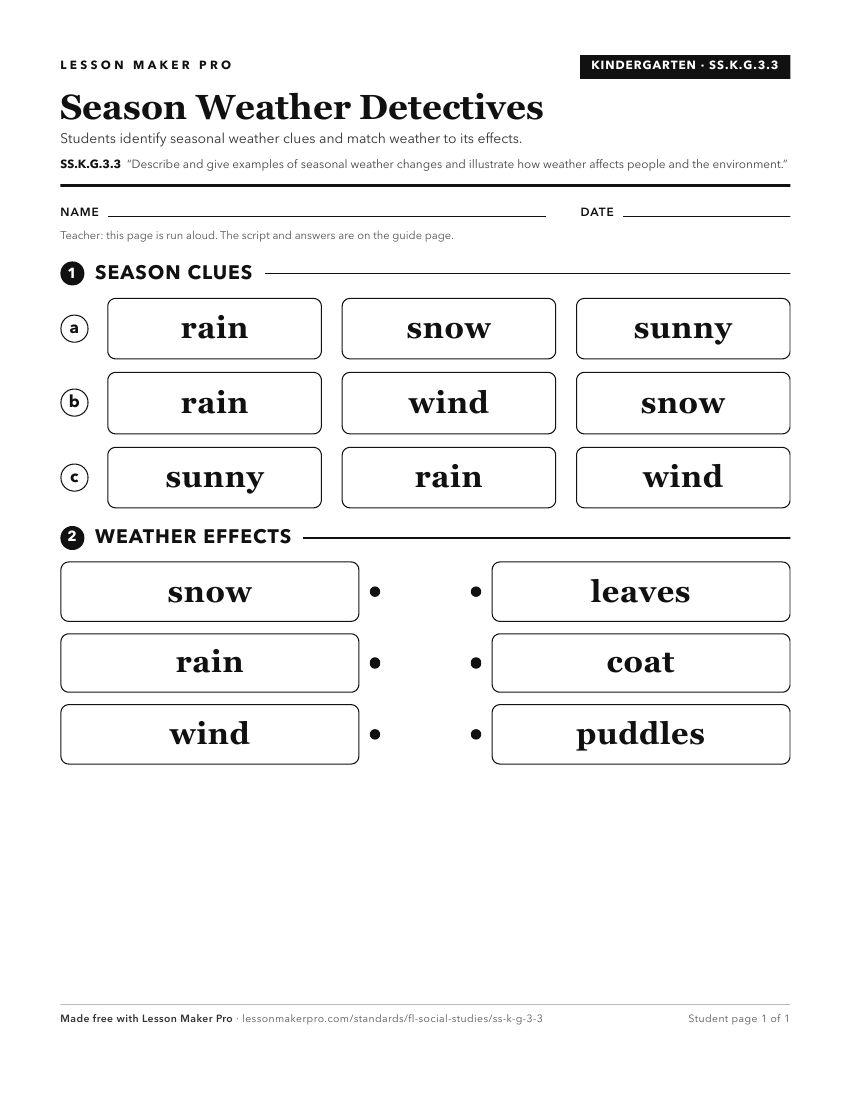
A ready-to-print activity worksheet aligned to SS.K.G.3.3, with an answer key for the teacher on its own page. No account needed.
PDF, US Letter, prints cleanly in black and white.
Download the worksheetKeep exploring
Related Standards
- SS.1.G.1.6
Describe how location, weather, and physical environment affect the way people live in our community.
- SS.3.G.3.1
Describe the climate and vegetation in the United States, Canada, Mexico, and the Caribbean.
- SS.4.G.1.3
Explain how weather impacts Florida.
- SS.8.G.5.2
Describe the impact of human modifications on the physical environment and ecosystems of the United States throughout history.
Turn this exact standard into a lesson
Grade, subject, topic, and the complete standard are prefilled. Create one free, no account needed.
Also for this standard:Make a WorksheetMake a QuizMake a Sub Lesson